
In this article
- How much fiber in an apple, size by size
- Where an apple keeps its fiber
- Does applesauce have fiber? What each form of apple keeps
- Do apples have fiber worth counting? How they compare with other fruit
- How one apple fits into your daily fiber target
- Small habits that keep more apple fiber on your plate
- When apples and your stomach don’t agree
- Whole, sauced or juiced: a quick way to choose
- Common questions about apple fiber
- Sources
Most people treat an apple as a light snack, not a serious fiber source. Yet one medium apple with the skin on carries about 4.4 grams of fiber, which covers roughly 16% of the 28 gram Daily Value printed on nutrition labels.
How much fiber in an apple you actually take in has less to do with the variety and more to do with what happens before the first bite. Peeling, blending, juicing and drying each change the number, sometimes dramatically.
Below you’ll find the numbers by size and by form, where the fiber actually sits in the fruit, and how apples measure up against other popular fruit.
How much fiber in an apple, size by size
USDA FoodData Central lists a raw apple with skin at about 2.4 grams of fiber per 100 grams. Because apples vary so much in weight, the size you grab matters more than whether it’s a Gala, a Fuji or a Granny Smith.
The USDA also publishes standard apple sizes by diameter. Multiply those weights by 2.4 grams per 100 and you get a quick reference for the fruit bowl:
| Apple size | Weight | Fiber | Calories |
|---|---|---|---|
| Extra small (2.5 in across) | 101g | 2.4g | 53 |
| Small (2.75 in across) | 149g | 3.6g | 77 |
| Medium (3 in across) | 182g | 4.4g | 95 |
| Large (3.25 in across) | 223g | 5.4g | 116 |
| Sliced, 1 cup | 109g | 2.6g | 57 |
Slicing on its own doesn’t cost you anything. A cup of slices with the skin on still delivers about 2.6 grams, a handy number if you portion fruit for lunchboxes or recipes.
If your apple fills your palm and then some, it’s likely in the large range, closer to 5 grams than 4.
You may see a slightly different figure elsewhere. Mayo Clinic’s fiber chart, for example, lists a medium apple at 4.5 grams. That small gap comes from rounding and sample differences between databases, so treat 4.4 to 4.5 grams as the realistic range for a medium apple.
Where an apple keeps its fiber
Apples contain both kinds of dietary fiber. A 2015 review in Nutrients puts whole apples at roughly 2 to 3% fiber by weight, with pectin as the main soluble type.
That same review lists about 0.67 grams of soluble fiber per 100 grams of raw apple with skin. For a medium apple, that works out to around 1.2 grams of soluble fiber, with the remaining 3 or so grams being insoluble.
The two types do different jobs. Soluble fiber dissolves into a gel that slows digestion and can help with cholesterol and blood sugar, according to Mayo Clinic, while insoluble fiber adds bulk and keeps material moving through your digestive tract.
Pectin has a second life once it reaches your colon. Because stomach acid and digestive enzymes can’t break it down, your gut bacteria ferment it into short chain fatty acids such as butyrate, a key fuel for the cells lining your gut.
The peel carries more than its share
Compare the USDA entries side by side and the role of the skin becomes obvious. A peeled apple drops to about 1.3 grams of fiber per 100 grams, almost half the 2.4 grams found in the unpeeled fruit.
The skin is also where most of the plant compounds live. Research published in Nutrition Journal found apple peels hold two to six times more phenolic compounds than the flesh, depending on the variety, with antioxidant activity rising by a similar margin.
Unpeeled apples kept more of that activity in lab testing too. A rinse under running water gets the skin ready to eat without giving up the most fiber dense part of the fruit.
Does applesauce have fiber? What each form of apple keeps
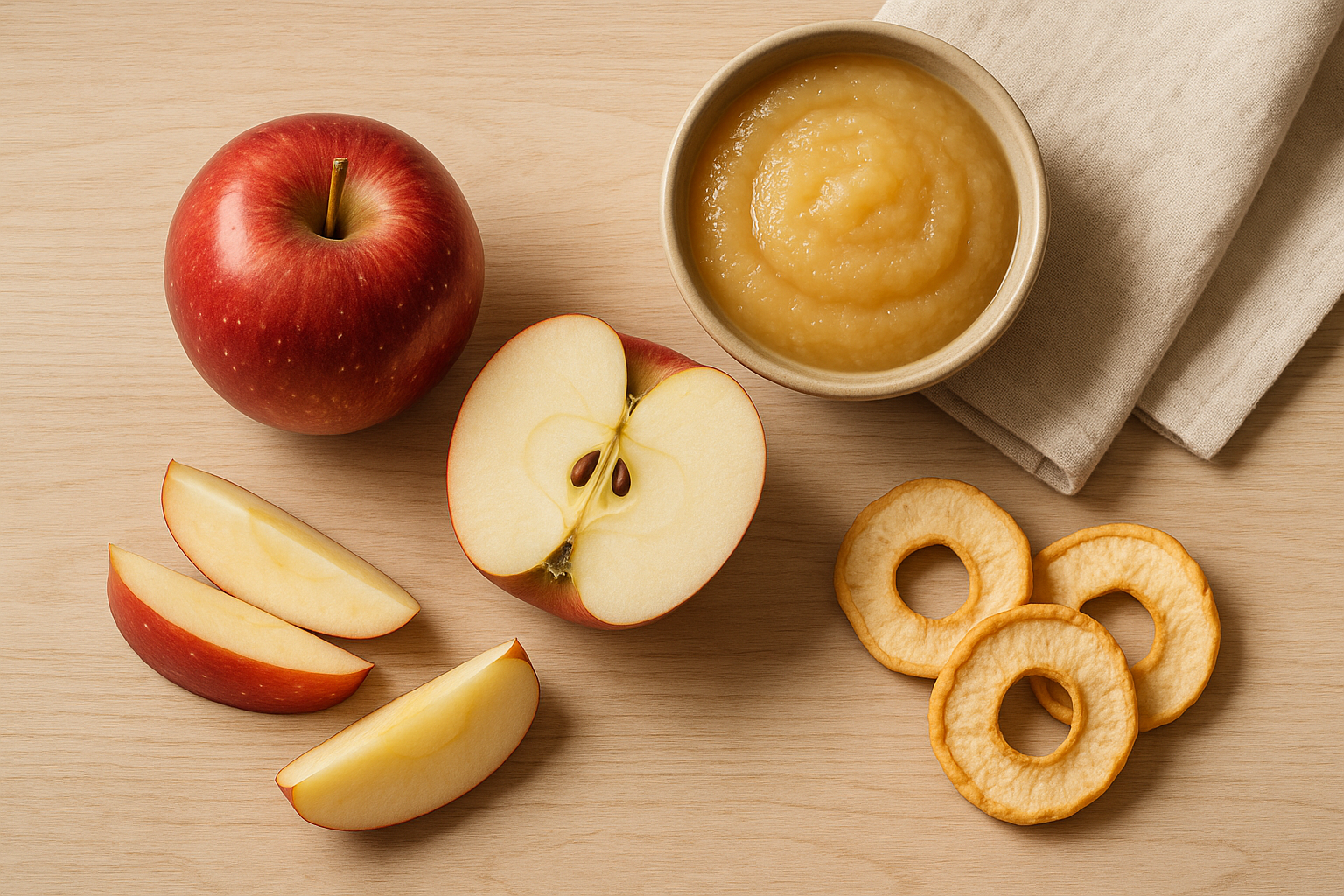
Processing is where most of an apple’s fiber quietly disappears. Here’s how common forms compare using USDA values:
| Apple form | Serving | Fiber | Calories |
|---|---|---|---|
| Whole apple with skin | 1 medium (182g) | 4.4g | 95 |
| Apple, peeled | 1 medium (161g) | 2.1g | 77 |
| Unsweetened applesauce | 1 cup (244g) | 2.7g | 102 |
| Dried apple rings | 1 oz (28g) | 2.4g | 68 |
| Apple juice, unsweetened | 1 cup (248g) | 0.5g | 114 |
Applesauce does have fiber, about 2.7 grams per cup when unsweetened. Cup for cup, though, it still delivers less than a single medium whole apple.
Juice is the outlier. Pressing and filtering leave behind most of the pulp and skin, so a full cup of apple juice delivers only about half a gram of fiber while carrying more calories than a medium apple.
Dried apples go the other way. With the water gone, an ounce of rings holds about as much fiber as an extra small fresh apple, but those few chewy pieces disappear fast, and the calories add up with them.
Whole fruit fills you up differently
Form changes how full you feel, not only the fiber count. In a 2009 study in the journal Appetite, adults who ate apple segments before lunch went on to eat 15% fewer calories at that meal, about 187 calories less than when they had no starter.
Applesauce and apple juice served before the same lunch were less effective than the whole fruit. Even juice with fiber added back at natural levels didn’t close the gap, which suggests the chewing and structure of a whole apple matter alongside the fiber itself.
Do apples have fiber worth counting? How they compare with other fruit
Apples land in the upper middle of the everyday fruit pack. Using Mayo Clinic’s chart of high fiber foods, here’s where a medium apple sits:
| Fruit | Serving | Fiber |
|---|---|---|
| Raspberries | 1 cup | 8.0g |
| Pear | 1 medium | 5.5g |
| Apple, with skin | 1 medium | 4.5g |
| Banana | 1 medium | 3.0g |
| Orange | 1 medium | 3.0g |
| Strawberries | 1 cup | 3.0g |
If you’re asking what fruit has the most fiber among the usual grocery picks, raspberries win by a wide margin, and a pear edges out an apple by about a gram.
Apples still beat bananas, oranges and a cup of strawberries. They also need no prep and travel well in a bag, which makes them one of the easier fruits high in fiber to keep on hand.
How one apple fits into your daily fiber target
Mayo Clinic puts adult fiber needs at 25 grams a day for women 50 and younger and 21 grams after 50. For men, the targets are 38 grams up to age 50 and 30 grams after.
Against those numbers, a medium apple covers about 18% of a younger woman’s daily goal and about 12% of a younger man’s. Two apples spread across the day would bring a woman more than a third of the way there.
The 28 gram Daily Value on food labels sits between those targets, which is why a medium apple shows up as about 16% on a label even though its share of your own goal may be higher or lower.
Hitting a full day’s target from apples alone would take five or more, which isn’t the point. They work best as one steady contributor alongside beans, whole grains, vegetables and other fruit.
Curious where your own number lands? Our fiber calculator works out a personal daily target from your age, sex and activity level.
Small habits that keep more apple fiber on your plate
You don’t need a new diet to get the most from apples. A few small choices protect most of the fiber you’d otherwise lose:
- Keep the skin on. Wash it well instead of peeling and you hold onto nearly half the fiber.
- Grate rather than strain. Grated apple stirred into oatmeal, yogurt or muffin batter keeps the peel and pulp.
- Choose unsweetened applesauce when you want something soft, and look for versions that list whole or unpeeled apples.
- Measure dried apples before you start snacking, since a handful can easily run two or three ounces.
- Treat juice as a drink, not a fruit serving, when you’re counting fiber.
A sliced apple before dinner is an easy test of the satiety research above. Try it for a week and notice whether the rest of the plate feels as necessary.
Running out of ways to use a bag of apples? Our recipe eBooks are full of simple, high fiber meals that put whole fruit to work beyond the lunchbox.
When apples and your stomach don’t agree
Some people feel gassy or bloated after a raw apple and assume the fiber is to blame. Often it’s the fruit’s natural sugars instead.
Monash University, the research group behind the low FODMAP diet, lists apples as high in both fructose and sorbitol, two fermentable carbohydrates known as FODMAPs. Pears, mango, watermelon and apple juice appear on the same high FODMAP list.
That helps explain why one person handles an apple a day with no trouble while another reaches for something else. The fiber itself is rarely the whole story.
If bloating is a regular companion, our gut health guides walk you through building up fiber at a pace your digestion can handle.
Whole, sauced or juiced: a quick way to choose
Each form of apple earns a place, as long as you know what you’re getting. Use this as a simple rule of thumb:
If your goal is fiber and fullness, eat the apple whole with the skin. If texture or chewing is the issue, pick unsweetened applesauce and plan on a cup to get close to 3 grams.
If you want something shelf stable for a bag or desk drawer, dried rings work, as long as you portion them first. And if juice is what you enjoy, keep it, but count your fiber from the fruit on your plate instead of the glass.
Common questions about apple fiber
How many grams of fiber are in an apple?
A medium apple with skin, about 3 inches across, has roughly 4.4 grams of fiber. A small apple has about 3.6 grams and a large one about 5.4 grams.
Does applesauce have as much fiber as a whole apple?
No. Unsweetened applesauce has about 2.7 grams of fiber per cup, so it takes more volume to match one medium whole apple at 4.4 grams.
Is the fiber in apples soluble or insoluble?
Both. A medium apple has around 1.2 grams of soluble fiber, mostly pectin, and roughly 3 grams of insoluble fiber.
Do apples have more fiber than bananas?
Yes. A medium apple with skin has about 4.5 grams of fiber compared with about 3 grams in a medium banana.
Does apple juice count toward my daily fiber?
Barely. A cup of unsweetened apple juice has only about 0.5 grams of fiber, because pressing and filtering remove most of the pulp and skin.
Is eating an apple before a meal helpful?
It can make you feel fuller. In one study, eating apple segments before lunch led people to eat about 15% fewer calories at the meal than eating nothing first.
How many apples would it take to meet my daily fiber needs?
About six medium apples would be needed to reach 25 grams, so apples work best as one part of a varied, fiber rich diet.
Sources
- USDA FoodData Central. “Apples, raw, with skin (FDC ID 171688), plus entries for peeled apples, unsweetened applesauce, apple juice and dried apples.” 2026. fdc.nal.usda.gov
- Mayo Clinic. “Chart of high-fiber foods.” 2026. www.mayoclinic.org
- Mayo Clinic. “Dietary fiber: Essential for a healthy diet.” 2026. www.mayoclinic.org
- U.S. Food and Drug Administration. “Daily Value on the Nutrition and Supplement Facts Labels.” 2026. www.fda.gov
- Koutsos A, Tuohy KM, Lovegrove JA. Nutrients. “Apples and Cardiovascular Health: Is the Gut Microbiota a Core Consideration?” 2015. www.mdpi.com
- Boyer J, Liu RH. Nutrition Journal. “Apple phytochemicals and their health benefits.” 2004. pmc.ncbi.nlm.nih.gov
- Flood-Obbagy JE, Rolls BJ. Appetite. “The effect of fruit in different forms on energy intake and satiety at a meal.” 2009. www.sciencedirect.com
- Monash University. “About FODMAPs and IBS.” 2026. www.monashfodmap.com