
In this article
- How much of your daily fiber dinner can carry
- Fiber rich dinner foods, sorted by where they go on the plate
- Balanced meals that still hit a high fiber number
- Comparing dinner starches: which grain earns its spot
- Letting legumes share the protein spot
- Vegetable sides that pull the most fiber per cup
- Five high fiber dinner meals, with the math
- Digestive friendly dinners while you build up
- One move for tonight’s dinner
- Questions about high fiber dinners
- Sources
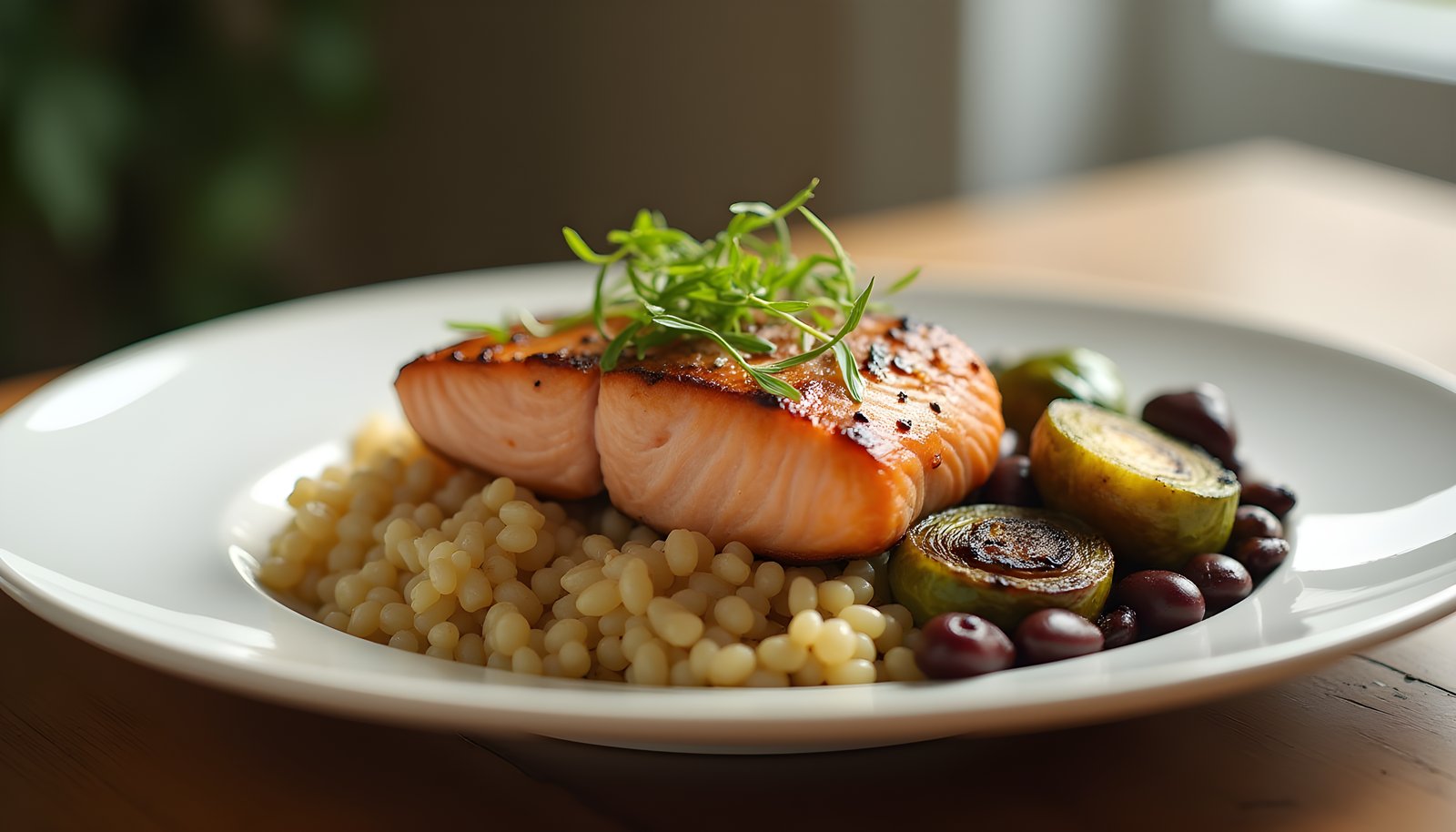
Picture a typical weeknight plate: a salmon fillet, a cup of brown rice and a raw carrot on the side. By Mayo Clinic’s numbers, that dinner has about 5 grams of fiber, and nearly all of it comes from the rice.
Keep the salmon, trade the rice for a cup of pearled barley and the carrot for a cup of boiled green peas, and the same plate jumps to about 15 grams. That’s the whole idea behind choosing fiber rich dinner foods: small swaps in the starch and the sides, not a different way of eating.
How much of your daily fiber dinner can carry
Mayo Clinic puts the daily target at 25 grams for women and 38 grams for men up to age 50, then 21 and 30 grams after that. Spread across three meals, that’s roughly 7 to 13 grams per meal.
Dinner is usually the biggest plate of the day, so it’s the easiest place to land in the upper half of that range. A dinner with 12 to 18 grams covers about half of a 25 gram day before you count breakfast, lunch or snacks.
The CDC notes that most U.S. adults get only about half the fiber they need. One high fiber dinner meal a day can close most of that gap on its own.
Curious where your own number sits? Our fiber calculator works out a personal daily target from a couple of quick details.
Fiber rich dinner foods, sorted by where they go on the plate
Harvard’s Healthy Eating Plate splits dinner into three zones: half vegetables and fruit, a quarter whole grains and a quarter protein. The table groups strong fiber picks for each zone, using Mayo Clinic’s 1 cup portions.
| Plate zone | Food (1 cup cooked) | Fiber |
|---|---|---|
| Protein quarter | Split peas | 16.0 g |
| Protein quarter | Lentils | 15.5 g |
| Protein quarter | Black beans | 15.0 g |
| Protein quarter | White beans, canned | 13.0 g |
| Grain quarter | Whole wheat spaghetti | 6.0 g |
| Grain quarter | Pearled barley | 6.0 g |
| Grain quarter | Quinoa | 5.0 g |
| Grain quarter | Brown rice | 3.5 g |
| Vegetable half | Green peas | 9.0 g |
| Vegetable half | Broccoli | 5.0 g |
| Vegetable half | Turnip greens | 5.0 g |
| Vegetable half | Brussels sprouts | 4.5 g |
| Vegetable half | Sweet corn | 4.0 g |
Legumes dwarf everything else. A cup of lentils has more fiber than a cup of brown rice and a cup of broccoli put together, with room to spare.
Balanced meals that still hit a high fiber number
The plate model matters because fiber travels with the plants on it. Harvard recommends filling half the plate with vegetables and fruit, choosing whole grains such as barley, quinoa and brown rice over white rice and white bread, and favoring fish, poultry, beans and nuts for protein.
One detail surprises people: potatoes don’t count toward the vegetable half on Harvard’s plate. A baked potato with skin still has about 4 grams, per Mayo Clinic, but it sits in the starch slot rather than replacing a green vegetable.
Beans and lentils are the flexible piece. They can fill the protein quarter alone, or they can share it with chicken or fish, which have no fiber of their own.
Fruit belongs in the vegetable half too, which makes dessert part of the plan. A cup of raspberries after dinner adds 8.0 grams, and a sliced pear adds 5.5, according to Mayo Clinic.
That turns an 11 gram salmon and quinoa plate into a 19 gram dinner without touching the main course.
Comparing dinner starches: which grain earns its spot
The grain quarter is where most plates leave fiber on the table. Here’s how common choices compare, with Mayo Clinic values for full cups and Dietary Guidelines values for half cups.
| Starch | Portion | Fiber |
|---|---|---|
| Whole wheat spaghetti | 1 cup | 6.0 g |
| Pearled barley | 1 cup | 6.0 g |
| Quinoa | 1 cup | 5.0 g |
| Bulgur | 1/2 cup | 4.1 g |
| Baked potato with skin | 1 medium | 4.0 g |
| Spelt | 1/2 cup | 3.8 g |
| Brown rice | 1 cup | 3.5 g |
| Whole wheat tortilla | 1 tortilla | 2.8 g |
Barley and whole wheat pasta give almost twice the fiber of brown rice cup for cup. Bulgur deserves more attention: a half cup has 4.1 grams for 76 calories, so a full cup would land around 8.
If your household won’t give up rice, mixing half brown rice and half barley is an easy middle ground. A cup of that blend works out to roughly 4.75 grams.
Tortillas look weak on a per item basis, at 2.8 grams each. But a taco night usually means two or three of them, which quietly adds 5.6 to 8.4 grams before any filling goes in.
Letting legumes share the protein spot
You don’t have to go meatless to get the legume bonus. Stirring half a cup of black beans into a chicken burrito bowl adds about 7.5 grams, according to the Dietary Guidelines list.
Lentils melt into pasta sauce and chili, and half a cup adds 7.8 grams. Split peas thicken soup the same way, at 8.2 grams per half cup.
Canned white beans are the fastest of all. Mayo Clinic lists 13 grams per cup for cannellini, navy or Great Northern beans, and they need nothing more than a rinse and a few minutes in a hot pan.
Edamame is another easy add for stir fries and grain bowls. Half a cup of shelled edamame brings 4.1 grams, plus a mild, buttery bite that pairs well with soy, ginger and garlic.
Vegetable sides that pull the most fiber per cup
Cooked vegetables usually beat raw ones cup for cup, partly because cooking softens and shrinks them, so more fits in the measure. Mayo Clinic lists a cup of raw chopped cauliflower at 2.0 grams, while the Dietary Guidelines give 4.9 grams for a cup cooked.
| Side (1 cup cooked) | Fiber | Calories |
|---|---|---|
| Artichoke | 9.6 g | 89 |
| Green peas | 8.8 g | 134 |
| Brussels sprouts | 6.4 g | 65 |
| Broccoli | 5.2 g | 54 |
| Turnip greens | 5.0 g | 29 |
| Cauliflower | 4.9 g | 34 |
| Carrots | 4.8 g | 54 |
| Kale | 4.7 g | 43 |
| Green beans | 4.0 g | 44 |
Peas and artichokes are in a league of their own, but every side here gives at least 4 grams. Two of them on one plate add 9 to 18 grams before you count the grain or the protein.
Five high fiber dinner meals, with the math
Each of these uses the portions from the tables above. They’re simple enough for a weeknight and easy to scale up for leftovers.
The soup and the stir fry both reheat well, so cooking a double batch on Sunday covers a second dinner or a next day lunch with no extra effort.
| Dinner | What’s on the plate | Fiber |
|---|---|---|
| Black bean tacos | 2 whole wheat tortillas, 1/2 cup black beans, 1/2 cup avocado | 18.1 g |
| Lentil, barley and kale soup | 1/2 cup lentils, 1/2 cup barley, 1 cup cooked kale | 15.5 g |
| Spaghetti with peas | 1 cup whole wheat spaghetti, 1 cup green peas, tomato sauce | 14.8 g |
| Chicken stir fry over bulgur | 1/2 cup bulgur, 1 cup broccoli, 1/2 cup edamame, chicken | 13.4 g |
| Salmon with quinoa | 1 cup quinoa, 1 cup Brussels sprouts, salmon | 11.4 g |
Avocado, barley and whole wheat pasta are doing more work in these meals than most people realize. Even the lightest option here, the salmon plate, still gives more than twice the fiber of the rice and carrot dinner at the top of this article.
Looking for more weeknight dinners built on beans, whole grains and vegetables? Our recipe eBooks are packed with easy, fiber rich ideas.
Digestive friendly dinners while you build up
Jumping from a 5 gram dinner to an 18 gram one overnight can backfire. The CDC warns that adding fiber too fast can cause bloating, gas, cramps, constipation or diarrhea, and it recommends increasing slowly and drinking plenty of water.
A gentler path is one swap per week. Start with the grain, since moving from brown rice to barley adds only a few grams, then add a cooked vegetable side, and bring in beans last.
Here’s a quick decision rule for which swap to try first:
- If dinner is usually rice or pasta, switch to barley or whole wheat spaghetti
- If the plate has meat and a starch but no vegetable, add a cup of cooked peas or broccoli
- If you already eat plenty of vegetables, stir half a cup of beans or lentils into the main dish
- If beans tend to bother you, start with a quarter cup and build from there
If evening bloating is the part that worries you, our gut health guides walk through a slower build up step by step.
One move for tonight’s dinner
Open a can of white beans and stir a cup of them into whatever is already on the stove, whether that’s soup, pasta sauce or a skillet of greens. That one addition brings about 13 grams, more than the entire salmon, rice and carrot plate from the start of this article.
Do it two or three nights this week, and you’ll have a feel for how your body handles a higher fiber dinner before you change anything else.
Questions about high fiber dinners
What dinner foods are highest in fiber?
Legumes lead by a wide gap. A cup of cooked split peas has 16 grams, lentils 15.5 and black beans 15, while the best grains and vegetables give about 5 to 10 grams per cup.
How much fiber should dinner have?
Aim for roughly 7 to 13 grams if you eat three meals a day. A dinner with 12 to 18 grams covers about half of a 25 gram daily target.
Is brown rice a high fiber side?
It’s moderate. A cup of cooked brown rice has about 3.5 grams, while the same amount of pearled barley or whole wheat spaghetti has 6.
Are potatoes a good fiber side dish?
They help, but they aren’t a vegetable swap. A medium baked potato with skin has about 4 grams, and Harvard’s Healthy Eating Plate counts it as a starch rather than a vegetable.
Can a high fiber dinner cause gas at night?
Yes, especially if your usual dinner is low in fiber. The CDC suggests increasing fiber gradually and drinking plenty of water to limit bloating and gas.
What is a quick fiber rich dinner?
Black bean tacos on whole wheat tortillas with avocado take about 10 minutes and deliver around 18 grams. Canned beans stirred into pasta sauce work almost as fast.
Is quinoa or barley higher in fiber?
Barley wins slightly. A cooked cup of pearled barley has 6 grams, compared with 5 grams for a cup of cooked quinoa.
Sources
- U.S. Department of Agriculture and U.S. Department of Health and Human Services. “Food Sources of Dietary Fiber.” Dietary Guidelines for Americans, 2020 to 2025. dietaryguidelines.gov
- Mayo Clinic Staff. “Chart of high-fiber foods.” Mayo Clinic, 2025. www.mayoclinic.org
- Mayo Clinic Staff. “Dietary fiber: Essential for a healthy diet.” Mayo Clinic, 2025. www.mayoclinic.org
- Harvard T.H. Chan School of Public Health. “Healthy Eating Plate.” The Nutrition Source, 2025. nutritionsource.hsph.harvard.edu
- Centers for Disease Control and Prevention. “Fiber: The Carb That Helps You Manage Diabetes.” 2024. www.cdc.gov