
In this article
- A single cell with a tough coat
- Chlorella fiber content at real doses
- What kind of fiber chlorella holds
- Chlorella nutrition: the iron and folate story
- Chlorella compared with spirulina and other add ins
- What the fiber detox pitch gets wrong
- Digestive support and what the trials measured
- Getting more out of a chlorella habit
- When chlorella makes sense, and when it doesn’t
- Chlorella fiber: what people ask
- Sources
People often treat chlorella and spirulina as two names for the same green powder. They aren’t, and fiber is one place the difference shows: chlorella fiber content lands around 7 to 16 grams per 100 grams, while USDA lists spirulina at just 3.6.
That still doesn’t make chlorella a fiber food. At the 5 grams a day used in several human studies, you get somewhere between a third of a gram and 0.8 grams.
A single cell with a tough coat
Chlorella is a freshwater green alga made of single round cells too small to see. Each cell is wrapped in a stiff wall, and a 2020 review in Nutrients by Bito and colleagues notes that this wall is made of cellulose, the same structural fiber found in plant cell walls.
That wall is the reason chlorella has measurable fiber at all. It’s also why the review states that people can’t digest whole chlorella cells in their natural state.
To get around this, most supplements are processed to crack the cell walls open. You’ll often see “broken cell wall” on the label for exactly that reason.
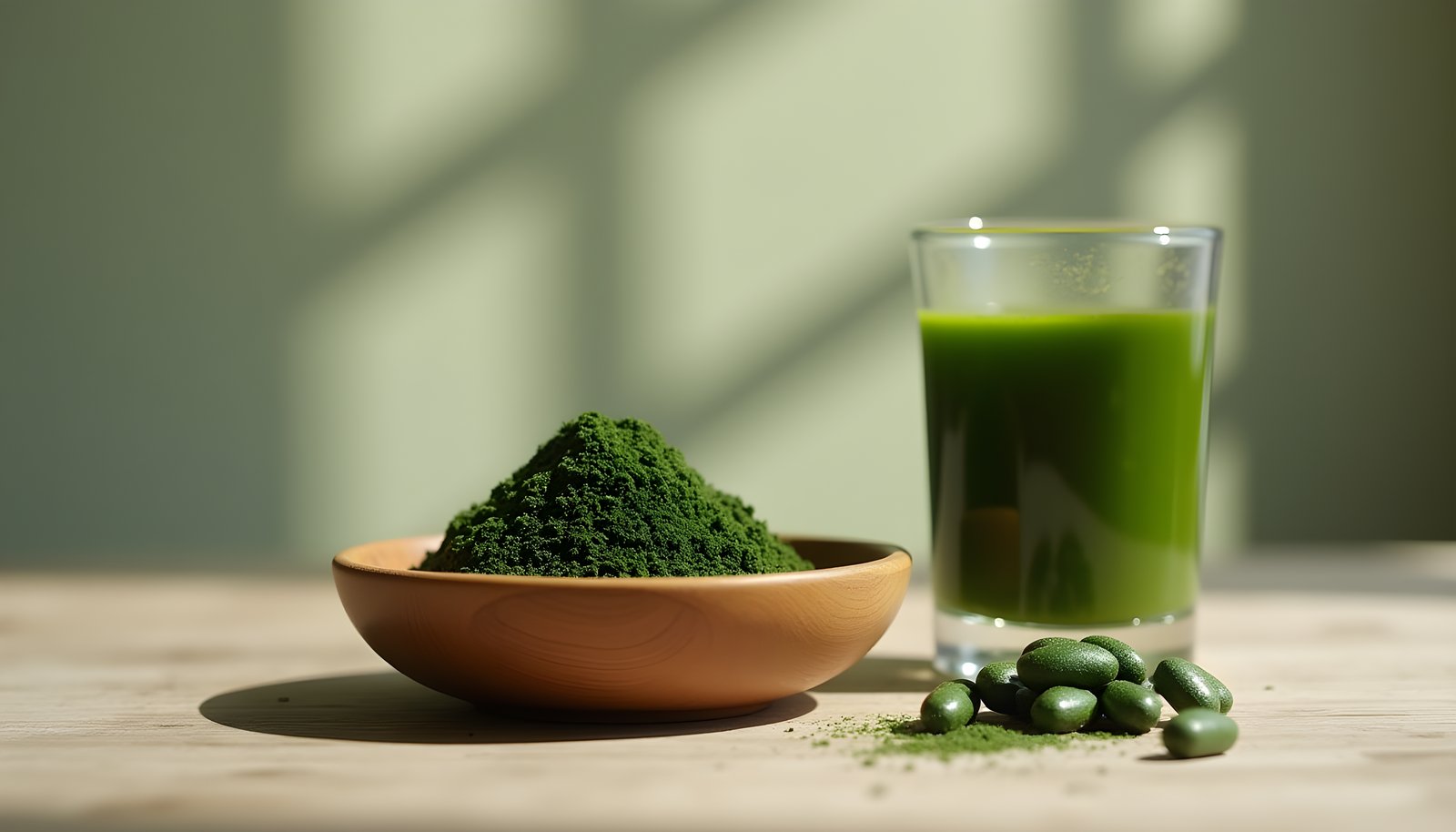
You’ll find chlorella sold as loose powder and as pressed tablets. Both are the same dried cells, so the fiber math below works for either one once you know how many grams you take.
Chlorella fiber content at real doses
There’s no USDA FoodData Central entry for chlorella, so the best figures come from research on commercial powders. The Bito review reports that chlorella products contain about 17% carbohydrate, and more than 65% of that carbohydrate is dietary fiber.
That works out to at least 11 grams of fiber per 100 grams. A 2025 study in the journal Foods by Panova and colleagues recorded the label values of two powders, one at 7.0 grams and the other at 16.1 grams per 100 grams.
| Chlorella amount | Fiber at 7.0 g/100 g | Fiber at 16.1 g/100 g | % of 28 g Daily Value |
|---|---|---|---|
| 1.2 g (smallest study dose) | 0.08 g | 0.19 g | under 1% |
| 5 g (common study dose) | 0.35 g | 0.81 g | 1 to 3% |
| 9 g (larger study dose) | 0.63 g | 1.45 g | 2 to 5% |
| 100 g | 7.0 g | 16.1 g | 25 to 58% |
The doses come from the human trials summarized in the Bito review, which ranged from about 1.2 grams to 10 grams a day. Even at the top of that range, you’d get less fiber than half an apple.
Two products on the same shelf can differ by more than double. That’s why the fiber line on your own label is the number to trust.
Wondering how many grams you should be aiming for in a day? Our fiber calculator works out a personal target in a few seconds.
What kind of fiber chlorella holds
Because much of chlorella’s fiber comes from its cellulose wall, it leans toward the insoluble side. Harvard’s Nutrition Source describes cellulose as an insoluble fiber found in the cell walls of many fruits and vegetables.
Insoluble fiber doesn’t dissolve in water. According to Harvard, it helps food move through your digestive system and supports regularity.
Soluble fiber, the type in oats, beans, apples and chia, dissolves into a gel that can help lower blood cholesterol and glucose. Chlorella isn’t a meaningful source of that kind at the amounts people take.
Chlorella nutrition: the iron and folate story
Fiber is a side note in chlorella nutrition. The Bito review lists commercial powders at roughly 59% protein, about 11% fat and about 17% carbohydrate by dry weight.
| Nutrient | Per 100 g chlorella | Per 5 g dose | % Daily Value per 5 g |
|---|---|---|---|
| Protein | about 59 g | about 3 g | 6% |
| Iron | 104 mg | 5.2 mg | 29% |
| Folate | about 2.5 mg (2,500 mcg) | about 125 mcg | 31% |
| Potassium | 986 mg | 49 mg | 1% |
| Dietary fiber | 7 to 16 g | 0.35 to 0.8 g | 1 to 3% |
Daily Value percentages use the FDA’s reference amounts of 50 grams of protein, 18 milligrams of iron, 400 micrograms of folate and 4,700 milligrams of potassium. Iron and folate are where a small scoop actually adds up, while the protein and fiber stay modest at this size.
Vitamin B12 is harder to pin down. The review found anywhere from 6 to 500 micrograms per 100 grams across products, and notes that some of what’s measured may be inactive compounds that look like B12 but don’t work like it.
Chlorella compared with spirulina and other add ins
Here’s how a 5 gram scoop of chlorella stacks up against other spoonable foods. Spirulina comes from USDA FoodData Central, and the rest from the Dietary Guidelines food source list:
| Food | Portion | Fiber |
|---|---|---|
| Chlorella powder | 5 g | 0.35 to 0.8 g |
| Spirulina, dried | 5 g | 0.18 g |
| Chia seeds | 1 tablespoon | 4.1 g |
| Flaxseed | 1 tablespoon | 2.8 g |
| Oat bran, cooked | 1/2 cup | 2.9 g |
| Raspberries | 1 cup | 8.0 g |
| Kale, cooked | 1 cup | 4.7 g |
Chlorella beats spirulina on fiber per gram, by a factor of two to four depending on the product. Next to a tablespoon of chia, though, a chlorella scoop delivers roughly a fifth of the fiber or less.
A cup of cooked kale is the more useful green comparison. It gives about 4.7 grams of fiber, five or more times what a chlorella dose provides.
Weighing chlorella against spirulina and other green powders? Our comparison charts set the popular choices out side by side.
What the fiber detox pitch gets wrong
Chlorella is often sold with fiber detox language, the idea that its fibrous wall soaks up toxins on the way through. The research behind that is thin.
Myth: Chlorella’s fiber sweeps toxins out of your body. Fact: The detox trial in the Bito review used a related alga, Parachlorella beijerinckii, at 9 grams a day for three months, and it measured lower mercury in hair and blood. It was open label, with no placebo group, and it didn’t test fiber as the cause.
Myth: More chlorella means more cleansing fiber. Fact: Even 9 grams gives you about 1.5 grams of fiber at most, far less than a bowl of beans.
Insoluble fiber’s real job in digestion is simpler: it helps food keep moving, as Harvard puts it. Whole foods deliver far more of it than any algae powder.
Digestive support and what the trials measured
Most chlorella studies looked at markers far from the gut. The Bito review summarizes trials on cholesterol, blood pressure, blood sugar, liver enzymes and immune activity, usually at 5 to 9 grams a day for 4 to 12 weeks.
One meta analysis of 19 randomized trials with 797 people found improvements in total cholesterol, LDL cholesterol, blood pressure and fasting glucose. It found no change in triglycerides, HDL or body mass index.
For digestive support specifically, the evidence is limited. The 2025 Foods study notes that chlorella’s rigid wall limits how much of its contents are released during simulated digestion, which is one reason particle size and processing matter.
Picture a breakfast bowl of half a cup of cooked oat bran with a tablespoon of flaxseed and a cup of raspberries. Using the Dietary Guidelines values, that’s 13.7 grams of fiber before any chlorella goes in.
Stir in 5 grams of a high fiber chlorella powder and the bowl reaches about 14.5 grams. The algae adds green color and some iron, while the oats, seeds and berries carry the fiber.
If your goal is smoother digestion, our gut health guides walk you through building more fiber into your meals at a pace that stays comfortable.
Getting more out of a chlorella habit
- Buy broken cell wall chlorella. Intact cells resist digestion, so the cracked form is the one that delivers its nutrients.
- Pair it with real fiber. Stir the powder into a smoothie with berries and chia, or into a bowl of oatmeal, so the meal carries the fiber load.
- Read the label’s fiber line. Products range from about 7 to 16 grams per 100 grams, so the numbers on yours tell you which end you’re at.
- Count the iron. A 5 gram scoop can bring close to a third of the Daily Value for iron, which matters if you also take an iron supplement.
When chlorella makes sense, and when it doesn’t
- If you want more fiber, skip the powder and add a tablespoon of chia, a cup of raspberries or half a cup of lentils instead.
- If you want plant protein, iron or folate in a small serving, chlorella does that better than it does fiber.
- If you’re choosing between chlorella and spirulina for fiber, chlorella edges ahead, but neither moves your daily total much.
- If detox is the draw, know that the main human trial was small and uncontrolled, and fiber wasn’t what it tested.
Harvard’s Nutrition Source puts the target at 25 to 35 grams of fiber a day and notes that most Americans get about 15. Chlorella can sit in your routine for its other nutrients, while beans, berries, whole grains and seeds close that gap.
Chlorella fiber: what people ask
Does chlorella have fiber?
Yes, a little. Commercial powders contain roughly 7 to 16 grams per 100 grams, mostly from the alga’s cellulose cell wall.
How much fiber is in a serving of chlorella?
A 5 gram dose gives about 0.35 to 0.8 grams of fiber. That’s 1 to 3% of the 28 gram Daily Value.
Does chlorella have more fiber than spirulina?
Yes. USDA lists dried spirulina at 3.6 grams of fiber per 100 grams, while chlorella products run about two to four times higher.
Is chlorella fiber soluble or insoluble?
Mostly insoluble, because much of it is cellulose from the cell wall. Harvard’s Nutrition Source classes cellulose as insoluble fiber.
Does chlorella help with detox?
The evidence is thin. One small open label trial found lower mercury levels with 9 grams a day of a related alga, but it had no placebo group and didn’t test fiber.
Why does chlorella need a broken cell wall?
Its cellulose wall keeps people from digesting whole cells. Breaking the wall during processing lets your body reach the protein and other nutrients inside.
Can chlorella replace a fiber supplement?
No. A typical dose gives under a gram of fiber, while foods like chia seeds give 4.1 grams per tablespoon.
Sources
- Bito T, Okumura E, Fujishima M, Watanabe F. “Potential of Chlorella as a Dietary Supplement to Promote Human Health.” Nutrients. 2020. www.mdpi.com
- Panova N, Gerasimova A, Todorova M, et al. “Metabolite Signatures and Particle Size as Determinants of Anti-Inflammatory and Gastrointestinal Smooth Muscle Modulation by Chlorella vulgaris.” Foods. 2025. www.mdpi.com
- U.S. Department of Agriculture, Agricultural Research Service. “Seaweed, spirulina, dried (170495).” FoodData Central, SR Legacy. 2019. fdc.nal.usda.gov
- U.S. Department of Agriculture and U.S. Department of Health and Human Services. “Food Sources of Dietary Fiber.” Dietary Guidelines for Americans, 2020 to 2025. dietaryguidelines.gov
- U.S. Food and Drug Administration. “Daily Value on the Nutrition and Supplement Facts Labels.” 2024. www.fda.gov
- Harvard T.H. Chan School of Public Health. “Fiber.” The Nutrition Source. 2024. nutritionsource.hsph.harvard.edu