

In this article
- Taro root fiber by serving
- Taro nutrition in a cup
- Taro vs other starchy roots
- Taro as a fiber rich carb
- A taro and chickpea curry, counted
- Taro leaves: the other half of the plant
- What taro fiber does for digestion
- A quick taro prep checklist
- One thing to try this week
- Taro root fiber questions
- Sources
A cup of cooked taro root slices has about 6.7 grams of fiber, roughly 24% of the Daily Value, for 187 calories. That’s a touch more than a cup of cooked sweet potato.
The twist comes when taro is turned into poi, the smooth Hawaiian paste. USDA lists poi at only 0.4 grams of fiber per 100 grams, compared with 5.1 grams in plain cooked taro, so the form you eat changes the taro root fiber story completely.
Taro root fiber by serving
USDA FoodData Central lists cooked taro at 5.1 grams of fiber and 142 calories per 100 grams. Here’s how that plays out in everyday portions.
| Taro form | Serving | Fiber | % DV (28 g) | Calories |
|---|---|---|---|---|
| Cooked taro, sliced | 1/2 cup (66 g) | 3.4 g | 12% | 94 |
| Cooked taro, sliced | 1 cup (132 g) | 6.7 g | 24% | 187 |
| Cooked taro | 100 g | 5.1 g | 18% | 142 |
| Raw taro | 100 g | 4.1 g | 15% | 112 |
| Poi | 100 g | 0.4 g | 1% | 112 |
| Taro leaves, cooked | 1 cup | 2.9 g | 10% | 35 |
The Dietary Guidelines for Americans list cooked taro at 6.7 grams per cup, matching the USDA figure. Taro is peeled and cooked before eating, so the cooked numbers are the ones that matter in the kitchen.
Cooking drives off some water, which is why cooked taro is a little denser than raw in both fiber and calories per 100 grams. The fiber itself doesn’t appear out of nowhere; it’s simply packed into less weight.
Poi is the outlier. It’s made by mashing cooked taro with water, and USDA’s poi record shows less than a tenth of the fiber of cooked taro per 100 grams, so it shouldn’t be counted as a fiber source the way the root can.
That doesn’t mean poi has no place on the plate. It’s a traditional staple with its own appeal. If it’s part of your meal, let the fiber come from what’s served alongside it, such as cooked taro leaves, beans or other vegetables.
Taro nutrition in a cup
Beyond fiber, a cup of cooked taro slices (132 g) gives you about:
| Nutrient | Amount | % Daily Value |
|---|---|---|
| Fiber | 6.7 g | 24% |
| Copper | 0.26 mg | 29% |
| Vitamin E | 3.9 mg | 26% |
| Vitamin B6 | 0.44 mg | 26% |
| Manganese | 0.59 mg | 26% |
| Potassium | 639 mg | 14% |
| Magnesium | 40 mg | 10% |
| Calories | 187 | n/a |
Four nutrients land above a quarter of the Daily Value in a single cup, based on the FDA’s reference amounts.
Vitamin E stands out most. A cup supplies about a quarter of the 15 mg Daily Value, with almost no fat, just 0.15 grams per cup.
Sugar is very low, at about 0.6 grams per cup. Apart from the fiber, nearly all of taro’s carbohydrate is starch rather than sugar.
Taro vs other starchy roots
Taro belongs to a big family of starchy roots and tubers eaten around the world. Here’s how a cup compares, using the Dietary Guidelines figures for cooked foods.
| Starchy food (cooked) | Serving | Fiber | Calories | Fiber per 100 calories |
|---|---|---|---|---|
| Breadfruit | 1 cup | 8.0 g | 170 | 4.7 g |
| Taro root | 1 cup | 6.7 g | 187 | 3.6 g |
| Sweet potato | 1 cup | 6.3 g | 190 | 3.3 g |
| Yam | 1 cup | 5.3 g | 158 | 3.4 g |
| Potato, with skin | 1 medium | 3.9 g | 161 | 2.4 g |
| Lotus root | 1 cup | 3.8 g | 108 | 3.5 g |
| Plantain | 1 cup | 3.1 g | 215 | 1.4 g |
| Cassava (yuca) | 1 cup | 3.0 g | 267 | 1.1 g |
Taro lands second for fiber per cup, behind breadfruit and just ahead of sweet potato. It beats cassava by more than double, for about 80 fewer calories.
Per calorie, only breadfruit beats taro in this group, with lotus root, yam and sweet potato close behind. Plantain and cassava fall well behind on both measures.
Taro as a fiber rich carb
A cup of cooked taro has about 45.7 grams of carbohydrate. Subtract the 6.7 grams of fiber and you’re left with roughly 39 grams of net carbs, the carbs your body breaks down for energy.
That’s a hearty amount, so taro works best as the starch on the plate rather than an extra. Swapping it in for a lower fiber starch is where it pays off.
Mayo Clinic lists a cup of cooked brown rice at 3.5 grams of fiber. Trade that cup for a cup of cooked taro and you gain about 3.2 grams of fiber, nearly double, without changing the size of the portion.
Whole grains make a useful comparison too. The Dietary Guidelines list half a cup of cooked bulgur at 4.1 grams and half a cup of cooked barley at 3.0 grams, so a cup of taro sits between a cup of barley and a cup of bulgur for fiber.
Mayo also notes that soluble fiber can slow the absorption of sugar and help improve blood sugar levels. Choosing starches that carry more fiber is one of the simplest ways to move a meal in that direction.
Not sure how much fiber you need each day? Our fiber calculator can work out a personal target for you in seconds.
A taro and chickpea curry, counted
Picture a weeknight curry: a cup of cooked taro cubes, half a cup of chickpeas and a cup of cooked taro leaves simmered in a spiced coconut sauce.
| Ingredient | Fiber |
|---|---|
| Taro root, 1 cup cooked | 6.7 g |
| Chickpeas, 1/2 cup | 6.3 g |
| Taro leaves, 1 cup cooked | 2.9 g |
| Total | 15.9 g |
One bowl lands near 16 grams of fiber, more than half the Daily Value. The root and the leaves come from the same plant, so you’re using more of it in one pot.
Serve it with a small portion of rice, or skip the rice entirely. The taro already does the job of the starch.
Looking for more curries, stews and root vegetable dinners? Our recipe eBooks are full of easy, high fiber meals.
Taro leaves: the other half of the plant
In many kitchens, the big heart shaped leaves of the taro plant are cooked as greens. The Dietary Guidelines list a cup of cooked taro leaves at 2.9 grams of fiber for just 35 calories.
| Cooked greens | Serving | Fiber | Calories |
|---|---|---|---|
| Turnip greens | 1 cup | 5.0 g | 29 |
| Beet greens | 1 cup | 4.2 g | 39 |
| Escarole | 1 cup | 4.2 g | 22 |
| Taro leaves | 1 cup | 2.9 g | 35 |
Taro leaves trail some other cooked greens for fiber, but they still deliver over 8 grams of fiber per 100 calories. That’s more than twice the density of the root.
Like the root, the leaves are cooked before eating. Simmered in coconut milk or stewed with beans, they turn one plant into both the starch and the greens on your plate.
What taro fiber does for digestion
Taro fiber works like the fiber in other vegetables. Mayo Clinic explains that soluble fiber dissolves in water to form a gel like material, while insoluble fiber helps material move through your digestive system.
Together, they add weight and softness to stool, which makes it easier to pass and lowers the risk of constipation. Mayo also notes that high fiber foods tend to be more filling, and a dense, starchy root like taro is a good example.
A cup of taro plus a bowl of beans can be a big jump for someone used to a low fiber diet. Mayo recommends increasing fiber gradually over a few weeks and drinking plenty of water, since adding it too fast can cause gas, bloating and cramping.
If your gut needs a slower on ramp, our guides walk you through raising your fiber one step at a time.
A quick taro prep checklist
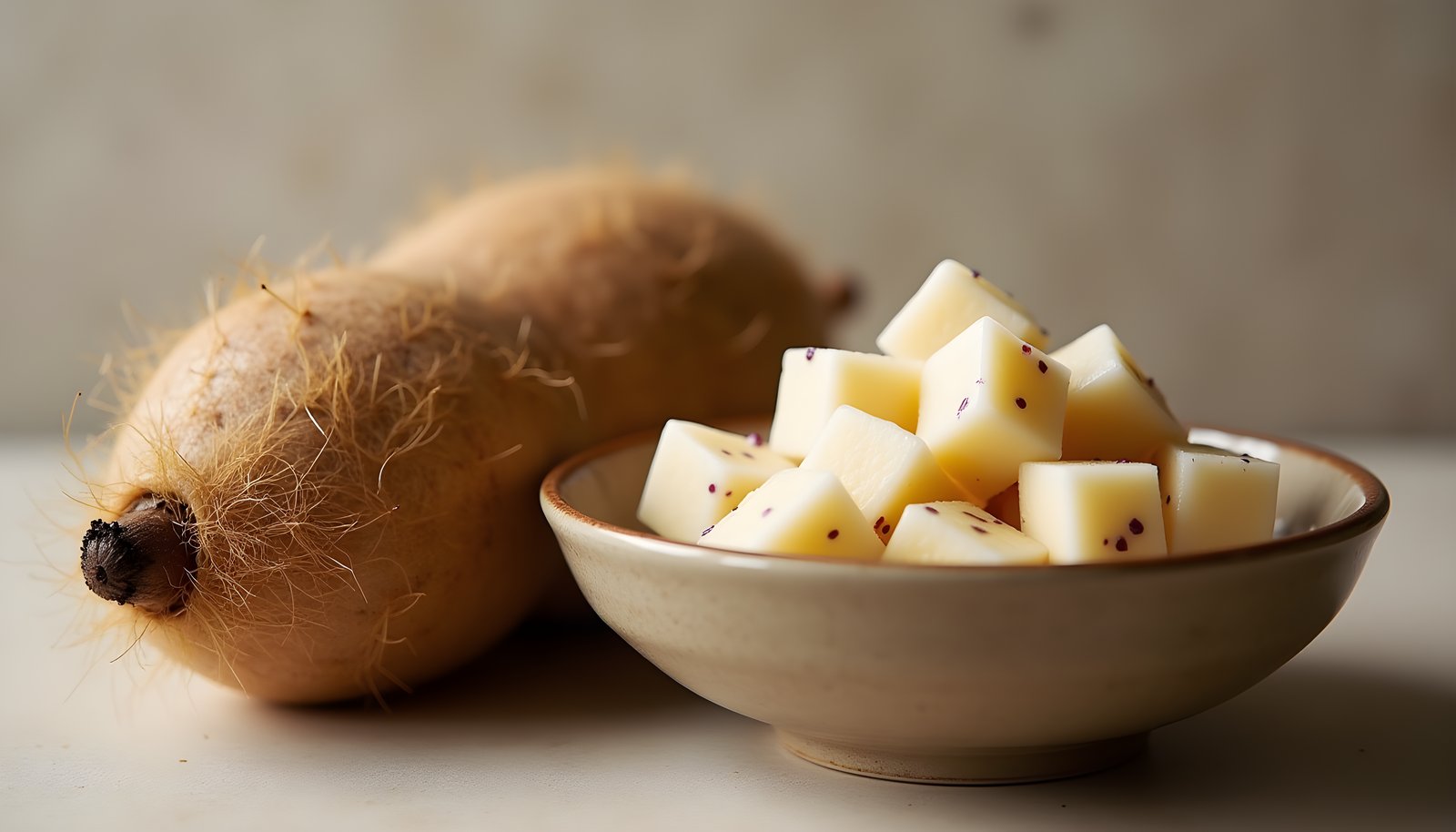
- Peel the brown, shaggy skin before cooking
- Cut the root into even chunks so they cook at the same rate
- Boil or steam until a knife slides through easily
- Cube cooked taro for soups, curries and stews
- Mash it with a little olive oil and garlic as a potato swap
- Roast cooked slices for crisp edges
- Choose whole cooked taro over poi when fiber is the goal
Mayo Clinic suggests 21 to 25 grams of fiber a day for women and 30 to 38 grams for men. A single cup of cooked taro covers about 27 to 32% of a woman’s daily target.
One thing to try this week
Next time you plan a rice or potato side, buy one taro root instead. Peel it, boil it in chunks and serve a cup alongside dinner.
That one swap adds around 3 grams of fiber over a cup of brown rice, and it brings a quarter of the day’s copper, vitamin E, vitamin B6 and manganese along with it. Any leftovers keep well for soup the next day.
If you already cook with taro, reach for the plain cooked root more often. Chunks in a stew, a simple mash or roasted slices all count at the full 6.7 grams per cup, while poi, as USDA’s numbers show, lands far lower and works better as a side to fiber rich foods than as a fiber source itself.
Taro root fiber questions
Is taro root high in fiber?
Yes. A cup of cooked taro slices has about 6.7 grams of fiber, roughly 24% of the 28 gram Daily Value, according to USDA and the Dietary Guidelines.
Does taro have more fiber than potatoes?
Yes. A cup of cooked taro has 6.7 grams, while a medium baked potato with skin has 3.9 grams.
Does poi have fiber?
Very little. USDA lists poi at about 0.4 grams of fiber per 100 grams, compared with 5.1 grams in plain cooked taro.
How many calories are in taro root?
About 187 calories in a cup of cooked slices and 142 calories per 100 grams.
Is taro a healthy carb?
It’s a fiber rich one. A cup has about 46 grams of carbohydrate, including 6.7 grams of fiber, plus a quarter of the Daily Value for copper, vitamin E, vitamin B6 and manganese.
Do taro leaves have fiber?
Yes. A cup of cooked taro leaves has about 2.9 grams of fiber for only 35 calories.
Is taro better than sweet potato for fiber?
Slightly. A cup of cooked taro has 6.7 grams of fiber and a cup of cooked sweet potato has 6.3 grams, with similar calories.
Sources
- USDA Agricultural Research Service. FoodData Central: SR Legacy Taro, cooked, without salt (168486); Taro, raw (169308); Poi (170431). 2019. fdc.nal.usda.gov
- U.S. Department of Agriculture and U.S. Department of Health and Human Services. “Food Sources of Dietary Fiber.” Dietary Guidelines for Americans, 2020 to 2025. dietaryguidelines.gov
- U.S. Food and Drug Administration. “Daily Value on the Nutrition and Supplement Facts Labels.” 2024. fda.gov
- Mayo Clinic Staff. “Dietary fiber: Essential for a healthy diet.” Mayo Clinic. 2025. mayoclinic.org

