
In this article
- Parsnips fiber, raw vs cooked
- Parsnip nutrition beyond fiber
- How parsnips compare with other root vegetables
- Where parsnips sit among high fiber foods
- Raw or roasted: choosing how to eat parsnips
- Parsnip myths vs facts
- What parsnip fiber does for digestion
- A checklist for getting the most from parsnips
- The one caveat: calories add up
- Parsnip questions people ask
- Sources
Parsnips look like pale carrots and taste sweeter, so it’s easy to assume they’re a starchy indulgence. In fact, a cup of raw parsnip slices carries about 6.5 grams of fiber, and, unusually, raw parsnips hold more fiber per bite than boiled ones.
Cooked, a cup still delivers roughly 5.6 to 6.2 grams, depending on the data source. Either way, parsnips fiber puts this winter root near the top of the vegetable list, well ahead of carrots and potatoes.
Parsnips fiber, raw vs cooked
USDA FoodData Central lists raw parsnips at 4.9 grams of fiber per 100 grams and boiled parsnips at 3.6 grams. So parsnips come out of the pot with less fiber per gram than they went in.
| Parsnip form | Serving | Fiber | % DV (28 g) | Calories |
|---|---|---|---|---|
| Raw slices | 1 cup (133 g) | 6.5 g | 23% | 100 |
| Boiled slices | 1/2 cup (78 g) | 2.8 g | 10% | 55 |
| Boiled slices | 1 cup (156 g) | 5.6 g | 20% | 111 |
| Cooked (Dietary Guidelines) | 1 cup | 6.2 g | 22% | 110 |
| Raw | 100 g | 4.9 g | 18% | 75 |
| Boiled | 100 g | 3.6 g | 13% | 71 |
The Dietary Guidelines’ Food Sources of Dietary Fiber list puts a cup of cooked parsnips at 6.2 grams and 110 calories, a little higher than USDA’s boiled record. The two sources use slightly different servings, but both put a cooked cup at about a fifth of the Daily Value.
If you enjoy them raw, grated into a slaw or shaved thin onto a salad, you get the most fiber for the calories. A raw cup has about 6.5 grams of fiber for 100 calories.
Parsnip nutrition beyond fiber
Parsnips carry a good spread of vitamins and minerals. Based on USDA’s raw record, one cup of slices (133 g) provides about:
- Manganese: 0.74 mg, about 32% of the Daily Value
- Vitamin C: 22.6 mg, about 25% DV
- Vitamin K: 30 mcg, about 25% DV
- Folate: 89 mcg DFE, about 22% DV
- Vitamin E: 2.0 mg, about 13% DV
- Potassium: 499 mg, about 11% DV
- Magnesium: 39 mg, about 9% DV
Folate is one of the more useful numbers here. A cup of raw parsnips covers more than a fifth of the Daily Value, which is a lot for a vegetable you might only think of at holiday dinners.
The NIH Office of Dietary Supplements explains that folate helps your body make DNA and other genetic material, and that it’s needed for cells to divide. A cup of parsnips adds a useful amount toward your daily folate.
Manganese is the other standout. A raw cup supplies nearly a third of the Daily Value, and a cooked cup still provides about 0.45 mg, roughly 20% DV.
Cooking changes the picture a little. A cup of boiled slices still has about 90 mcg of folate, 20 mg of vitamin C and 573 mg of potassium, but vitamin K nearly disappears in USDA’s boiled record, dropping to about 2 mcg per cup.
Parsnips also bring about 6.4 grams of natural sugar per raw cup, which explains their sweet flavor. That’s sugar that comes packaged with fiber, so it’s a very different situation from added sugar.
How parsnips compare with other root vegetables
Root vegetable fiber varies a lot, and parsnips sit near the top of the range. The Dietary Guidelines comparison, cup for cup, looks like this.
| Root vegetable (1 cup, cooked) | Fiber | Calories |
|---|---|---|
| Sweet potato, baked | 6.3 g | 190 |
| Parsnips | 6.2 g | 110 |
| Carrots | 4.8 g | 54 |
| Potato, baked with skin (1 medium) | 3.9 g | 161 |
| Turnip | 3.1 g | 34 |
| Rutabaga | 3.1 g | 51 |
| Beets | 2.8 g | 49 |
Parsnips essentially tie baked sweet potato on fiber, with 80 fewer calories per cup. They also beat a medium baked potato by more than 2 grams of fiber while coming in about 50 calories lower.
Against carrots, their brighter lookalike, parsnips bring about 1.4 grams more fiber per cup. Carrots win on calories, at 54 per cup compared with 110, so the pair works well together on one tray.
Per 100 calories, cooked parsnips deliver about 5.6 grams of fiber. That’s well ahead of baked sweet potato at about 3.3 grams and a baked potato at about 2.4 grams, though carrots lead at nearly 9 grams thanks to their lower calorie count.
Turnips and rutabaga are the lighter choices, with about half the fiber of parsnips and far fewer calories. Mixing them in one roasting pan is an easy way to balance fiber and calories.
Mayo Clinic puts daily fiber needs at about 21 to 25 grams for women and 30 to 38 grams for men. A cup of cooked parsnips covers about 25 to 30% of a woman’s target and 16 to 21% of a man’s.
Want to know your own daily target? Our fiber calculator gives you a personal number in seconds.
Where parsnips sit among high fiber foods
Parsnips hold their own beyond the root vegetable aisle too. On the Dietary Guidelines list, a cup of cooked parsnips matches or beats several well-known high fiber foods.
- Brussels sprouts, cooked: 6.4 grams per cup
- Parsnips, cooked: 6.2 grams per cup
- Chickpeas, cooked: 6.3 grams per half cup
- Broccoli, cooked: 5.2 grams per cup
- Popcorn: 5.8 grams per 3 cups
A few vegetables on the list go even further. A cup of cooked artichoke has about 9.6 grams of fiber and a cup of cooked green peas about 8.8 grams, so parsnips sit in the upper tier rather than at the very top.
Legumes still lead the list. Half a cup of cooked lentils has about 7.8 grams of fiber and half a cup of navy beans about 9.6, so parsnips work best as a strong supporting player alongside beans and whole grains.
Raw or roasted: choosing how to eat parsnips
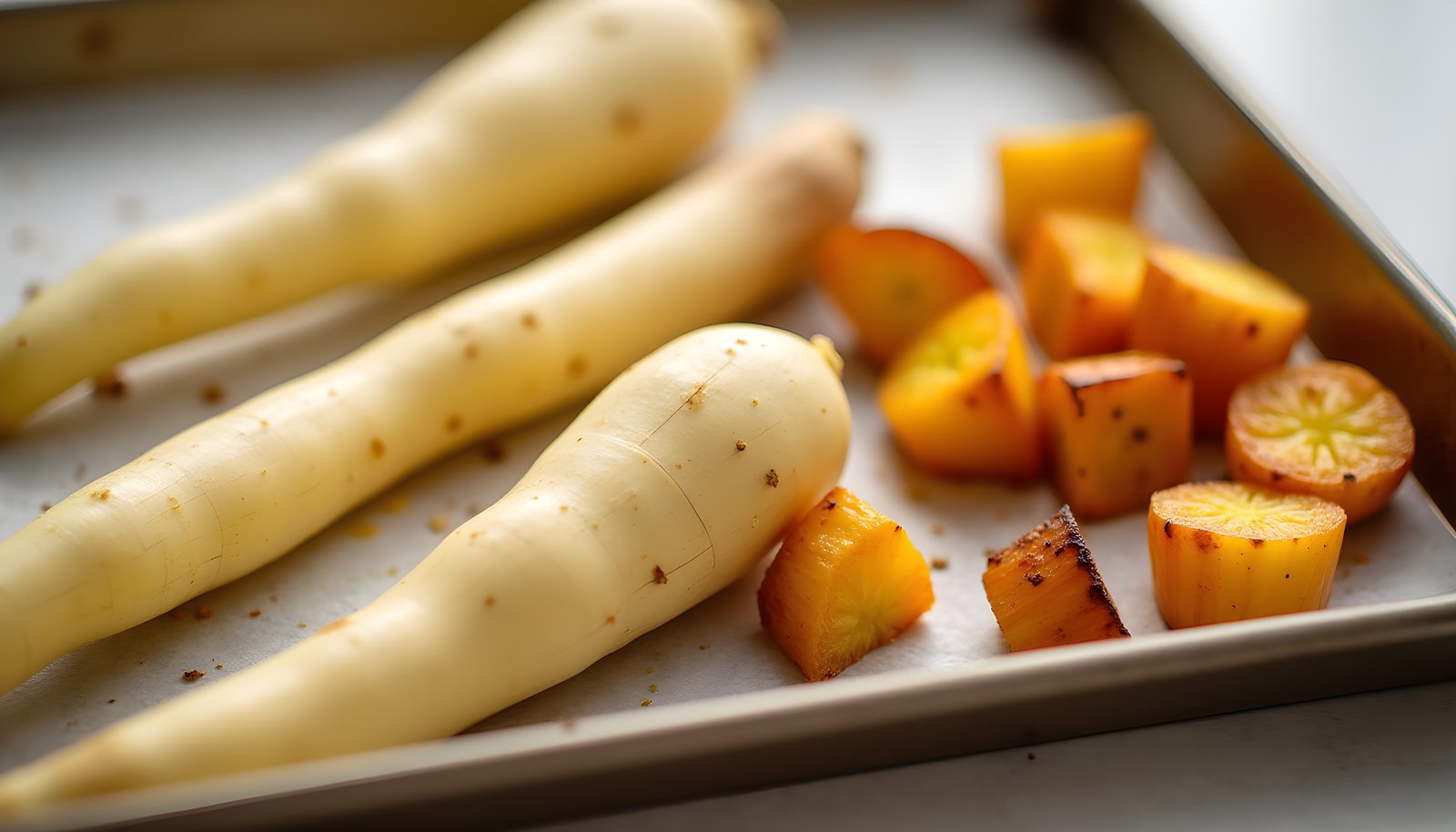
Roasting is a fine way to enjoy parsnips. You’ll still get several grams of fiber per cup, along with a deeper, caramelized sweetness.
Raw parsnips are worth a try if you want the maximum fiber per gram. Grated finely, they work like carrots in a slaw, adding a slightly sweet, nutty crunch. Toss them with an apple, lemon juice and a little olive oil for a quick winter salad.
Whichever way you choose, portion matters more than method. A full cup of cooked parsnips still lands at 5.6 to 6.2 grams of fiber, so eating a generous serving does more for your daily total than worrying about raw versus cooked.
Parsnip myths vs facts
Myth: parsnips are just a starchy potato substitute
A cup of cooked parsnips has about 2.3 grams more fiber than a medium baked potato and about 50 fewer calories, according to the Dietary Guidelines. They’re a step up in fiber, not a like-for-like swap.
Myth: cooking always increases fiber
For parsnips, it’s the reverse per gram. USDA lists 4.9 grams of fiber per 100 grams raw and 3.6 grams boiled, so raw parsnips are the more fiber dense option.
Myth: sweet vegetables are bad for blood sugar
The sweetness of parsnips comes with plenty of fiber, about 6.5 grams per raw cup. Mayo Clinic notes that fiber can help slow the absorption of sugar and improve blood sugar levels.
What parsnip fiber does for digestion
The fiber in parsnips supports regularity like fiber from other plant foods. Mayo Clinic explains that fiber increases the weight and size of stool and softens it, making it easier to pass and helping prevent constipation.
Mayo Clinic also links high fiber diets with healthier cholesterol levels, steadier blood sugar and feeling full for longer. A cup of parsnips is a solid step toward those benefits in a single side dish.
If you’re adding several high fiber foods at once, go slowly. Mayo Clinic recommends increasing fiber gradually over a few weeks and drinking plenty of water.
If your gut tends to complain when you change your diet, our guides walk you through a gentler plan step by step.
A checklist for getting the most from parsnips
- Try them raw: grate into slaws or shave thin into salads for the most fiber per gram
- Roast chunks with carrots, turnips or other root vegetables
- Leave the skin on well-scrubbed parsnips if you like the texture
- Mash boiled parsnips with potatoes for a sweeter, higher fiber mash
- Blend roasted parsnips into soups with onion and broth
- Pair them with lentils, beans or chickpeas to build a high fiber plate
Want more ideas for cozy dishes built around root vegetables? Our recipe eBooks are full of easy, high fiber meals.
The one caveat: calories add up
Parsnips are among the more energy dense vegetables on this list, at about 110 calories per cooked cup. That’s double a cup of carrots and more than three times a cup of turnips.
It isn’t a reason to skip them, since they still beat potatoes and sweet potatoes on calories. But if you’re roasting a big tray with plenty of oil, the calories climb quickly, so treat parsnips as a satisfying starch on the plate rather than a free extra.
Parsnip questions people ask
Are parsnips high in fiber?
Yes. A cup of cooked parsnips has about 5.6 to 6.2 grams of fiber, roughly 20 to 22% of the 28 gram Daily Value.
Do raw parsnips have more fiber than cooked?
Per gram, yes. USDA lists raw parsnips at 4.9 grams of fiber per 100 grams and boiled parsnips at 3.6 grams.
Do parsnips have more fiber than carrots?
Yes. The Dietary Guidelines list a cup of cooked parsnips at 6.2 grams of fiber and a cup of cooked carrots at 4.8 grams.
Are parsnips healthier than potatoes?
They have more fiber and fewer calories. A cup of cooked parsnips has 6.2 grams of fiber and 110 calories, while a medium baked potato has 3.9 grams and 161 calories.
How many calories are in parsnips?
About 100 calories in a cup of raw slices and about 110 in a cup of cooked parsnips.
What vitamins are in parsnips?
A raw cup provides about 25% of the Daily Value for vitamin C and vitamin K, 22% for folate and 32% for manganese, according to USDA.
Are parsnips good for weight loss?
They can fit. Parsnips are filling and high in fiber, but at about 110 calories per cooked cup they’re best treated as a starch on the plate.
Sources
- USDA Agricultural Research Service. FoodData Central: SR Legacy Parsnips, raw (170417); Parsnips, cooked, boiled, drained, without salt (170009). 2019. fdc.nal.usda.gov
- U.S. Department of Agriculture and U.S. Department of Health and Human Services. “Food Sources of Dietary Fiber.” Dietary Guidelines for Americans, 2020 to 2025. dietaryguidelines.gov
- U.S. Food and Drug Administration. “Daily Value on the Nutrition and Supplement Facts Labels.” 2024. fda.gov
- National Institutes of Health Office of Dietary Supplements. “Folate: Fact Sheet for Consumers.” 2022. ods.od.nih.gov
- Mayo Clinic Staff. “Dietary fiber: Essential for a healthy diet.” Mayo Clinic. 2025. mayoclinic.org