

In this article
- Cheese fiber content, type by type
- Why milk based cheese has zero fiber
- Cheddar, mozzarella and the usual suspects
- Does shredded cheese have hidden fiber?
- Plant based cheese: a small exception
- What cheese does bring: dairy protein and calcium
- Cheese next to other savory snacks
- A cheese plate, counted with and without plants
- A checklist of fiber partners for cheese
- Turning cheesy favorites into fiber meals
- How cheese fits your daily fiber goal
- One swap to make today
- Cheese and fiber: what people ask
- Sources
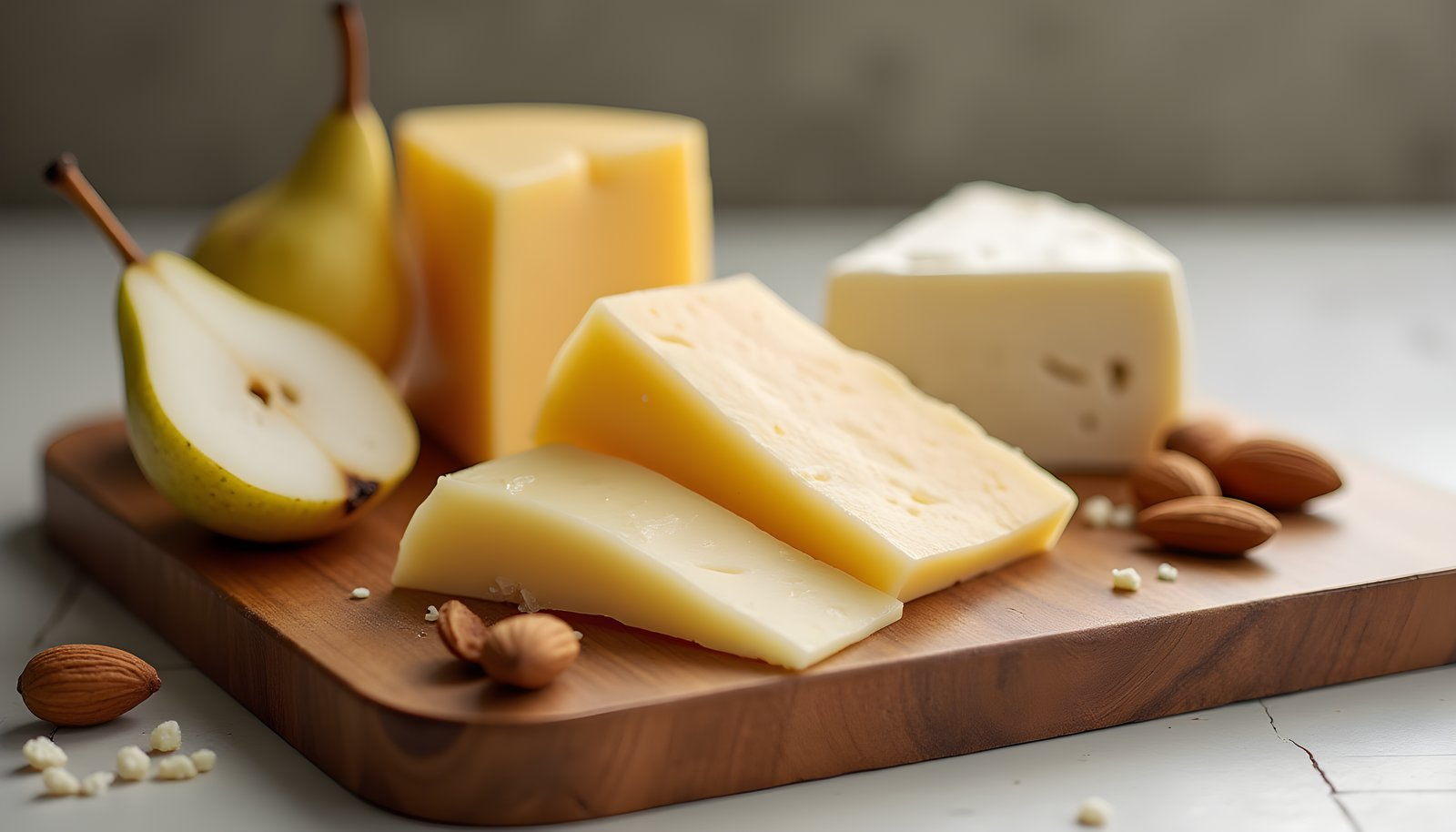
You build a snack plate with a few slices of cheddar, some cubes of mozzarella and a crumble of feta, and it feels like a balanced little meal. Counted up, the cheese fiber content on that plate is 0 grams.
Every everyday cheese we checked in USDA FoodData Central lists zero fiber or no fiber value at all. That doesn’t make cheese a poor choice, but it does mean the fiber has to come from whatever sits next to it.
Cheese fiber content, type by type
Here’s how common cheeses compare, using USDA FoodData Central records and two branded labels:
| Cheese | Serving | Fiber | Calories | Protein | Calcium | Sodium |
|---|---|---|---|---|---|---|
| Cheddar (USDA) | 1 slice (17 g) | 0 g | 70 | 4 g | 120 mg | 110 mg |
| Mozzarella, whole milk (USDA) | 1 oz (28 g) | 0 g | 85 | 6.3 g | 143 mg | 138 mg |
| Feta (USDA) | 1 oz (28 g) | 0 g | 75 | 4 g | 140 mg | 323 mg |
| Parmesan, grated (USDA) | 1 tbsp (7.6 g) | Not reported | 32 | 2.3 g | 67 mg | 133 mg |
| Kraft Sharp Cheddar, shredded | 1/4 cup (28 g) | 0 g | 110 | 6 g | 180 mg | 170 mg |
| Nuttin Ordinary Plain Cashew Cheese | 1 oz (28 g) | 1 g | 90 | 3 g | 20 mg | 130 mg |
The only cheese in the table with any fiber isn’t made from milk at all. The cashew version gets its single gram from the nuts.
Why milk based cheese has zero fiber
Mayo Clinic defines dietary fiber as the parts of plant foods your body can’t digest or absorb. Milk comes from an animal, so it starts with no fiber, and cheese is milk concentrated.
Turning milk into cheese concentrates its protein, fat and calcium. Per 100 grams, cheddar carries about 23 grams of protein and 707 milligrams of calcium, yet nothing in the process adds plant material.
That’s why cheese sits alongside eggs, meat and fish as one of the zero fiber foods. Aging changes the flavor and texture, yet an aged cheddar and a fresh mozzarella both land at 0 grams.
Cheddar, mozzarella and the usual suspects
Cheddar and mozzarella go into sandwiches, pizza and pasta all week long in many kitchens. Neither has a gram of fiber, and that holds for sharp, mild, low moisture and fresh styles alike.
Their carbohydrate is close to zero too. USDA lists 0 grams of carbohydrate in a slice of cheddar and 0.7 grams in an ounce of whole milk mozzarella, with no sugar in either.
On a pizza night, two ounces of mozzarella give you around 12.6 grams of protein and 286 milligrams of calcium. The fiber on that slice comes entirely from the crust and any vegetables you pile on.
Feta and grated Parmesan follow the same pattern. Feta lists 0 grams of fiber per ounce, and USDA’s grated Parmesan record doesn’t report fiber at all.
Does shredded cheese have hidden fiber?
Bags of shredded cheese contain an anti caking agent so the shreds don’t clump. Kraft’s shredded sharp cheddar uses modified cornstarch for that job, along with natamycin, a natural mold inhibitor.
The amount is too small to show up on the label. Kraft lists 0 grams of fiber and under a gram of carbohydrate per quarter cup, so shredded cheese counts the same as a block.
Plant based cheese: a small exception
Cheese alternatives made from nuts can carry a little fiber. Nuttin Ordinary’s plain cashew cheese is made from cashews, water, salt, nutritional yeast and a probiotic culture, and it lists 1 gram of fiber per ounce.
That’s about 4% of the Daily Value, a small step up rather than a fiber food. It also lists only 20 milligrams of calcium, compared with 143 in an ounce of mozzarella, and half the protein.
Comparing dairy cheese with nut and coconut based alternatives for your fridge? Our comparison charts set the main options side by side.
What cheese does bring: dairy protein and calcium
Cheese earns its place as one of the most concentrated dairy protein foods. An ounce of mozzarella gives you about 6 grams of protein, and USDA lists cheddar at 23 grams of protein per 100 grams.
It’s a strong calcium source too. Using the FDA’s 1,300 milligram Daily Value, a slice of cheddar covers about 9% and an ounce of mozzarella or feta about 11%.
The tradeoffs are saturated fat and sodium. A quarter cup of shredded cheddar lists 6 grams of saturated fat, 30% of the Daily Value, and an ounce of feta has 323 milligrams of sodium, about 14% of the FDA’s 2,300 milligram limit.
Cheese next to other savory snacks
If you snack on cheese for its protein and staying power, it helps to know how plant based savory snacks stack up on fiber. Each of these Dietary Guidelines options carries fiber where an ounce of cheese carries none:
- Pumpkin seeds, whole, 1 ounce: 5.2 grams
- Almonds, 1 ounce: 3.5 grams
- Sunflower seeds, 1 ounce: 3.1 grams
- Pistachios, 1 ounce: 2.9 grams
- Edamame, 1/2 cup cooked: 4.1 grams
None of these has to replace cheese. Eating an ounce of cheese with an ounce of pumpkin seeds gives you the savory, filling snack you were after plus nearly a fifth of the fiber Daily Value.
Cheese still brings its calcium, about 140 milligrams in an ounce of feta, so the easy move is pairing rather than replacing.
A cheese plate, counted with and without plants
Go back to that snack plate: a slice of cheddar, an ounce of mozzarella and an ounce of feta. It gives you roughly 14 grams of protein and around 400 milligrams of calcium, and still 0 grams of fiber.
Now add an ounce of whole wheat crackers, a medium pear in slices and an ounce of almonds. Using Dietary Guidelines numbers, those bring 2.9, 5.5 and 3.5 grams.
The plate jumps to about 11.9 grams of fiber, more than 40% of the 28 gram Daily Value. The cheese didn’t change; the company it keeps did.
A checklist of fiber partners for cheese
These pairings come from the Dietary Guidelines fiber list and suit the way most people already eat cheese:
- Whole wheat crackers, 1 ounce: 2.9 grams, for a cheese board or snack
- Apple with skin, 1 medium: 4.8 grams, sliced next to sharp cheddar
- Dried figs, 1/4 cup: 3.7 grams, a classic match for blue cheese or Parmesan
- Whole wheat tortilla, 1 ounce: 2.8 grams, for quesadillas
- Black beans, 1/2 cup cooked: 7.5 grams, under melted cheese in a burrito bowl
- Broccoli, 1 cup cooked: 5.2 grams, topped with grated Parmesan
- Popcorn, 3 cups: 5.8 grams, dusted with finely grated cheese
Want more cheesy meals that are built around beans, vegetables and whole grains? Our recipe eBooks are full of easy, high fiber ideas.
Turning cheesy favorites into fiber meals
Most cheese is eaten inside other dishes, which makes it easy to add fiber without giving anything up. Building a quesadilla on an ounce of whole wheat tortilla with half a cup of black beans brings about 10.3 grams of fiber from those two ingredients alone.
Pasta with mozzarella and Parmesan gets a similar lift from vegetables. Stirring in a cup of cooked broccoli or cauliflower adds about 5 grams, and a handful of halved cherry tomatoes adds color too.
Pizza works the same way. A cup of raw red bell pepper strips scattered over the top adds about 3.1 grams, and a cup of cooked mushrooms adds another 3.4.
Salads with feta are an easy win. Toss an ounce of crumbled feta with half a cup of chickpeas and half a cup of avocado, and you add 6.3 and 5.0 grams, or about 11 grams before you count the greens.
A baked potato loaded with cheddar can carry fiber too, as long as you eat the skin. One medium potato with skin lists 3.9 grams, and a cup of cooked broccoli on top brings the total to about 9.1 grams.
How cheese fits your daily fiber goal
Mayo Clinic suggests about 25 grams of fiber a day for women and 38 grams for men up to age 50. Since cheese contributes nothing toward either number, a day heavy in cheese, bread and meat can fall far short without feeling unusual.
Mayo Clinic also notes that fiber helps keep bowel movements regular. If a cheese heavy week leaves you feeling backed up, the missing plants are the likely reason, and the fix is more fruit, vegetables, beans and whole grains alongside the cheese.
Not sure how many grams you should be aiming for? Our fiber calculator works out a personal number in a few seconds.
One swap to make today
The next time you reach for cheese as a snack, put a piece of fruit or a handful of nuts on the same plate. A slice of cheddar with a medium apple gives you 4.8 grams of fiber and about 4 grams of protein in a snack that takes a minute to put together.
Keep the cheese you enjoy, and let it be the reason you eat the fiber next to it.
Cheese and fiber: what people ask
Does any cheese have fiber?
No dairy cheese does. Cheddar, mozzarella and feta all list 0 grams, and only nut based cheese alternatives show a small amount, like 1 gram per ounce for a cashew cheese.
Is cheese a zero fiber food?
Yes. Cheese is made from milk, and fiber only comes from plant foods, so it sits with eggs and meat as a food with no fiber.
Does aged cheese have more fiber than fresh cheese?
No. Aging changes flavor and texture, but aged cheddar and fresh mozzarella both have 0 grams of fiber.
Does shredded cheese contain fiber from anti caking agents?
Not in any amount you can count. Kraft’s shredded sharp cheddar lists 0 grams of fiber per quarter cup even with modified cornstarch added.
Can eating a lot of cheese cause constipation?
Cheese itself has no fiber, so a diet heavy in cheese and light on plants can leave you short. Pairing cheese with fruit, vegetables or whole grains helps fill that gap.
Is cheese a good source of protein?
Yes. An ounce of whole milk mozzarella has about 6 grams of protein, and cheddar has about 23 grams per 100 grams.
What should I eat with cheese to get more fiber?
Fruit, whole grains, beans and nuts work best. A medium pear adds 5.5 grams and an ounce of almonds adds 3.5 grams.
Sources
- USDA Agricultural Research Service. FoodData Central, Foundation and SR Legacy entries for cheddar cheese (328637), whole milk mozzarella (170845), feta (173420) and grated Parmesan (325036), plus branded records for Kraft Sharp Cheddar Shredded Cheese (2023) and Nuttin Ordinary Plain Cashew Cheese (2021). fdc.nal.usda.gov
- U.S. Food and Drug Administration. “Daily Value on the Nutrition and Supplement Facts Labels.” 2024. fda.gov
- U.S. Department of Agriculture and U.S. Department of Health and Human Services. “Food Sources of Dietary Fiber.” Dietary Guidelines for Americans, 2020 to 2025. dietaryguidelines.gov
- Mayo Clinic Staff. “Dietary fiber: Essential for a healthy diet.” Mayo Clinic. 2025. mayoclinic.org

