
In this article
- Mustard greens fiber by form
- Mustard greens nutrition: vitamin K, A and C
- How mustard greens compare with other leafy greens
- Mustard greens among other fiber rich foods
- Mustard greens myths vs facts
- A peppery greens plate, counted
- Fitting mustard greens into a leafy greens diet
- What mustard greens fiber does for digestion
- The edge case: raw mustard greens in a salad
- Mustard greens questions people ask
- Sources
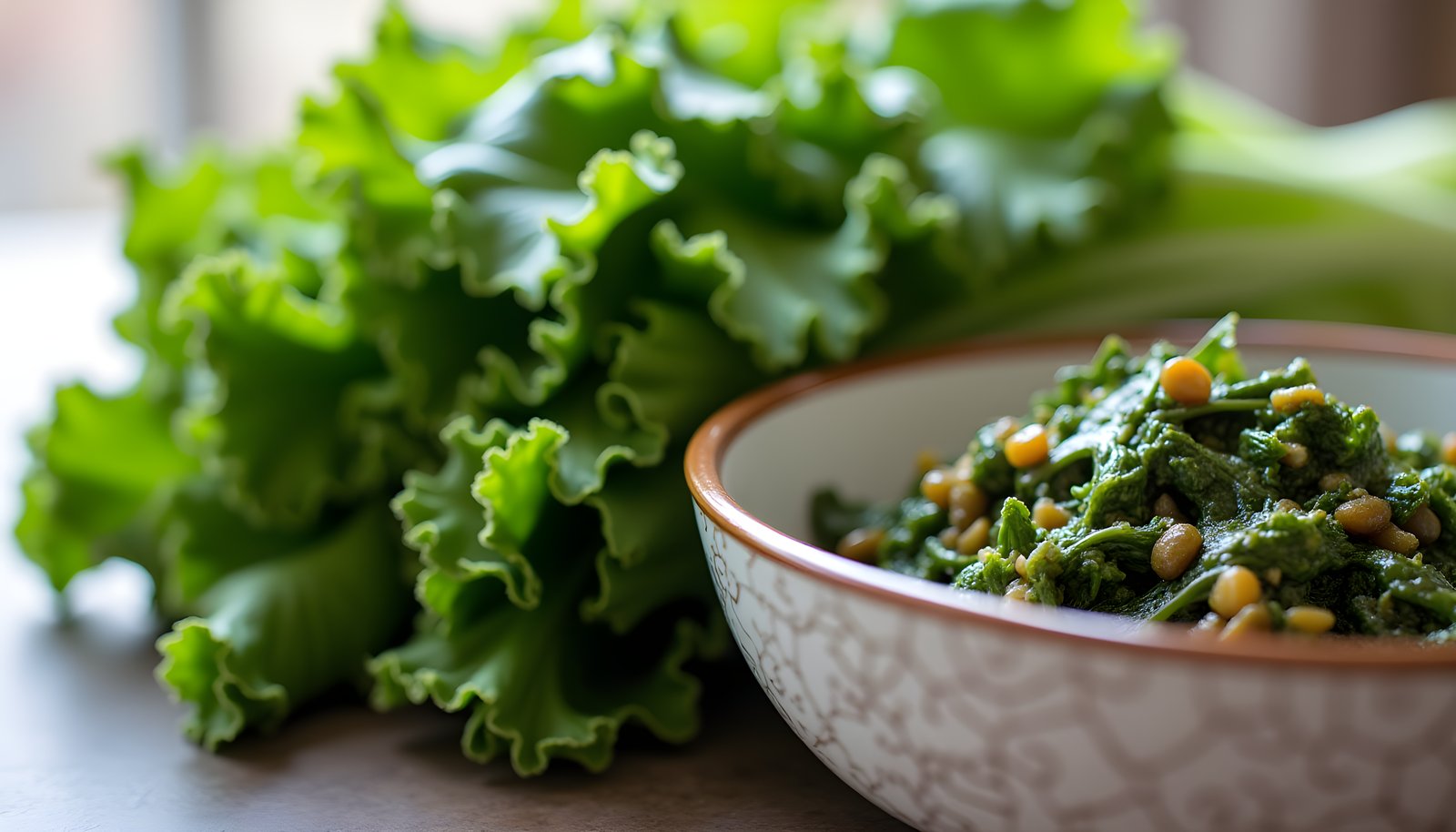
You toss a pile of frilly mustard greens into a hot pan, and within a minute that sharp, peppery smell fills the kitchen. The leaves collapse into a small, glossy heap. So how much fiber is actually left in that heap?
A cup of boiled fresh mustard greens has about 2.8 grams of fiber for 36 calories, a moderate amount. The surprise is in the freezer aisle: frozen mustard greens, cooked, carry about 4.2 grams per cup, which puts mustard greens fiber close to kale.
Mustard greens fiber by form
USDA FoodData Central has separate records for raw, boiled fresh and boiled frozen mustard greens. The numbers differ more than you might expect.
| Mustard greens form | Serving | Fiber | % DV (28 g) | Calories |
|---|---|---|---|---|
| Boiled from frozen, chopped | 1 cup (150 g) | 4.2 g | 15% | 29 |
| Boiled from fresh, chopped | 1 cup (140 g) | 2.8 g | 10% | 36 |
| Raw, chopped | 1 cup (56 g) | 1.8 g | 6% | 15 |
| Raw | 100 g | 3.2 g | 11% | 27 |
| Boiled from fresh | 100 g | 2.0 g | 7% | 26 |
| Boiled from frozen | 100 g | 2.8 g | 10% | 19 |
Raw mustard greens have more fiber per 100 grams than boiled fresh greens, 3.2 grams compared with 2.0. Because a raw cup is so light, though, a cooked cup still gives you more fiber per serving.
The Dietary Guidelines’ Food Sources of Dietary Fiber list matches USDA’s fresh record, putting a cup of cooked mustard greens at 2.8 grams of fiber and 36 calories. Frozen greens aren’t on that list, but USDA’s frozen record comes in about 1.4 grams higher per cup.
Mustard greens nutrition: vitamin K, A and C
Mustard greens are light on calories and heavy on vitamins. Based on USDA’s record for boiled fresh greens, one chopped cup (140 g) provides about:
- Vitamin K: 830 mcg, about 692% of the Daily Value
- Vitamin A: 865 mcg RAE, about 96% DV
- Vitamin C: 35 mg, about 39% DV
- Copper: 0.20 mg, about 22% DV
- Vitamin E: 2.5 mg, about 17% DV
- Calcium: 165 mg, about 13% DV
- Protein: about 3.6 grams
Vitamin K leads by a wide margin. The NIH Office of Dietary Supplements explains that vitamin K is important for blood clotting and healthy bones, and it lists green leafy vegetables among the main food sources.
Vitamin A comes close to a full day’s worth in one cup. The NIH notes that vitamin A supports normal vision, the immune system, reproduction, and growth and development.
Raw mustard greens are a strong vitamin C source too. A raw chopped cup has about 39 mg, roughly 44% of the Daily Value, for only 15 calories.
What frozen mustard greens add
USDA’s frozen, boiled record shows its own strengths. A cup has about 105 mcg DFE of folate, roughly 26% of the Daily Value, along with 503 mcg of vitamin K and 531 mcg RAE of vitamin A.
Calcium is similar in both forms, at about 165 mg per cup for fresh and 152 mg for frozen, roughly 12 to 13% of the Daily Value. That’s a useful amount from a vegetable side.
Fresh greens hold more vitamin C and vitamin A per cup, while frozen greens bring more fiber and folate. Both are worth keeping in your rotation, and a bag of frozen greens is easy to keep on hand.
How mustard greens compare with other leafy greens
On the Dietary Guidelines list, fresh-cooked mustard greens sit at the bottom of the cooked greens for fiber. Frozen greens, using USDA’s figure, move up into the middle of the pack.
| Cooked greens (1 cup) | Fiber | Calories |
|---|---|---|
| Turnip greens | 5.0 g | 29 |
| Collard greens | 4.8 g | 63 |
| Kale | 4.7 g | 43 |
| Spinach | 4.3 g | 41 |
| Mustard greens, from frozen (USDA) | 4.2 g | 29 |
| Swiss chard | 3.7 g | 35 |
| Mustard greens, from fresh | 2.8 g | 36 |
Fresh-cooked mustard greens trail turnip greens by about 2 grams per cup. Frozen mustard greens close most of that gap and beat Swiss chard, at just 29 calories a cup.
Per 100 calories, frozen mustard greens deliver about 14.5 grams of fiber, second only to turnip greens on this table. Fresh-cooked greens come in near 7.8 grams.
Mayo Clinic suggests about 21 to 25 grams of fiber a day for women and 30 to 38 grams for men. A cup of frozen, cooked mustard greens covers about 17 to 20% of a woman’s target, while fresh greens cover about 11 to 13%.
Want to know exactly how much fiber your day should hold? Our fiber calculator gives you a personal target in seconds.
Mustard greens among other fiber rich foods
Outside the leafy greens group, mustard greens are best seen as a helpful contributor rather than a main fiber source. The Dietary Guidelines list a cup of cooked broccoli at 5.2 grams, Brussels sprouts at 6.4 grams and green beans at 4.0 grams.
Frozen, cooked mustard greens land right alongside green beans, while fresh-cooked greens match a cup of cooked cabbage at 2.8 grams. Legumes are in a different league: half a cup of cooked lentils has about 7.8 grams.
That’s why mustard greens work best as part of a mix. Pair them with beans, whole grains or a higher fiber vegetable, and they add flavor, vitamins and a few extra grams without many calories.
Mustard greens myths vs facts
Myth: all leafy greens have about the same fiber
Cooked greens range from 2.8 grams per cup for fresh mustard greens to 5.0 grams for turnip greens on the Dietary Guidelines list. That’s nearly double from one green to the next.
Myth: frozen greens are less nutritious than fresh
For mustard greens, USDA’s frozen, boiled record shows more fiber and more folate per cup than the fresh, boiled record. Fresh wins on vitamin C and vitamin A, so each form has an edge.
Myth: you need to eat mustard greens raw to get the benefits
Raw greens do have the most fiber per gram, but a raw cup weighs only 56 grams. A cooked cup packs in far more leaves, along with 830 mcg of vitamin K and nearly a day’s vitamin A.
A peppery greens plate, counted
Picture a cup of frozen mustard greens simmered with garlic and a splash of vinegar, served next to half a cup of black-eyed peas and a cup of brown rice. It’s a simple, filling plate built mostly from plants.
The greens bring about 4.2 grams of fiber. The black-eyed peas add about 5.6 grams, according to the Dietary Guidelines, and the brown rice about 3.5 grams, according to Mayo Clinic.
That’s roughly 13.3 grams of fiber, around half of a 21 to 25 gram target for women. Mixing in a cup of turnip greens or collards would push the plate past 18 grams.
Looking for more ideas for building fiber rich foods into your meals? Our recipe eBooks are full of easy, high fiber dishes.
Fitting mustard greens into a leafy greens diet
Mustard greens have a bold, peppery flavor that sets them apart from milder greens like spinach. That makes them useful for adding variety to a leafy greens diet without eating the same salad every day.
- Saute them with garlic and a squeeze of lemon
- Simmer them with onions and broth as a side
- Mix them half and half with collards or kale to soften the bite
- Stir chopped greens into soups, beans and stews
- Add a handful of raw leaves to salads for a peppery kick
Mustard greens are also very light on carbs. A cup of boiled fresh greens has about 6.3 grams of carbohydrate and 2.8 grams of fiber, for roughly 3.5 grams of net carbs, and frozen greens come in near 0.5 grams.
What mustard greens fiber does for digestion
Fiber from mustard greens works like fiber from other leafy vegetables. Mayo Clinic explains that fiber increases the weight and size of stool and softens it, making it easier to pass and helping prevent constipation.
Mayo Clinic also links fiber rich eating with healthier cholesterol levels, steadier blood sugar and feeling full on fewer calories. Greens that cost you under 40 calories a cup are an easy way to add more of those benefits.
If you’re adding a lot of greens and beans at once, ease in. Mayo Clinic recommends increasing fiber gradually over a few weeks and drinking plenty of water.
If your gut needs a slower start, our gut health guides walk you through the process step by step.
The edge case: raw mustard greens in a salad
Raw mustard greens have the highest fiber per gram of any form, at 3.2 grams per 100 grams. But a cup of chopped raw leaves weighs only 56 grams, so a typical salad handful gives you less than 2 grams of fiber.
If you love them raw, use them generously or pair them with beans, seeds or whole grains in the same bowl. If fiber is the goal, cooked or frozen greens give you more per serving with almost no extra effort.
Mustard greens questions people ask
Are mustard greens high in fiber?
They’re a moderate source. A cup of boiled fresh mustard greens has about 2.8 grams of fiber, and a cup of boiled frozen greens has about 4.2 grams.
Do frozen mustard greens have more fiber than fresh?
Yes, per cooked cup. USDA lists frozen, boiled mustard greens at about 4.2 grams of fiber per cup compared with 2.8 grams for fresh, boiled greens.
Are mustard greens healthier than kale?
They’re different. Cooked kale has a bit more fiber at 4.7 grams per cup, while cooked mustard greens have about 692% of the Daily Value for vitamin K and 96% for vitamin A.
What vitamins are in mustard greens?
Mustard greens are rich in vitamins K, A and C. A cup of boiled fresh greens has about 692% of the Daily Value for vitamin K, 96% for vitamin A and 39% for vitamin C.
How many calories are in mustard greens?
About 36 calories in a cup of boiled fresh greens, 29 in a cup of boiled frozen greens and 15 in a cup of chopped raw leaves.
Are mustard greens good for weight loss?
They can help. Mustard greens are very low in calories, at under 40 per cooked cup, and they add fiber and volume to meals.
Can you eat mustard greens raw?
Yes. Raw mustard greens have a peppery bite and about 1.8 grams of fiber per chopped cup, along with about 44% of the Daily Value for vitamin C.
Sources
- USDA Agricultural Research Service. FoodData Central: SR Legacy Mustard greens, raw (169256); Mustard greens, cooked, boiled, drained, without salt (169257); Mustard greens, frozen, cooked, boiled, drained, without salt (169259). 2019. fdc.nal.usda.gov
- U.S. Department of Agriculture and U.S. Department of Health and Human Services. “Food Sources of Dietary Fiber.” Dietary Guidelines for Americans, 2020 to 2025. dietaryguidelines.gov
- U.S. Food and Drug Administration. “Daily Value on the Nutrition and Supplement Facts Labels.” 2024. fda.gov
- National Institutes of Health Office of Dietary Supplements. “Vitamin K: Fact Sheet for Consumers.” 2021. ods.od.nih.gov
- National Institutes of Health Office of Dietary Supplements. “Vitamin A and Carotenoids: Fact Sheet for Consumers.” 2025. ods.od.nih.gov
- Mayo Clinic Staff. “Dietary fiber: Essential for a healthy diet.” Mayo Clinic. 2025. mayoclinic.org