
In this article
- Insoluble fiber vegetables ranked per 100 grams
- Leafy greens fiber: high share, low weight
- Brussels sprouts, broccoli and cauliflower
- Root vegetables pull their weight
- Celery, fennel and green beans for everyday crunch
- What steaming does to insoluble fiber
- How vegetables compare with other digestive bulk foods
- Why insoluble fiber matters for colon health
- One dinner, two ways
- Easing into more roughage
- A quick rule for choosing your vegetables
- Insoluble fiber vegetable questions
- Sources
Most people picture a big bowl of leafy greens when they think of roughage. Per bite, though, the top insoluble fiber vegetables are Brussels sprouts, parsnips, radishes, broccoli and swede, which each carry close to 4 grams or more of insoluble fiber per 100 grams raw.
Leafy greens fiber is mostly the insoluble kind too. Swiss chard and endive simply hold so much water that 100 grams of leaves delivers about half what the same weight of Brussels sprouts does.
These figures come from a 2017 lab study of 29 vegetables by Kalala and colleagues, which measured each one raw and steamed.
Insoluble fiber vegetables ranked per 100 grams
The study reported fiber per 100 grams of dried vegetable. The table converts that to fresh, raw weight using each vegetable’s measured dry matter, so you can compare them as you’d buy them.
| Vegetable, raw | Insoluble fiber per 100 g |
|---|---|
| Brussels sprouts | 4.6 g |
| Parsnip | 4.3 g |
| Radish | 4.0 g |
| Tuberous parsley | 3.9 g |
| Swede (rutabaga) | 3.8 g |
| Broccoli | 3.8 g |
| Cauliflower | 3.1 g |
| Celery | 3.1 g |
| Artichoke | 2.7 g |
| Carrot | 2.7 g |
| Turnip | 2.6 g |
| Fennel | 2.6 g |
| Leek | 2.4 g |
| Swiss chard | 1.9 g |
| Endive | 1.8 g |
| Asparagus | 1.7 g |
| Zucchini | 1.2 g |
The vegetables were peeled and trimmed to their edible parts before testing. Skins, stems and outer leaves you’d normally eat could push some of these numbers a little higher.
Two patterns stand out. Dense, crunchy vegetables with less water rise to the top, and the cabbage family claims four of the first six spots: Brussels sprouts, radishes, swede and broccoli.
Leafy greens fiber: high share, low weight
Swiss chard is about 72% insoluble fiber and endive about 88%, by the study’s measurements. So leafy greens are firmly on the insoluble side.
The catch is water. Raw chard is more than 92% water, so 100 grams gives you only about 1.9 grams of insoluble fiber.
Cooking changes the math by shrinking the leaves. The Dietary Guidelines list a cooked cup of turnip greens at 5.0 grams of total fiber, collards at 4.8 grams, kale at 4.7 grams and spinach at 4.3 grams, because a cup of cooked greens packs in several cups of raw leaves.
Steamed chard held its insoluble share at about 74%, so cooking greens doesn’t tip them toward the soluble side. You get the same kind of fiber, just more of it per forkful.
If you love salads, they still count. Just know that a cooked side of greens or a handful of Brussels sprouts will do more for stool bulk than a plate of raw lettuce.
Brussels sprouts, broccoli and cauliflower
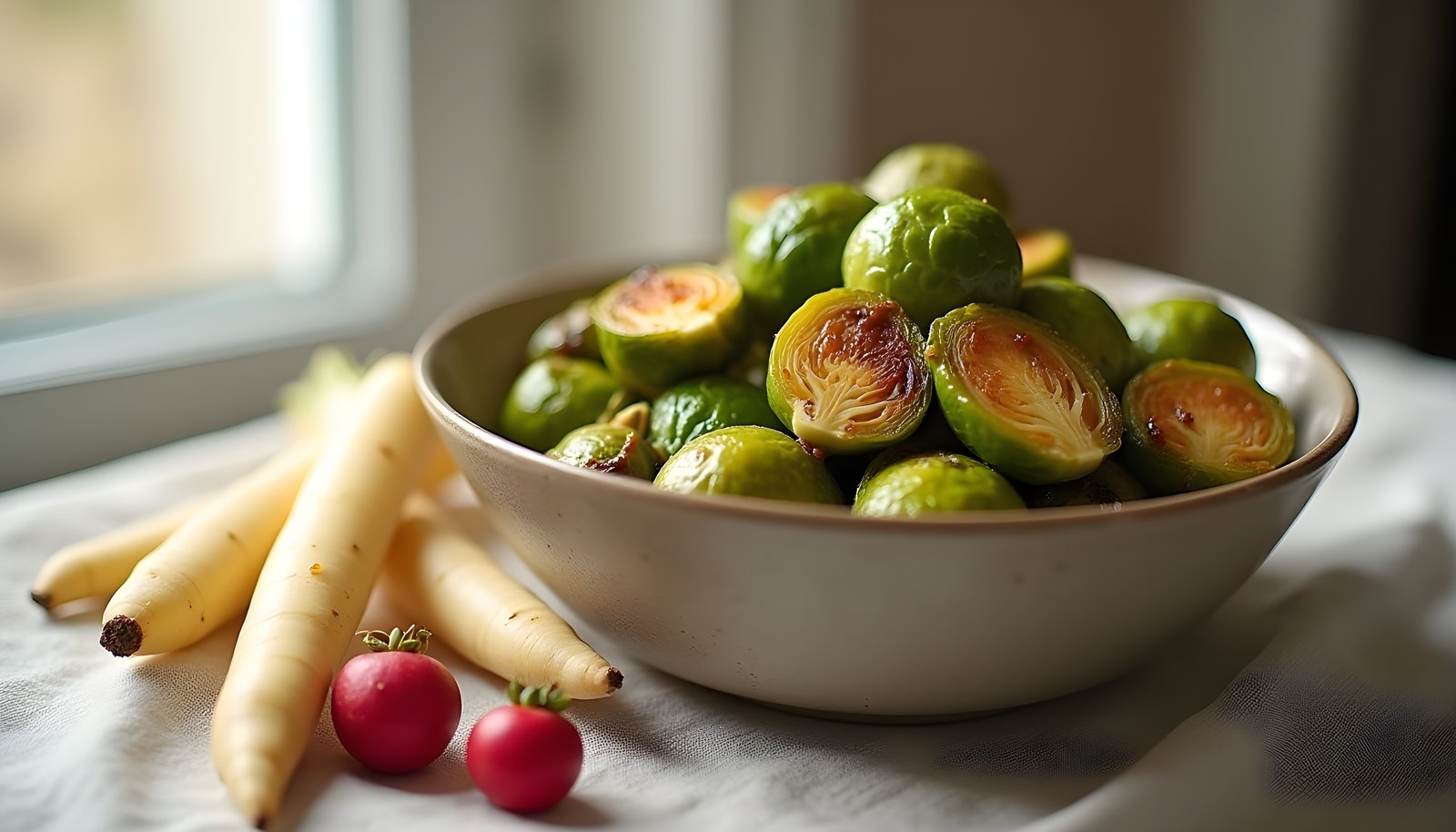
Brussels sprouts lead the whole list at about 4.6 grams of insoluble fiber per 100 grams raw. Around 87% of their fiber is the insoluble kind.
Broccoli follows at about 3.8 grams, with the same 87% insoluble share. Cauliflower lands at about 3.1 grams, and roughly 91% of its fiber is insoluble, one of the highest shares in the study.
Mayo Clinic names cauliflower among its examples of insoluble fiber foods. The Dietary Guidelines put a cooked cup of Brussels sprouts at 6.4 grams of total fiber and a cooked cup of broccoli at 5.2 grams.
Want more ways to cook Brussels sprouts and broccoli so they taste great? Our recipe eBooks are full of easy, high fiber vegetable sides.
Root vegetables pull their weight
Parsnips come second overall at about 4.3 grams per 100 grams raw. They’re denser than most vegetables, with more than 21% dry matter, so each bite carries more fiber.
Radishes reach about 4.0 grams, and roughly 93% of their fiber is insoluble, the highest share in the study. Swede, also called rutabaga, and tuberous parsley (Hamburg parsley root) both sit at about 3.8 to 3.9 grams.
Carrots and turnips add about 2.7 and 2.6 grams. Mayo Clinic also lists potatoes as an insoluble fiber vegetable, and the Dietary Guidelines give a medium baked potato with skin 3.9 grams of total fiber.
Celery, fennel and green beans for everyday crunch
Some of the most insoluble vegetables are the ones you already snack on. Raw celery carries about 3.1 grams of insoluble fiber per 100 grams, and about 86% of its fiber is the insoluble kind.
Fennel lands near 2.6 grams, with roughly 91% of its fiber insoluble. Shaved thin into a salad, it adds crunch and bulk with very few calories.
Green beans weren’t part of the lab study, but both Mayo Clinic and Cleveland Clinic name them as insoluble fiber foods. The Dietary Guidelines list a cooked cup at 4.0 grams of total fiber for just 44 calories.
These three are easy wins because they need little prep. Keep celery sticks in the fridge, toss fennel into slaws and add green beans to stir fries or sheet pan dinners.
What steaming does to insoluble fiber
The researchers steamed each vegetable for 20 to 30 minutes until fully cooked. Total fiber barely moved in most of them, but in 18 of the 29 vegetables part of the insoluble fiber shifted into the soluble column.
| Vegetable | Raw insoluble per 100 g | Steamed insoluble per 100 g |
|---|---|---|
| Brussels sprouts | 4.6 g | 3.9 g |
| Radish | 4.0 g | 3.5 g |
| Broccoli | 3.8 g | 3.3 g |
| Parsnip | 4.3 g | 2.9 g |
| Cauliflower | 3.1 g | 2.6 g |
| Swede | 3.8 g | 2.5 g |
| Carrot | 2.7 g | 2.4 g |
Not every vegetable shifted. Asparagus and Swiss chard kept essentially all of their insoluble fiber after steaming, while celery changed the most, with its soluble share jumping from about 14% to nearly half.
So cooking doesn’t destroy fiber. It moves some of it from the bulking side to the gel forming side.
For the most bulk, eat some vegetables raw or lightly cooked, like shaved Brussels sprouts, sliced radishes or crisp broccoli florets. Fully steamed vegetables still bring plenty, with a little more soluble fiber in the mix.
How vegetables compare with other digestive bulk foods
Vegetables aren’t the most concentrated insoluble fiber foods. The Dietary Guidelines list a half cup of high fiber bran cereal at 14 grams of total fiber and a half cup of navy beans at 9.6 grams.
| Food | Serving | Total fiber | Calories |
|---|---|---|---|
| Brussels sprouts, cooked | 1 cup | 6.4 g | 65 |
| Parsnips, cooked | 1 cup | 6.2 g | 110 |
| Broccoli, cooked | 1 cup | 5.2 g | 54 |
| Turnip greens, cooked | 1 cup | 5.0 g | 29 |
| Cauliflower, cooked | 1 cup | 4.9 g | 34 |
| Green beans, cooked | 1 cup | 4.0 g | 44 |
| Navy beans, cooked | 1/2 cup | 9.6 g | 128 |
What vegetables offer is fiber for very few calories. A cup of cooked cauliflower gives nearly 5 grams for 34 calories, which makes it easy to eat a lot of them alongside beans and whole grains.
Not sure how many grams your own day should include? Our fiber calculator works out a personal target in seconds.
Why insoluble fiber matters for colon health
Mayo Clinic explains that insoluble fiber helps material move through your digestive system and increases stool bulk. That can help if you deal with constipation or irregular stools.
Cleveland Clinic adds that insoluble fiber may lower the risk of hemorrhoids and of diverticulitis, an inflammation of small pouches in the colon wall. Harvard’s Nutrition Source recommends 25 to 35 grams of total fiber a day, while most Americans eat about 15.
Vegetables can close a good part of that gap. Three cooked cups across the day, chosen from the table above, add roughly 15 grams.
One dinner, two ways
Picture two plates. The first holds grilled chicken, white rice and a side salad of iceberg lettuce.
The second keeps the chicken but swaps in a cup of roasted Brussels sprouts and a cup of mashed parsnips. Using the Dietary Guidelines figures, that’s about 12.6 grams of fiber from the vegetables alone, much of it insoluble.
Same protein, same effort at the stove. The second plate simply puts the densest insoluble fiber vegetables where the filler used to be.
If your gut needs time to adjust to more roughage, our guides walk you through building it up step by step.
Easing into more roughage
Cleveland Clinic warns that adding too much fiber too fast can cause gas pain and bloating, and advises building up slowly. Add one extra vegetable serving a day for a week before adding another.
Mayo Clinic suggests drinking plenty of water as you eat more fiber. Cleveland Clinic explains that insoluble fiber absorbs fluid as it forms stool, so a glass of water with your vegetable heavy meals helps it do its job.
A quick rule for choosing your vegetables
- You want the most insoluble fiber per bite: pick Brussels sprouts, parsnips, radishes or broccoli.
- You want the most per calorie: pick cauliflower, cooked greens or green beans.
- You eat a lot of salad: add shaved Brussels sprouts or sliced radishes to the leaves.
- You prefer soft, cooked vegetables: steam or roast freely, and expect a little more soluble fiber in the mix.
- You need more bulk fast: pair vegetables with beans or bran cereal, since vegetables alone are lighter hitters.
Insoluble fiber vegetable questions
Which vegetable has the most insoluble fiber?
Brussels sprouts topped a 2017 study of 29 vegetables, with about 4.6 grams of insoluble fiber per 100 grams raw. Parsnips, radishes, broccoli and swede followed at around 4 grams.
Are leafy greens soluble or insoluble fiber?
Mostly insoluble. Swiss chard was about 72% insoluble fiber and endive about 88% in lab testing, though their high water content keeps grams per bite low.
Does cooking reduce insoluble fiber in vegetables?
Somewhat. Steaming shifted part of the insoluble fiber into soluble fiber in 18 of 29 vegetables tested, while total fiber stayed about the same.
Is broccoli soluble or insoluble fiber?
Mostly insoluble. About 87% of raw broccoli’s fiber was insoluble, or roughly 3.8 grams per 100 grams.
Do carrots have insoluble fiber?
Yes. Raw carrots had about 2.7 grams of insoluble fiber per 100 grams, close to 80% of their total fiber.
Are insoluble fiber vegetables good for constipation?
Yes, they can help. Insoluble fiber adds bulk to stool and helps material move through the digestive system, according to Mayo Clinic.
Is spinach high in insoluble fiber?
It’s a decent source once cooked. A cooked cup of spinach has about 4.3 grams of total fiber, because cooking packs many cups of raw leaves into one serving.
Sources
- Kalala G, Kambashi B, Everaert N, et al. “Characterization of fructans and dietary fibre profiles in raw and steamed vegetables.” International Journal of Food Sciences and Nutrition, 2017. sites.uclouvain.be
- Mayo Clinic Staff. “Dietary fiber: Essential for a healthy diet.” Mayo Clinic, 2024. mayoclinic.org
- Cleveland Clinic. “What’s the Difference Between Soluble and Insoluble Fiber?” Health Essentials, 2021. health.clevelandclinic.org
- Dietary Guidelines for Americans. “Food Sources of Dietary Fiber.” 2020. dietaryguidelines.gov
- Harvard T.H. Chan School of Public Health. “Fiber.” The Nutrition Source, 2022. nutritionsource.hsph.harvard.edu