
In this article
- Why bananas and plantains stand alone
- Resistant starch fruits and forms compared
- Ripeness, variety and the yellow banana question
- Myth vs fact: cooking wipes out the resistant starch
- Green banana flour: the easiest way in
- How other fruits compare: fiber without the starch
- What resistant starch fruits do for your gut
- Easy ways to eat more green bananas and plantains
- How much resistant starch to aim for
- Choosing your fruit for resistant starch
- The edge case: fully ripe and baked bananas
- Resistant starch and fruit: common questions
- Sources
You slice a banana over your cereal every morning and figure your gut bacteria are getting a treat. Whether they are depends on the color of the peel, because the best resistant starch fruits are green bananas and plantains, and they’re almost the only fruits that supply it in meaningful amounts.
In a 2024 lab study, raw unripe banana held about 24 grams of resistant starch per 100 grams of dry weight. Apples, berries and pears are excellent fiber foods, but they aren’t where resistant starch comes from.
Why bananas and plantains stand alone
Resistant starch is starch that slips past digestion in your small intestine and reaches the large intestine intact. Cleveland Clinic explains that it feeds the helpful bacteria there, which is why it’s often called a prebiotic starch.
Cleveland Clinic sorts resistant starch into four types. Unripe bananas carry type 2, the raw, tightly packed starch granules your enzymes struggle to break down.
Most fruits you eat ripe are sweet rather than starchy, so they offer little starch to resist digestion in the first place. Bananas and plantains are different, especially before they ripen, because their pulp is packed with starch.
A 2020 study by Borges and colleagues in Food Research International found total starch in unripe banana and plantain pulp ranged from about 42% to 81% of dry weight, depending on the variety. Plantains and cooking bananas carried the most.
Resistant starch fruits and forms compared
Published data on fruit and resistant starch is thin, and nearly all of it covers bananas. Here’s what the studies used in this article actually measured:
| Fruit or form | Resistant starch | Basis | Study |
|---|---|---|---|
| Unripe banana, raw | 23.9 g per 100 g | Dry weight | Karunarathna 2024 |
| Nam-wa banana, across ripeness stages | 20 to 25 g per 100 g | Dry weight | Chaipai 2018 |
| Unripe banana, boiled 15 min | 17.8 g per 100 g | Dry weight | Karunarathna 2024 |
| Unripe banana, boiled 45 min | 4.8 g per 100 g | Dry weight | Karunarathna 2024 |
| Pancake made with green banana flour | 1.78 g per 100 g | As eaten | Hareer 2024 |
Dry weight figures look big because the water has been removed. They’re useful for comparing one banana sample with another, not for counting grams on your plate.
The green banana flour pancake is the only fruit based food in the list measured as eaten. At 1.78 grams per 100 grams, it beat wholemeal bread in the same Australian study.
Ripeness, variety and the yellow banana question
Cleveland Clinic points to unripe bananas as the resistant starch source. As a banana ripens it turns softer and sweeter, and the cooking studies here focus on the green stage.
One Thai study adds a twist. Chaipai and colleagues measured Nam-wa bananas, a common Southeast Asian variety, and found resistant starch held at about 20 to 25 grams per 100 grams of dry weight across the ripening stages they tested, with no significant change.
That doesn’t mean every yellow banana is a resistant starch food. It does mean variety matters, and that cooking bananas and plantains, which stay starchy longer, may be a more reliable choice than dessert bananas.
The Borges team also reported that plantains and cooking bananas had the most starch and resistant starch at the stage they described as green with yellow traces. That gives you a handy cue at the store: look for peels that are mostly green and only just starting to turn.
Want more ways to cook with plantains and green bananas? Our recipe eBooks are full of easy, high fiber dishes.
Myth vs fact: cooking wipes out the resistant starch
Myth: Once you cook a banana or plantain, the resistant starch is gone.
Fact: It depends on how, and for how long. In the Karunarathna study, 15 minutes of boiling left unripe banana at 17.8 grams per 100 grams of dry weight, about three quarters of the raw amount.
Longer cooking was the problem. After 45 minutes of boiling the figure dropped to 4.8 grams, and 15 minutes of pressure cooking cut it to about 4 grams.
The method mattered in the Chaipai study too. Boiled bananas kept more resistant starch than roasted ones, and letting roasted bananas cool for two hours raised their resistant starch again.
Boiling also gave a gentler blood sugar profile. The boiled bananas had an estimated glycemic index, a measure of how quickly a food raises blood sugar, of 34 to 56, compared with 53 to 56 for roasted bananas.
Green banana flour: the easiest way in
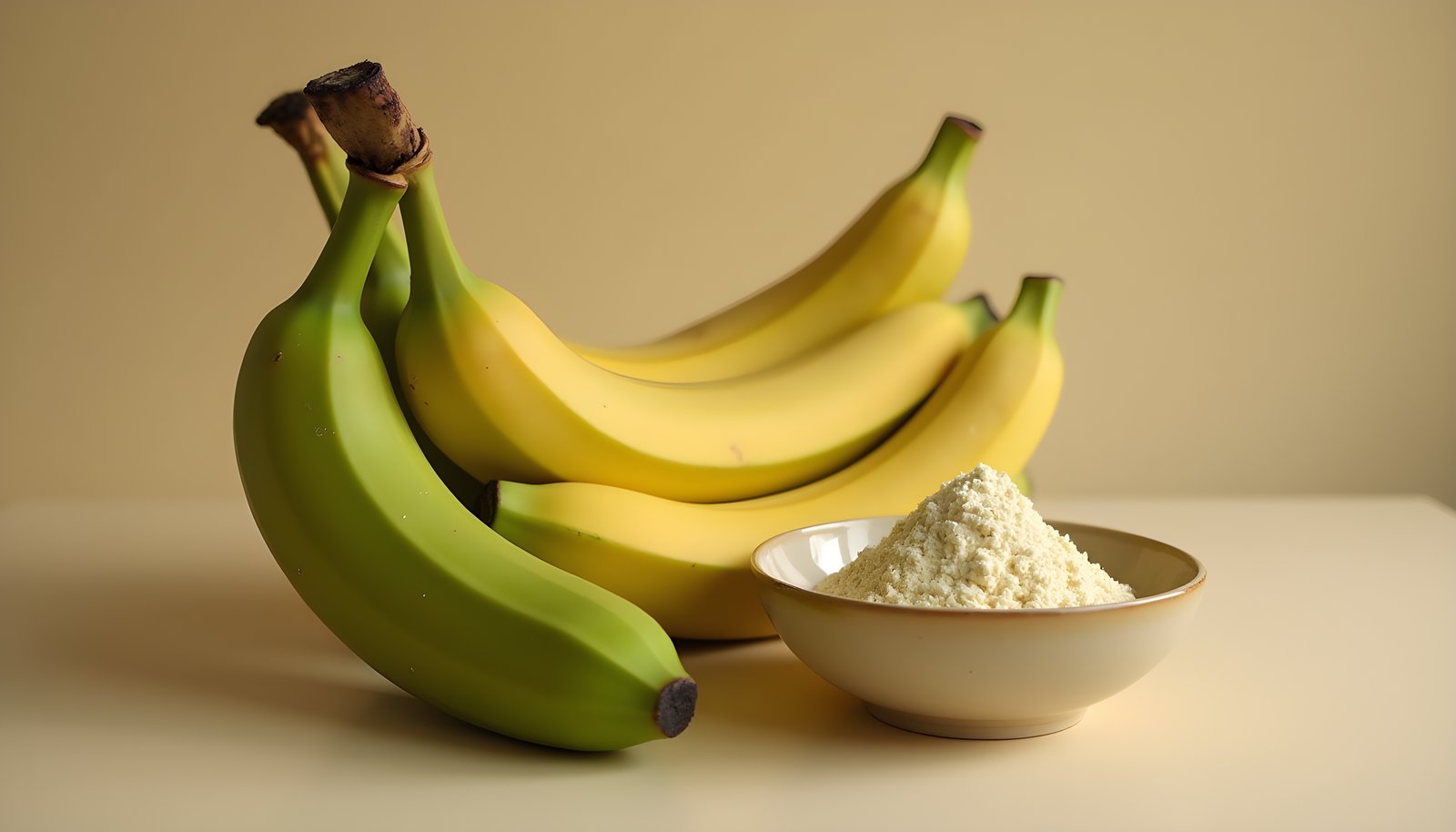
If you don’t enjoy the firm, slightly chalky bite of a green banana, the flour is a practical swap. It’s made from dried unripe bananas and works in pancakes, muffins and quick breads.
The Hareer study measured a pancake made with green banana flour at 1.78 grams of resistant starch per 100 grams as eaten. That’s from a cooked food, so it reflects what actually survives the pan.
Swapping part of your usual flour for green banana flour is an easy test. Start with a quarter of the flour in a recipe and see how you like the texture.
How other fruits compare: fiber without the starch
Other fruits still matter for your gut, just through regular fiber rather than resistant starch. The Dietary Guidelines list these amounts:
| Fruit | Serving | Total fiber | Calories |
|---|---|---|---|
| Raspberries | 1 cup | 8.0 g | 64 |
| Blackberries | 1 cup | 7.6 g | 62 |
| Pear | 1 medium | 5.5 g | 103 |
| Apple, with skin | 1 medium | 4.8 g | 104 |
| Orange | 1 medium | 3.7 g | 73 |
| Banana | 1 medium | 3.2 g | 112 |
A ripe banana has less total fiber than a pear or a cup of berries. A slightly green one brings resistant starch on top of that fiber, which is what earns it the top spot here.
The smartest fruit plan uses both. Pair a green tipped banana with a handful of raspberries and you get resistant starch and plenty of regular fiber in one bowl.
What resistant starch fruits do for your gut
Cleveland Clinic links resistant starch with better blood sugar management and improved gut and microbiome health. Because bacteria in the large intestine ferment it, it acts as food for the microbes rather than for you.
It may also help you feel full for longer, which Cleveland Clinic notes may contribute to some weight loss. A green banana brings that effect in a portable, ready to eat form.
Those benefits come from regular intake, not one banana. Treat green bananas and plantains as an everyday ingredient rather than an occasional extra.
Easy ways to eat more green bananas and plantains
- Slice a firm, green tipped banana over oatmeal or yogurt instead of a spotty one.
- Boil peeled green plantain for about 15 minutes, then mash it with olive oil and garlic.
- Add chunks of green banana to curries and stews near the end of cooking so they don’t simmer too long.
- Roast plantain slices, then let them cool before adding them to a grain bowl.
- Mix green banana flour into pancake or muffin batter for part of the regular flour.
Each idea keeps cooking short or adds a cooling step, the two habits the research supports. Pick one and work it into your week.
How much resistant starch to aim for
A Cleveland Clinic dietitian notes that most people in the U.S. get only about 5 grams of resistant starch a day, and suggests aiming for at least 6 grams per meal.
Fruit alone won’t get you there easily. The green banana flour pancake would need more than 300 grams to reach 6 grams, so think of fruit as one contributor rather than the whole plan.
Beans fill the gap well. In the same Australian study, kidney beans held about 3.2 grams per 100 grams as eaten, nearly twice the banana pancake.
Not sure how much total fiber you need each day? Our fiber calculator gives you a personal target in seconds.
Choosing your fruit for resistant starch
- For the most resistant starch: eat bananas while the peel is still green or green tipped.
- For cooking: choose plantains or cooking bananas and boil them briefly rather than for a long time.
- For baking: replace part of the flour with green banana flour.
- For roasted bananas: let them cool before eating to recover some resistant starch.
- For overall fruit fiber: add berries, pears and apples alongside your banana.
If your gut is new to fermentable foods, our guides walk you through adding them gradually.
The edge case: fully ripe and baked bananas
The bananas many people eat most are the ones least likely to supply resistant starch. Spotty bananas in smoothies and banana bread are at their sweetest, softest stage, and baking adds a long stretch of heat.
None of the studies here measured banana bread or frozen ripe bananas, so there’s no reliable number for them. If resistant starch is your goal, keep a second bunch on the counter and eat a couple while they’re still firm and green tipped.
Resistant starch and fruit: common questions
Which fruit has the most resistant starch?
Green bananas and plantains. Raw unripe banana tested at about 24 grams of resistant starch per 100 grams of dry weight, far more than any other common fruit is known to supply.
Do ripe bananas have resistant starch?
Probably less than green ones, though the evidence is mixed. One study of Thai Nam-wa bananas found levels stayed similar across ripeness, so variety matters.
Do plantains have resistant starch?
Yes. Plantains and cooking bananas carried the most starch in a 2020 study of unripe banana varieties, which makes them strong resistant starch fruits.
Does cooking bananas destroy resistant starch?
Not always. Boiling unripe banana for 15 minutes kept about three quarters of it, but 45 minutes of boiling cut it to about a fifth.
Is green banana flour high in resistant starch?
Yes, for a cooked food. A pancake made with green banana flour held about 1.8 grams of resistant starch per 100 grams as eaten, more than wholemeal bread.
Do apples or berries have resistant starch?
Not in meaningful amounts. They’re valued for regular fiber instead, with a cup of raspberries giving about 8 grams of total fiber.
How much resistant starch should you eat?
Most people in the U.S. get about 5 grams a day. A Cleveland Clinic dietitian suggests aiming for at least 6 grams per meal from foods like green bananas and beans.
Sources
- Cleveland Clinic. “Are Foods With Resistant Starch Good for You?” Health Essentials, 2025. health.clevelandclinic.org
- Karunarathna S, et al. “Investigating the impact of boiling and pressure cooking on resistant starch levels in food.” International Journal of Food Science and Technology, 2024. academic.oup.com
- Chaipai S, Kriangsinyot W, Srichamnong W. “Effects of ripening stage and cooking methods on available glucose, resistant starch and estimated glycemic index of bananas (Musa sapientum; Nam-wa variety).” Malaysian Journal of Nutrition, 2018. nutriweb.org.my
- Borges CV, Maraschin M, Coelho DS, et al. “Nutritional value and antioxidant compounds during the ripening and after domestic cooking of bananas and plantains.” Food Research International, 2020. agris.fao.org
- Hareer LW, Tran C, O’Neill HM, Genoni A. “Resistant starch content of Australian foods.” International Journal of Food Science and Technology, 2024. academic.oup.com
- Dietary Guidelines for Americans. “Food Sources of Dietary Fiber.” 2020. dietaryguidelines.gov