
In this article
- What makes a vegetable feed your gut bacteria
- The two week vegetable experiment
- What happened to their gut bacteria
- The results that stayed flat
- An unexpected effect on cravings
- Prebiotic fiber vegetables ranked by fructans
- Why variety may matter as much as dose
- Prebiotic vegetables vs other foods for microbiome health
- What a prebiotic vegetable week can look like
- Where the evidence runs out
- How to pick your prebiotic vegetables
- What people ask about prebiotic vegetables
- Sources
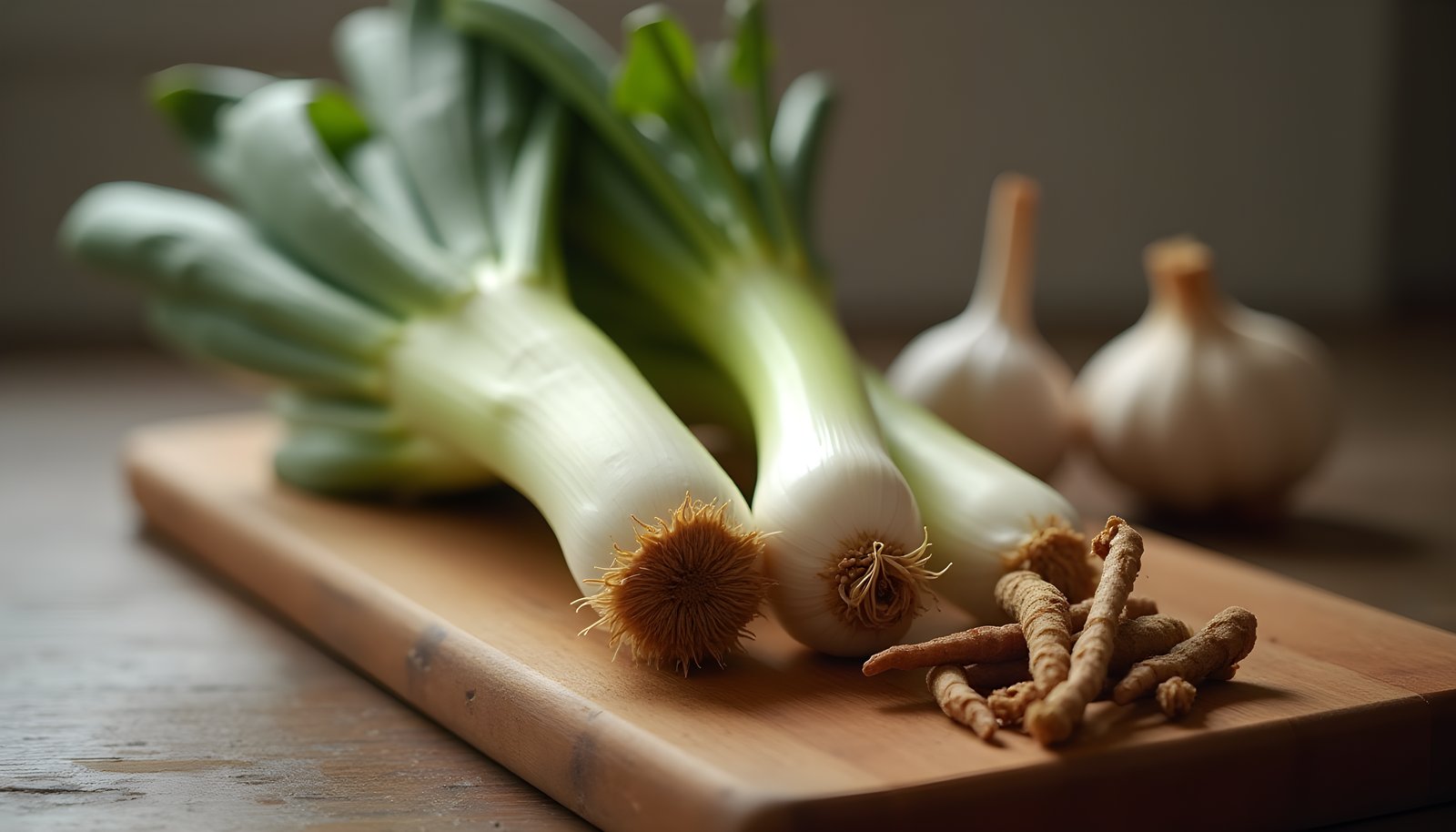
A lot of people assume that changing your gut bacteria takes a probiotic capsule or a pricey powder. Ordinary prebiotic fiber vegetables did it in a 2019 Belgian trial: salsify, artichokes, Jerusalem artichokes, leeks, onions and garlic raised levels of Bifidobacterium, a group of bacteria widely seen as beneficial, about threefold in two weeks.
Those vegetables share one thing, a family of fibers called inulin type fructans. Below you’ll find what that trial actually measured, which vegetables carry the most of these fibers, and why variety across the week matters too.
What makes a vegetable feed your gut bacteria
Most fiber passes through your small intestine untouched. Some of it is fermentable, meaning bacteria in your colon break it down for fuel.
Harvard’s Nutrition Source describes certain fibers as prebiotics, or food for gut bacteria, which ferment them into short chain fatty acids. Those small compounds are one reason fiber is linked with healthy colonies of gut bacteria and with anti-inflammatory effects.
Among vegetables, the best studied prebiotic fibers are inulin and its shorter relatives, grouped together as fructans. Harvard names onions, chicory root, asparagus and Jerusalem artichokes as sources of this fiber family.
The two week vegetable experiment
The study, led by Sophie Hiel at UCLouvain and published in the American Journal of Clinical Nutrition, recruited 26 healthy young adults with an average age of about 22. Twenty five finished, and 24 had their gut bacteria analyzed.
For two weeks, each person ate a hot weekday lunch at the university and a vegetable soup at home for dinner, with take home trays on weekends. The dishes were built around salsify, Jerusalem artichoke, globe artichoke, leek, onion, garlic and scorzonera (black salsify).
Everything else they ate was up to them. The design was simple on purpose: real meals, familiar vegetables, no supplements.
| Daily intake | Before | During the two weeks | Three weeks after |
|---|---|---|---|
| Fructans | about 3.1 g | about 15.7 g | about 2.7 g |
| Total fiber | about 18 g | about 31 g | about 17 g |
The vegetable meals took total fiber from well under the usual 25 to 35 gram target to just inside it. Calories, protein, fat and carbohydrate intake stayed the same, and so did body weight.
Not sure where your own day lands on fiber? Our fiber calculator gives you a personal target in a few seconds.
What happened to their gut bacteria
By day 14, Bifidobacterium had risen about 3.8-fold by gene sequencing and about 3.0-fold by a second lab method called qPCR. One species in particular, Bifidobacterium longum, went up.
Other groups shifted as well. Unclassified Clostridiales, Alistipes and Oscillibacter dropped, while Prevotellaceae increased.
| Measure | After two weeks of vegetables |
|---|---|
| Bifidobacterium | Up about 3 to 3.8 times |
| Bifidobacterium longum | Up |
| Unclassified Clostridiales | Down |
| Alistipes and Oscillibacter | Down |
| Prevotellaceae | Up |
| Number of species detected | Down slightly |
| Overall community structure | No significant change |
That species count result surprises people. A strong dose of one fiber type favored the bacteria that specialize in it, so the community became a little less varied rather than more.
The results that stayed flat
Stool frequency, stool consistency and gut transit time didn’t change. If you’re hoping prebiotic vegetables alone will fix constipation, this trial doesn’t show that.
The one symptom that rose was flatulence, during the two weeks of the diet. Other digestive symptoms tracked day by day held steady, and on the follow up test day, discomfort scores were actually lower than at the start.
Breath hydrogen, a rough marker of fermentation, didn’t change either. That fits the fact that every volunteer had been screened as a hydrogen producer before joining.
An unexpected effect on cravings
The appetite findings may be the most interesting part of the study. After two weeks, volunteers reported feeling fuller, and their desire for sweet and salty foods dropped.
Three weeks after the diet ended, the lower cravings were still there, and the wish for very sweet and fatty food was significantly reduced. Liking for salsify also trended upward, which hints that familiarity plays a part.
The bacteria told a different story. By that three week check, Bifidobacterium and most other shifts had drifted back to where they started.
So the microbial benefit lasts about as long as the habit does. Prebiotic vegetables work better as a regular part of your week than as a two week cleanse.
Want simple ways to make leek soup or roasted artichokes a weekly thing? Our recipe eBooks are full of easy, high fiber vegetable dishes.
Prebiotic fiber vegetables ranked by fructans
The Belgian group also measured fructans in raw vegetables in a separate 2017 study by Kalala and colleagues. The four leaders all appeared on the trial menu.
| Vegetable, raw | Fructans per 100 g fresh | On the trial menu? |
|---|---|---|
| Salsify | 15.6 g | Yes |
| Globe artichoke | 13.1 g | Yes |
| Jerusalem artichoke (sunchoke) | 11.6 g | Yes |
| Onion | 4.5 g | Yes |
Leeks came in much lower, at roughly 3 grams per 100 grams of dry matter (the weight left once water is removed). Carrots, parsnips and Brussels sprouts held 2 grams or less on that same dry basis.
Kalala’s team also found that steaming left fructan levels largely intact. Soups, steamed sides and braises all keep their prebiotic value.
Garlic and scorzonera were on the trial menu but weren’t among the vegetables with fresh weight figures in that table. They still count, just without a precise gram number here.
Onion’s lower figure is offset by how often it gets eaten. A little goes into almost every savory dish, so small amounts add up over a week.
Why variety may matter as much as dose
One fiber family can boost one group of bacteria. A broader mix of plants seems to support a broader mix of microbes.
The American Gut Project, a citizen science study of more than 11,000 people published in mSystems in 2018, compared diets by plant variety. People who ate more than 30 different plant types a week (41 people) had more diverse gut microbiomes than people who ate 10 or fewer (44 people).
The high variety group also carried fewer antibiotic resistance genes in their gut bacteria. This was an observational finding from self reported diets, so it shows a link rather than proof of cause.
Put the two studies side by side and a practical pattern emerges. A few fructan rich vegetables give targeted fuel, and a wide spread of other plants keeps the rest of the community fed.
Prebiotic vegetables vs other foods for microbiome health
Vegetables aren’t the only microbiome foods. Harvard lists several fermentable fibers, each with its own main sources:
| Fermentable fiber | Main food sources | Notes |
|---|---|---|
| Inulin type fructans | Onions, chicory root, asparagus, Jerusalem artichokes | The fiber behind the Belgian trial |
| Beta-glucans | Oats and barley | Soluble and highly fermentable |
| Pectins | Apples, berries and other fruits | Soluble and highly fermentable |
| Resistant starch | Legumes, unripe bananas, cooked and cooled pasta and potatoes | Starch that escapes digestion |
Vegetables bring fructans in small, low calorie portions along with other nutrients. Combining them with oats, fruit and beans covers all four families in one ordinary day of eating.
What a prebiotic vegetable week can look like
Picture a week where you don’t overhaul anything, you just tilt a few meals toward the trial vegetables. It could look like this:
- Monday: leek and potato soup, with the potatoes cooled and reheated for a little resistant starch.
- Tuesday: steamed globe artichoke as a starter before dinner.
- Wednesday: sunchokes simmered with onion into a creamy soup.
- Thursday: a stir fry that starts with plenty of garlic and onion.
- Friday: salsify or scorzonera, peeled and sautéed like parsnips.
- Weekend: a big tray of mixed roasted vegetables, counting each type toward your 30.
That’s not a lab diet, and it won’t match the trial’s 15 grams of fructans a day. It does put the same vegetables on your plate several times a week, which is the habit the bacteria responded to.
Each different vegetable in that plan also counts toward a weekly plant tally, so the same meals push both fructans and variety in the right direction.
If your stomach reacts to onions or sunchokes, our guides walk you through building up fermentable fiber in small steps.
Where the evidence runs out
The Hiel trial had no control group, so each person served as their own comparison. It was also small, involved only young, healthy, normal weight adults, and only included people who produce hydrogen on a breath test.
The authors were clear that the study doesn’t prove the bacterial changes caused any health benefit. Older adults, people with digestive conditions or people with overweight may respond differently.
The lab fermentation tests covered only six of the volunteers, and the questionnaires used for mood and eating behavior had low reliability. Treat the craving results as promising rather than settled.
How to pick your prebiotic vegetables
A few simple rules cover most situations:
- If you want the biggest fructan dose per bite, pick salsify, globe artichoke or sunchokes.
- If you want something you’ll actually eat every day, lean on onions, leeks and garlic as the base of soups and sauces.
- If gas is your main worry, start with small portions of onion and leek before trying sunchokes or artichokes.
- If you already eat these often, chase variety next and count how many different plants reach your plate each week.
What people ask about prebiotic vegetables
Which vegetable has the most prebiotic fiber?
Raw salsify leads, with about 15.6 grams of fructans per 100 grams in Belgian lab testing. Globe artichoke (13.1 grams) and Jerusalem artichoke (11.6 grams) are close behind.
How fast do prebiotic vegetables change gut bacteria?
In the 2019 Hiel trial, Bifidobacterium rose about threefold within two weeks. Most of those shifts faded within three weeks of returning to a normal diet.
Are prebiotic vegetables the same as probiotics?
No. Probiotics are live bacteria, while prebiotic vegetables supply fiber that feeds the bacteria already living in your colon.
Do cooked vegetables still count as prebiotic?
Yes. Lab testing by Kalala and colleagues found steaming kept fructan levels largely intact, and the Belgian trial served its vegetables cooked in lunches and soups.
Will prebiotic vegetables help with constipation?
Not necessarily. Stool frequency, consistency and transit time didn’t change in the two week vegetable trial, even though fiber intake roughly doubled.
Why do prebiotic foods cause gas?
Gut bacteria produce gas as they ferment fructans. Flatulence was the one symptom that increased during the trial, and discomfort scores were lower than baseline three weeks later.
How many different plants should I eat for colon health?
The American Gut Project linked eating more than 30 plant types a week with a more diverse microbiome than eating 10 or fewer. That’s an observational link, but it’s an easy target to track.
Sources
- Hiel S, Bindels LB, Pachikian BD, et al. “Effects of a diet based on inulin-rich vegetables on gut health and nutritional behavior in healthy humans.” American Journal of Clinical Nutrition, 2019. sites.uclouvain.be
- Kalala G, Kambashi B, Everaert N, et al. “Characterization of fructans and dietary fibre profiles in raw and steamed vegetables.” International Journal of Food Sciences and Nutrition, 2017. sites.uclouvain.be
- McDonald D, Hyde E, Debelius JW, et al. “American Gut: an Open Platform for Citizen Science Microbiome Research.” mSystems, 2018. doaj.org
- UC San Diego Jacobs School of Engineering. “What’s in Your Gut?” 2018. jacobsschool.ucsd.edu
- Harvard T.H. Chan School of Public Health. “Fiber.” The Nutrition Source, 2022. nutritionsource.hsph.harvard.edu