
In this article
- Do cherries have fiber? Grams per cherry and per cup
- Are cherries high in fiber?
- Sweet vs tart cherries
- Dried and canned cherries: where the fiber goes
- How cherries compare with other fruits
- What else cherries bring
- How many cherries does it take?
- Checklist: getting the most fiber from cherries
- What researchers are still learning about cherries
- Cherry fiber: common questions
- Sources
Dried fruit has a reputation as concentrated fiber. With cherries, that reputation falls apart: a quarter cup of sweetened dried tart cherries gives you about 1 gram of fiber, along with 27 grams of sugar.
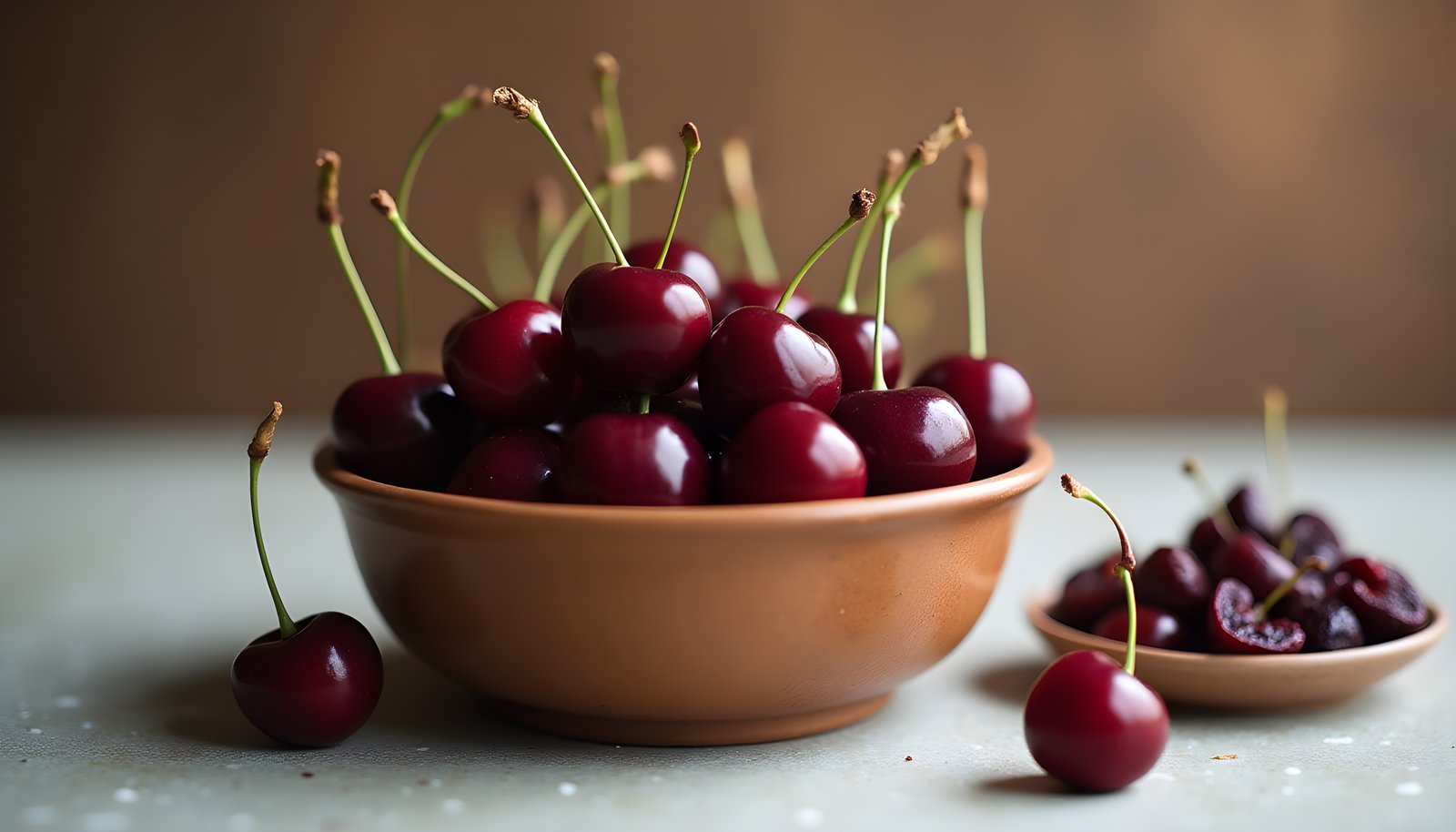
So do cherries have fiber? Fresh ones do. A cup of pitted sweet cherries has about 3.2 grams, according to USDA FoodData Central, which is a solid amount for under 100 calories.
Below you’ll find the numbers per cherry, cup and form, how cherries rank against other fruit, and what the research on cherries actually shows.
Do cherries have fiber? Grams per cherry and per cup
USDA lists raw sweet cherries at 2.1 grams of fiber per 100 grams, with about 82% water. Here’s how that adds up in the servings you’re likely to eat:
| Sweet cherries, raw | Weight | Fiber | Calories |
|---|---|---|---|
| 1 cherry | 8.2 g | 0.2 g | 5 |
| 10 cherries | 82 g | 1.7 g | 52 |
| 1 cup with pits | 138 g | 2.9 g | 87 |
| 1 cup pitted | 154 g | 3.2 g | 97 |
One cup of pitted sweet cherries covers about 11% of the 28 gram Daily Value. A single cherry is a rounding error on its own, which is why handfuls matter more than counting.
The cup measurement makes a difference, too. A cup of whole cherries with pits holds less fruit than a cup of pitted halves, so it comes in about 0.3 grams lower.
Are cherries high in fiber?
Not especially. Cherries sit in the middle of the fruit pack: better than a few, well behind the leaders.
Per calorie, you get about 3.3 grams of fiber for every 100 calories of sweet cherries. Berries like raspberries deliver roughly four times that ratio, because they pack more fiber into fewer calories.
Cherries are naturally sweet, with about 12.8 grams of sugar per 100 grams. That’s part of their appeal, and it’s also why the fiber per bite stays modest.
Sweet vs tart cherries
Cleveland Clinic dietitian Carly Sedlacek notes that more than 1,000 cherry varieties grow in the U.S., and they fall into two groups: sweet, like Bing, and tart, like Montmorency.
| Raw, 1 cup pitted | Weight | Fiber | Calories | Sugars |
|---|---|---|---|---|
| Sweet cherries | 154 g | 3.2 g | 97 | 19.7 g |
| Tart (sour) red cherries | 155 g | 2.5 g | 78 | 13.2 g |
Sweet cherries have a little more fiber per cup, while tart cherries are lower in sugar and calories. Tart cherries also bring more vitamin A, about 99 micrograms per cup, or 11% of the Daily Value.
Cleveland Clinic notes that cherries are also sold frozen, dried, canned, juiced and as jams. That’s where the fiber picture shifts.
Dried and canned cherries: where the fiber goes
Here’s how processed cherries compare with fresh ones, using USDA figures:
| Cherry form | Serving | Fiber | Calories | Sugars |
|---|---|---|---|---|
| Sweet, raw, pitted | 1 cup (154 g) | 3.2 g | 97 | 19.7 g |
| Tart, dried, sweetened | 1/4 cup (40 g) | 1.0 g | 133 | 26.9 g |
| Sweet, canned in extra heavy syrup | 1 cup (261 g) | 3.9 g | 266 | not listed |
Sweetened dried tart cherries have only 2.5 grams of fiber per 100 grams, barely more than fresh sweet cherries at 2.1. Drying removes water, but these cherries are also sweetened, so much of what’s left is sugar: about 67 grams per 100 grams.
Look at it per calorie and the gap is huge. Fresh sweet cherries give you about 3.3 grams of fiber per 100 calories, while sweetened dried tart cherries give you about 0.75.
Canned cherries in heavy syrup look better on fiber per cup, because a cup holds more fruit. But they cost you nearly three times the calories of fresh cherries.
Sedlacek’s advice for packaged cherries: check labels for added sugar, and look for terms like packed in 100% juice, unsweetened or no sugar added.
How cherries compare with other fruits
To see where cherries land, here’s a cup of pitted sweet cherries next to common fruit servings from the Dietary Guidelines list of fiber sources:
| Fruit and serving | Fiber | Calories |
|---|---|---|
| Raspberries, 1 cup | 8.0 g | 64 |
| Blackberries, 1 cup | 7.6 g | 62 |
| Pear, 1 medium | 5.5 g | 103 |
| Apple, 1 medium | 4.8 g | 104 |
| Orange, 1 medium | 3.7 g | 73 |
| Blueberries, 1 cup | 3.6 g | 84 |
| Sweet cherries, 1 cup pitted (USDA) | 3.2 g | 97 |
| Banana, 1 medium | 3.2 g | 112 |
| Strawberries, 1 cup | 3.0 g | 49 |
A cup of cherries ties a banana on fiber with fewer calories, and edges out a cup of strawberries. A pear or a cup of raspberries, though, will give you far more.
None of that means you should swap cherries out. If they’re the fruit you actually enjoy, a cup alongside a second, higher fiber fruit later in the day gives you the flavor you want and a better total.
Wondering how many grams of fiber you should be aiming for? Our fiber calculator gives you a personal daily target in a few seconds.
What else cherries bring
Cherries are rich in anthocyanins and polyphenols, plant compounds with antioxidant properties. Sedlacek explains that antioxidants help protect against inflammation and fight free radicals, which can damage cells.
A cup of pitted sweet cherries also provides about 342 milligrams of potassium according to USDA, about 7% of the Daily Value, with almost no sodium. Sedlacek notes that high potassium, low sodium foods can help lower blood pressure when eaten in moderation.
Cherries have a low glycemic index, and Cleveland Clinic says the fiber in their skin helps slow how quickly their sugar is absorbed. That holds for fresh cherries, not ones canned in syrup.
Beyond potassium, a cup of pitted sweet cherries has about 11 milligrams of vitamin C, roughly 12% of the Daily Value. Cleveland Clinic adds that cherries contain plant sterols, another reason they fit into a heart friendly eating pattern.
The blood sugar research is early but interesting. In one study cited by Cleveland Clinic, people with diabetes who drank about 1.35 ounces of concentrated sour cherry juice daily for six weeks saw significant drops in blood sugar. Sedlacek still advises moderation, since cherries are a source of carbohydrates.
If you’re adding fruit to support digestion, our gut health guides show you how to build up fiber at a comfortable pace.
How many cherries does it take?
To get the full 28 grams of fiber from sweet cherries alone, you’d need about 1,330 grams, or roughly 160 cherries. Nobody should try that, and you don’t need to.
Sedlacek suggests aiming for one cup of fresh cherries a day, or a quarter cup of dried. The fresh cup gives you about 3.2 grams of fiber; the dried quarter cup about 1 gram.
Mixing fruit is the easier route. A cup of cherries plus a cup of raspberries gives you about 11.2 grams of fiber, which is 40% of the Daily Value in one big bowl.
One review cited by Cleveland Clinic linked eating at least 45 cherries a day with lower inflammation. That’s about 370 grams, which would also bring roughly 7.7 grams of fiber and 230 calories.
Sedlacek points out that at that amount, people who are sensitive to salicylates, natural compounds found in cherries, may get an upset stomach. A cup a day is a more comfortable target for most people.
Checklist: getting the most fiber from cherries
- Choose fresh cherries over sweetened dried ones when fiber is the goal.
- Eat cherries whole with the skin, which Cleveland Clinic says holds fiber that helps slow sugar absorption.
- Pair a cup of cherries with Greek yogurt and a tablespoon of chia seeds for a bigger fiber boost.
- Toss pitted cherries into oatmeal or a salad with spinach and nuts.
- Read labels on canned cherries and pick ones packed in 100% juice or labeled no sugar added.
- Mix cherries with raspberries or blackberries to raise the fiber in a fruit bowl.
Want more ways to cook and bake with fruit like cherries? Our recipe eBooks are full of easy, high-fiber ideas.
What researchers are still learning about cherries
Most of the excitement around cherries isn’t about fiber. It’s about their other compounds, and the research is promising but early.
Gout is where interest runs highest. A 2017 survey cited by Cleveland Clinic found that as many as 1 in 4 people with gout eat cherries or use cherry juice or extract.
In a study of more than 600 people with gout cited by Cleveland Clinic, those who ate fresh cherries over two days had about 33% fewer flare ups. Among those who also took gout medication, flare ups dropped by 75%.
Other studies suggest tart cherries may help with sleep through melatonin and tryptophan, and with muscle soreness after running. In one, runners who took tart cherry powder for 10 days before a half marathon finished 13% faster than a placebo group.
Researchers are also looking at cherries and cancer, pointing to anthocyanins, melatonin and other bioactive compounds, though Cleveland Clinic gives no firm numbers yet.
Sedlacek prefers whole cherries over supplements. As those studies grow, fresh cherries remain the version that gives you fiber, too.
Cherry fiber: common questions
Are cherries high in fiber?
Not especially. A cup of pitted sweet cherries has about 3.2 grams, roughly 11% of the Daily Value, which puts cherries in the middle of the fruit range.
How much fiber is in 10 cherries?
About 1.7 grams. Ten sweet cherries weigh about 82 grams and have roughly 52 calories.
Do dried cherries have more fiber than fresh?
Not per serving. A quarter cup of sweetened dried tart cherries has about 1 gram of fiber and 133 calories, while a cup of fresh sweet cherries has 3.2 grams for 97 calories.
Do tart cherries have fiber?
Yes. A cup of pitted raw tart cherries has about 2.5 grams of fiber and 78 calories, slightly less fiber than sweet cherries but also less sugar.
Are cherries good for constipation?
They can help a little. Cherries add some fiber and a lot of water, but for a bigger effect pair them with higher fiber foods like raspberries, pears, beans or whole grains.
How much fiber is in one cherry?
About 0.2 grams. A single sweet cherry weighs around 8.2 grams and has roughly 5 calories, so it takes a handful to make a difference.
How many cherries should I eat a day?
Cleveland Clinic dietitian Carly Sedlacek suggests about one cup of fresh cherries a day, or a quarter cup of dried. A cup of fresh sweet cherries gives you about 3.2 grams of fiber.
Sources
- U.S. Department of Agriculture, Agricultural Research Service. “Cherries, sweet, raw (171719); Cherries, sour, red, raw (173954); Cherries, sweet, canned, extra heavy syrup (171720); Cherries, tart, dried, sweetened (171708).” FoodData Central, SR Legacy. 2019. fdc.nal.usda.gov
- U.S. Department of Agriculture and U.S. Department of Health and Human Services. “Food Sources of Dietary Fiber.” Dietary Guidelines for Americans, 2020 to 2025. dietaryguidelines.gov
- U.S. Food and Drug Administration. “Daily Value on the Nutrition and Supplement Facts Labels.” 2026. www.fda.gov
- Cleveland Clinic. “The Cherry on Top: 8 Health Benefits of Cherries.” 2023. health.clevelandclinic.org