
In this article
- Do tomatoes have fiber? Grams by size and serving
- Myth vs fact: tomatoes are a vegetable
- Canned, paste and sun-dried: where tomato fiber concentrates
- How tomatoes compare with other fruits
- Which vegetables have the most fiber compared with tomatoes?
- Salsa, sauce and grain bowls: tomato fiber in real dishes
- What else tomatoes bring
- Cooking tomatoes with olive oil
- Easy ways to get more fiber from tomatoes
- A quick rule for choosing your tomato
- Tomato fiber questions, answered
- Sources
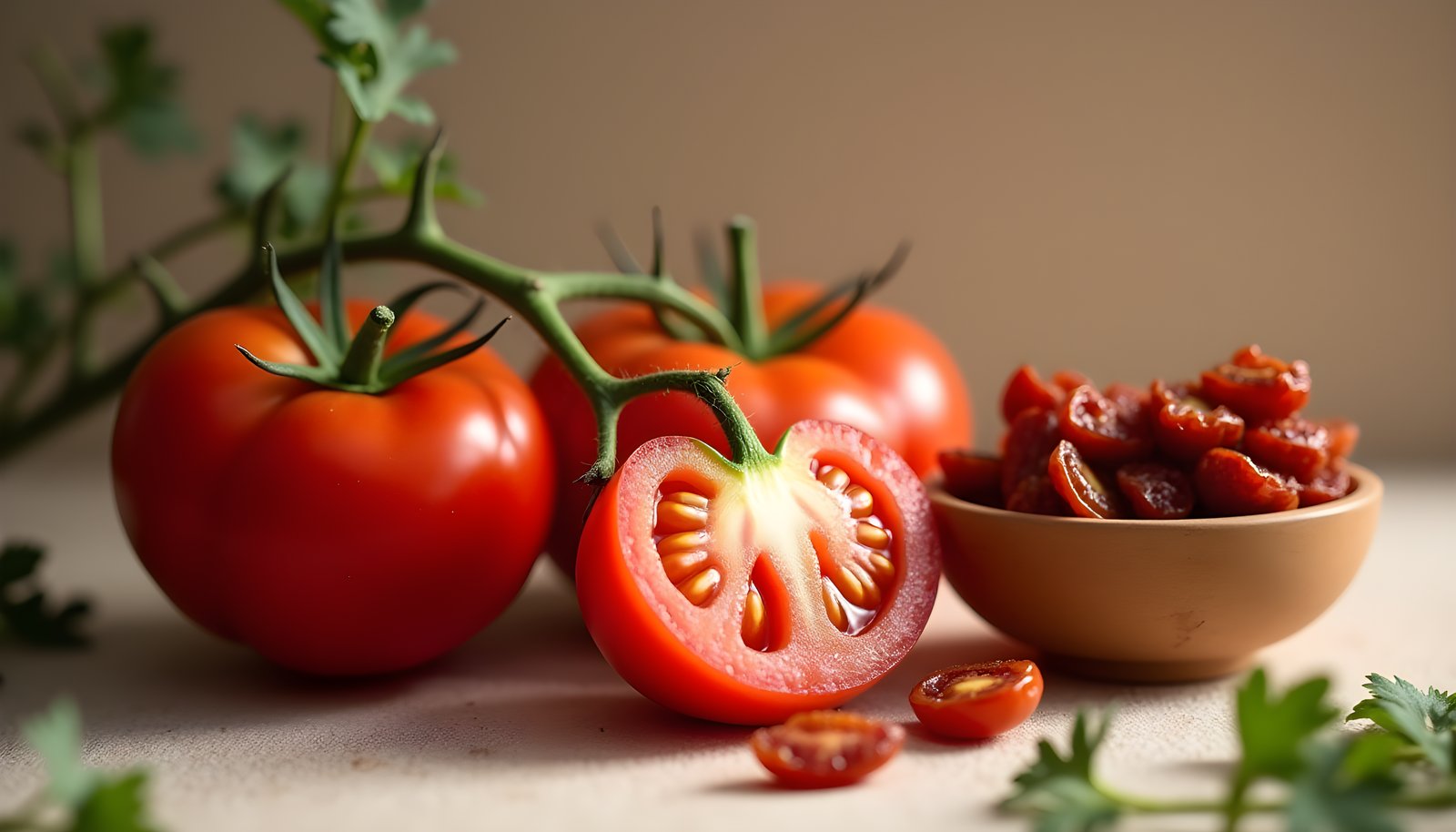
Most people file tomatoes with the vegetables, and the kitchen agrees. Botanically, though, Cleveland Clinic calls the tomato a fruit that’s often mistakenly called, and prepared like, a vegetable.
So do tomatoes have fiber? Yes, a modest amount. A medium raw tomato has about 1.5 grams of fiber for 22 calories, according to USDA FoodData Central.
Where tomatoes get interesting is in their processed forms. Canned tomatoes, tomato paste and sun-dried tomatoes all pack more fiber into each spoonful, and we’ll walk through each one below.
Do tomatoes have fiber? Grams by size and serving
USDA lists raw red tomatoes at 1.2 grams of fiber per 100 grams, with about 94.5 grams of water. Here’s how that plays out across the tomatoes you actually buy:
| Raw tomato | Weight | Fiber | Calories |
|---|---|---|---|
| 1 cherry tomato | 17 g | 0.2 g | 3 |
| 1 medium slice (1/4 inch) | 20 g | 0.2 g | 4 |
| 1 plum or Roma tomato | 62 g | 0.7 g | 11 |
| 1 small tomato | 91 g | 1.1 g | 16 |
| 1 medium tomato | 123 g | 1.5 g | 22 |
| 1 cup cherry tomatoes | 149 g | 1.8 g | 27 |
| 1 cup chopped | 180 g | 2.2 g | 32 |
| 1 large tomato | 182 g | 2.2 g | 33 |
USDA uses one entry for cherry, plum and slicing tomatoes, so per 100 grams their fiber is identical. Only the serving size changes, which is why a single cherry tomato barely registers.
The FDA’s raw vegetable label rounds a 148 gram tomato to 1 gram of fiber and 25 calories. Either way, a single fresh tomato covers about 5% of the 28 gram Daily Value.
That’s honest but small. A big sandwich slice adds only a fifth of a gram, so tomatoes on a burger won’t move your fiber total much.
Put another way, you’d need about three and a third medium tomatoes, roughly 410 grams, to reach 5 grams of fiber. That’s a lot of chewing for 74 calories’ worth of food.
Myth vs fact: tomatoes are a vegetable
Myth: Tomatoes are a vegetable.
Fact: They’re botanically a fruit, according to Cleveland Clinic, even though most of us cook and eat them like a vegetable. Registered dietitian Lara Whitson also notes that they belong to the nightshade family of plants.
For fiber purposes the label doesn’t change the numbers. It does change who tomatoes are competing against, so we’ll compare them with both lists below.
Canned, paste and sun-dried: where tomato fiber concentrates
When tomatoes lose water, the fiber left behind becomes much more concentrated. USDA’s figures per 100 grams show just how far that goes:
| Tomato form | Fiber per 100 g | Calories per 100 g | Typical serving |
|---|---|---|---|
| Fresh, raw | 1.2 g | 18 | 1 medium (123 g): 1.5 g |
| Canned, whole in juice | 1.9 g | 16 | 1 cup (240 g): 4.6 g |
| Tomato paste, unsalted | 4.1 g | 82 | 1/4 cup (66 g): 2.7 g |
| Sun-dried | 12.3 g | 258 | 1 cup (54 g): 6.6 g |
Canned tomatoes are the quiet standout. A cup has about 4.6 grams of fiber for just 38 calories, triple what you’d get from a medium fresh tomato.
Sun-dried tomatoes are ten times more concentrated than fresh. That cuts both ways: a cup carries 6.6 grams of fiber but also 139 calories and about 20 grams of natural sugar, so a small handful goes a long way.
Tomato paste lands in between. A single tablespoon, about 16 grams, has 0.7 grams of fiber, close to half of a whole medium tomato.
A whole 6 ounce can of paste, about 170 grams, holds roughly 7 grams of fiber and 139 calories. Spread across a big pot of chili, that adds up without anyone noticing.
One thing to watch with canned tomatoes is sodium. A cup of the regular kind packed in juice has about 276 milligrams, so no salt added cans are worth picking up when you see them.
How tomatoes compare with other fruits
If you count tomatoes as a fruit, they sit near the bottom of the fiber list. Here’s how a cup of chopped raw tomato compares with fruits from the Dietary Guidelines:
| Fruit (standard serving) | Fiber | Calories |
|---|---|---|
| Raspberries, 1 cup | 8.0 g | 64 |
| Pear, 1 medium | 5.5 g | 103 |
| Apple, 1 medium | 4.8 g | 104 |
| Orange, 1 medium | 3.7 g | 73 |
| Strawberries, 1 cup | 3.0 g | 49 |
| Tomato, raw, 1 cup chopped | 2.2 g | 32 |
What fruits have the most fiber? Raspberries, pears and apples lead, with two to nearly four times what fresh tomatoes provide. Tomatoes do win on calories, though, at just 32 per cup.
Which vegetables have the most fiber compared with tomatoes?
On the vegetable side, the gap is just as clear. Using Dietary Guidelines figures for cooked vegetables:
| Vegetable (1 cup cooked unless noted) | Fiber | Calories |
|---|---|---|
| Artichoke | 9.6 g | 89 |
| Green peas | 8.8 g | 134 |
| Brussels sprouts | 6.4 g | 65 |
| Broccoli | 5.2 g | 54 |
| Carrots | 4.8 g | 54 |
| Canned tomatoes (USDA) | 4.6 g | 38 |
| Raw tomato, chopped (USDA) | 2.2 g | 32 |
Canned tomatoes hold their own here, landing close to cooked carrots and broccoli for fewer calories. Fresh tomatoes trail because so much of their weight is water.
If you like knowing exactly where you stand, our fiber calculator can turn your own target into grams per meal in a few seconds.
Salsa, sauce and grain bowls: tomato fiber in real dishes
Numbers per 100 grams are useful, but it helps to see them in food you’d actually make. Here’s roughly what tomatoes contribute in three everyday dishes, using USDA figures:
| Dish | Tomato used | Fiber from tomatoes |
|---|---|---|
| Fresh salsa for two | 1 cup chopped raw tomato | 2.2 g total, about 1.1 g each |
| Simple pasta sauce for two | 1 cup canned tomatoes plus 2 tbsp paste | 5.9 g total, about 3 g each |
| Grain bowl topping | 1/4 cup sun-dried tomatoes | 1.7 g |
The sauce wins easily. Simmering canned tomatoes with a little paste gives each person about 3 grams of fiber before you add a single bean or vegetable.
Add half a cup of cooked lentils to that sauce for two, and the Dietary Guidelines figure of 7.8 grams per half cup brings each serving to nearly 7 grams.
What else tomatoes bring
A medium raw tomato, about 123 grams, gives you more than its fiber count suggests. USDA breaks it down like this, with % Daily Value from the FDA:
- Vitamin C: about 17 milligrams, around 19% of the Daily Value.
- Potassium: about 292 milligrams.
- Vitamin K: about 10 micrograms, around 8%.
- Folate: about 18 micrograms.
- Lycopene: about 3.2 milligrams.
Lycopene is the red pigment in tomatoes, and Cleveland Clinic highlights it as their signature nutrient. A review of 25 trials it cites linked high blood lycopene levels with a 14% lower risk of heart disease.
Concentrated tomato products carry far more of it. One tablespoon of tomato paste has about 4.6 milligrams of lycopene, more than a whole medium fresh tomato.
Cooking tomatoes with olive oil
Cleveland Clinic notes that how you prepare tomatoes can change how much of their goodness your body takes in. In research it describes, tomato sauce made with olive oil produced the biggest heart health improvement, likely because olive oil helps your body absorb more lycopene.
Cleveland Clinic also describes a study where people ate 40 grams of tomato paste with olive oil every day for 10 weeks and had 40% fewer sunburns. That daily dose of paste carries about 1.6 grams of fiber too.
That’s a good reason to lean on cooked tomato dishes. They also happen to be where the most fiber is, since sauces and stews usually start with canned tomatoes or paste.
Looking for easy sauces, soups and stews built around tomatoes and beans? Our recipe eBooks are full of high-fiber ideas that start with a can.
Easy ways to get more fiber from tomatoes
A few swaps make tomatoes pull more weight:
- Build sauce from canned whole tomatoes, then simmer in lentils or white beans.
- Stir a tablespoon or two of tomato paste into chili, soup or stew.
- Chop a few sun-dried tomatoes into pasta, grain bowls or scrambled eggs.
- Pair raw cherry tomatoes with hummus for a snack that brings in chickpea fiber.
- Pick the reddest tomatoes you can find, as Cleveland Clinic suggests for the most lycopene.
Gut feeling a little off as you add more fiber? Our gut health guides walk you through easing in so your digestion can keep up.
A quick rule for choosing your tomato
Use this when you’re deciding which tomatoes to reach for:
- If you want the most fiber per calorie, open a can. Whole canned tomatoes give you about 4.6 grams per cup for 38 calories.
- If you want a fiber boost in a small space, use sun-dried tomatoes or paste, and keep portions small.
- If you want crunch and freshness, eat them raw, and count on other foods for most of your fiber.
Fresh tomatoes are a great base for salads and sandwiches. For fiber, the can and the tube are where tomatoes really earn their spot.
Tomato fiber questions, answered
Are tomatoes high in fiber?
No, not when fresh. A medium raw tomato has about 1.5 grams of fiber, around 5% of the Daily Value, because tomatoes are about 94% water.
How much fiber is in a cup of cherry tomatoes?
A cup of cherry tomatoes, about 149 grams, has about 1.8 grams of fiber and 27 calories. Each cherry tomato has about 0.2 grams.
Do canned tomatoes have more fiber than fresh?
Yes. Canned whole tomatoes have about 1.9 grams of fiber per 100 grams, compared with 1.2 grams for fresh. A cup of canned tomatoes has about 4.6 grams.
Is tomato paste a good source of fiber?
In small amounts, yes. Tomato paste has 4.1 grams of fiber per 100 grams, so a quarter cup gives you about 2.7 grams for 54 calories.
Do sun-dried tomatoes have a lot of fiber?
Yes. Sun-dried tomatoes have 12.3 grams of fiber per 100 grams, and a cup has about 6.6 grams. They’re also higher in calories and natural sugar, so small portions work best.
Are tomatoes a fruit or a vegetable?
Botanically, tomatoes are a fruit, according to Cleveland Clinic. In the kitchen they’re usually cooked and eaten like a vegetable.
How many tomatoes would I need to eat for 5 grams of fiber?
About three and a third medium raw tomatoes, roughly 410 grams. A little over a cup of canned tomatoes gets you there with far less volume.
Sources
- U.S. Department of Agriculture, Agricultural Research Service. “Tomatoes, red, ripe, raw (170457); Tomatoes, red, ripe, canned, packed in tomato juice (170051); Tomato products, canned, paste, without salt (170459); Tomatoes, sun-dried (168567).” FoodData Central, SR Legacy. 2019. fdc.nal.usda.gov
- U.S. Food and Drug Administration. “Nutrition Information for Raw Vegetables.” 2017. www.fda.gov
- U.S. Department of Agriculture and U.S. Department of Health and Human Services. “Food Sources of Dietary Fiber.” Dietary Guidelines for Americans, 2020 to 2025. dietaryguidelines.gov
- U.S. Food and Drug Administration. “Daily Value on the Nutrition and Supplement Facts Labels.” 2026. www.fda.gov
- Cleveland Clinic. “What Are the Health Benefits of Tomatoes?” 2023. health.clevelandclinic.org