
In this article
- Does mango have fiber? Grams per serving
- Fiber per calorie: where mango ranks among fruits with fiber
- Fresh vs dried mango: what changes
- What else a cup of mango brings
- What a mango study found about constipation
- A checklist for getting the most fiber from mango
- Where mango research goes from here
- Mango and fiber: what people want to know
- Sources
One whole mango gives you about 5.4 grams of fiber and more than a full day’s vitamin C, according to USDA FoodData Central. That’s a bigger fiber payoff than most people expect from a fruit known mainly for its sweetness.
So does mango have fiber? It does, in a middle-of-the-pack amount. How you buy it, fresh or dried, changes the picture more than you might think.
Does mango have fiber? Grams per serving
USDA lists fresh mango by the cup and by the whole fruit. Here’s how much fiber in mangos of different portions, along with the sugar that comes with it:
| Portion | Weight | Fiber | Calories | Sugar |
|---|---|---|---|---|
| 100 grams | 100 g | 1.6 g | 60 | 13.7 g |
| 1 cup pieces | 165 g | 2.6 g | 99 | 22.6 g |
| Half a mango | 168 g | 2.7 g | 101 | 23.0 g |
| Amount used in a 2018 study | 300 g | 4.8 g | 180 | 41.1 g |
| 1 whole mango | 336 g | 5.4 g | 202 | 46.0 g |
A cup of mango and half a mango are almost the same amount, since one fruit without the pit and skin weighs about 336 grams. If you eat a whole mango in one sitting, you’re getting close to a fifth of the 28 gram Daily Value.
Is mango high in fiber?
Not by the FDA’s standards. A cup provides about 9% of the Daily Value, which lands between the FDA’s low mark of 5% or less and its high mark of 20% or more.
A whole mango, at about 19%, comes close to that high line. Most people eat mango by the cup or the half, though, so it’s best thought of as a moderate fiber fruit.
Two cups of pieces gets you to about 5.2 grams, or 19% of the Daily Value. That’s a generous bowl, and it comes with roughly 198 calories and 45 grams of natural sugar.
A more practical route is pairing one cup of mango with a second fiber source at the same meal. A spoonful of seeds, a handful of oats or a side of beans can carry the rest of the load while the mango brings the flavor.
Fiber per calorie: where mango ranks among fruits with fiber
Mango is sweet, so it’s worth looking at how much fiber you get for the calories. Using Dietary Guidelines and USDA numbers, here’s fiber per 100 calories for common fruits:
| Fruit | Typical serving | Fiber per serving | Fiber per 100 calories |
|---|---|---|---|
| Raspberries | 1 cup | 8.0 g | 12.5 g |
| Blackberries | 1 cup | 7.6 g | 12.3 g |
| Strawberries | 1 cup | 3.0 g | 6.1 g |
| Pear | 1 medium | 5.5 g | 5.3 g |
| Orange | 1 medium | 3.7 g | 5.1 g |
| Kiwifruit | 1 cup | 5.4 g | 4.9 g |
| Apple, with skin | 1 medium | 4.8 g | 4.6 g |
| Banana | 1 medium | 3.2 g | 2.9 g |
| Mango, fresh | 1 cup | 2.6 g | 2.7 g |
| Mango, dried and sweetened | 1 oz | 0.7 g | 0.8 g |
Fresh mango lands near bananas, giving you about 2.7 grams of fiber for every 100 calories. Berries deliver four to five times as much for the same calories.
Mango next to other tropical fruits
Among tropical picks, mango holds its own. A cup of fresh pineapple chunks has about 2.3 grams of fiber and 83 calories, per USDA, a little less fiber than a cup of mango.
A cup of kiwifruit, at 5.4 grams, roughly doubles both. A medium banana, at 3.2 grams, edges mango per serving but comes out nearly even per calorie.
Dried, sweetened mango is a different story. It drops to under 1 gram of fiber per 100 calories, which puts it at the very bottom of the list.
Curious how a mango fits into your own daily fiber needs? Our fiber calculator works out a target for you in a few seconds.
Fresh vs dried mango: what changes
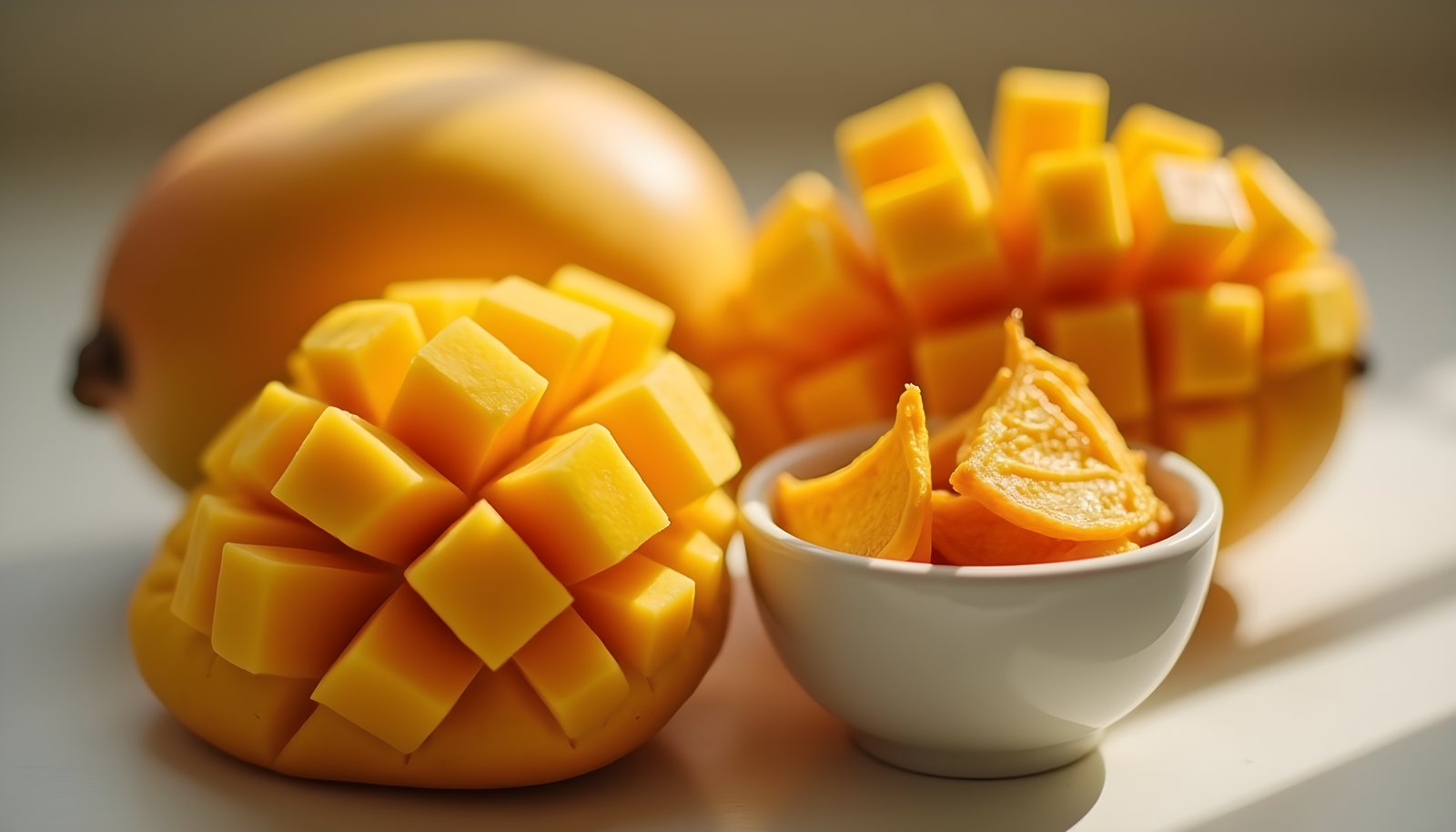
Drying removes water, so you’d expect dried mango to be a concentrated fiber source, the way dates or prunes are. Per 100 grams, sweetened dried mango does have more fiber than fresh, 2.4 grams versus 1.6.
The catch is everything else that gets concentrated, or added. The same 100 grams of sweetened dried mango has about 319 calories and 66 grams of sugar, compared with 60 calories and 14 grams for fresh.
That’s why the per calorie numbers flip. Added sugar takes up space in each piece, so a 1 ounce handful gives you about 0.7 grams of fiber with about 90 calories and roughly 19 grams of sugar.
How much dried mango matches one fresh mango?
To get the 5.4 grams of fiber in one whole fresh mango from sweetened dried mango, you’d need about 225 grams of the dried pieces. That portion carries roughly 720 calories and 149 grams of sugar, more than three times the calories of the fresh fruit.
Few people eat that much dried mango at once, but the math shows how fast the handfuls add up. A bag that looks small can hold more sugar than several whole mangoes.
If you love dried mango, treat it as a sweet treat rather than a fiber snack. A cup of fresh pieces gives you nearly four times the fiber of a 1 ounce handful for only about 10 more calories.
What else a cup of mango brings
Mango earns its spot on the plate with vitamins more than fiber. One cup of pieces gives you, based on USDA values and FDA Daily Values:
- About 60 milligrams of vitamin C, roughly 67% of the Daily Value
- About 0.18 milligrams of copper, roughly 20%
- About 71 micrograms of folate, roughly 18%
- About 0.20 milligrams of vitamin B6, roughly 12%
- About 89 micrograms of vitamin A and 1.5 milligrams of vitamin E, each roughly 10%
The same cup adds about 277 milligrams of potassium, close to 6% of the 4,700 milligram Daily Value. It’s a small share, but it stacks up when mango shares the plate with other fruits and vegetables.
That’s a broad spread for under 100 calories. It’s also why mango is worth eating even though it’s only a moderate fiber source.
Vitamin C is the headline. A whole mango holds about 122 milligrams, roughly 136% of the Daily Value, so a single fruit covers more than a full day.
What a mango study found about constipation
A 2018 pilot study in Molecular Nutrition and Food Research, led by researchers at Texas A&M, tested mango against a fiber supplement. Thirty-six adults with chronic constipation were randomly assigned to eat about 300 grams of mango a day or take a 5 gram dose of psyllium, a common fiber supplement, for four weeks.
Both groups improved, but the mango group did better. Mango significantly improved stool frequency, consistency and shape, and it raised levels of short-chain fatty acids, compounds gut bacteria make when they ferment fiber.
Compared with the fiber supplement, mango also lowered two blood markers linked to inflammation, endotoxin and interleukin 6. That 300 gram serving holds about 4.8 grams of fiber, close to the psyllium dose, which hints that something besides fiber may have been at work. The researchers also reported that mango raised levels of gastrin, a digestive hormone that helps trigger gut contractions.
If you’re working on regularity, our gut health guides walk you through adding fiber in a way your digestion can keep up with.
A checklist for getting the most fiber from mango
A few habits make mango pull more of its weight in a high fiber day:
- Pick fresh over sweetened dried. You get far more fiber per calorie.
- Eat it by the cup, not the slice. A full cup gives you 2.6 grams, while a few slices on a plate add much less.
- Pair it with a berry. A cup of mango plus a cup of raspberries comes to about 10.6 grams of fiber.
- Add seeds to mango bowls. A tablespoon of chia seeds adds about 4.1 grams.
- Use it to sweeten oats. Half a cup of cooked oat bran with a cup of mango gives you about 5.5 grams at breakfast.
- Read dried fruit labels. If you buy dried mango, look for versions without added sugar.
Want more ideas for smoothie bowls, salsas and salads built around mango? Our recipe eBooks are packed with easy, high-fiber combinations.
Where mango research goes from here
The 2018 constipation study is promising, but it was small, with just 36 people, and it was supported in part by the U.S. National Mango Board. Larger, independent trials are needed before anyone can say mango beats a fiber supplement for most people.
One open question is the gap between mango and psyllium. Both groups got a similar amount of fiber, yet mango changed short-chain fatty acids and inflammation markers more, which makes the rest of the fruit a natural target for future studies.
Until then, the practical takeaway is simple. A cup or two of fresh mango is a sweet way to add a few grams of fiber and plenty of vitamins, especially when you pair it with higher fiber foods.
Mango and fiber: what people want to know
How much fiber is in one mango?
A whole mango, about 336 grams without the skin and pit, has roughly 5.4 grams of fiber, according to USDA. That’s about 19% of the 28 gram Daily Value.
Is mango a good source of fiber?
It’s a moderate one. A cup of pieces has about 2.6 grams, or 9% of the Daily Value, which sits between the FDA’s low and high marks.
Does dried mango have more fiber than fresh?
Per 100 grams, sweetened dried mango has more, 2.4 versus 1.6 grams. Per calorie it has far less, because drying and added sugar pack in about 319 calories per 100 grams.
Is mango good for constipation?
A 2018 pilot study found that about 300 grams of mango a day for four weeks improved stool frequency and consistency more than a psyllium supplement. The study was small, with 36 people.
Does mango have more fiber than banana?
Slightly less per serving. A cup of mango has about 2.6 grams, while a medium banana has about 3.2 grams, and the two are nearly tied per calorie.
Is mango high in sugar?
It’s on the sweeter side. A cup of fresh mango has about 22.6 grams of natural sugar, along with its fiber and vitamins.
What fruits have more fiber than mango?
Raspberries, blackberries, pears, kiwifruit, apples and oranges all beat mango per serving. A cup of raspberries has about 8 grams, roughly three times a cup of mango.
Sources
- USDA Agricultural Research Service. FoodData Central, SR Legacy entries for mangos, raw (169910); mango, dried, sweetened (169091); and pineapple, raw, all varieties (169124). 2019. fdc.nal.usda.gov
- U.S. Department of Agriculture and HHS. “Food Sources of Dietary Fiber.” Dietary Guidelines for Americans, 2020 to 2025. dietaryguidelines.gov
- U.S. Food and Drug Administration. “Daily Value on the Nutrition and Supplement Facts Labels.” 2024. fda.gov
- Venancio VP, Kim H, Sirven MA, et al. “Mango (Mangifera indica L.) fruit ameliorates chronic constipation in comparison to an equivalent fiber supplement.” Molecular Nutrition and Food Research, 2018. pubmed.ncbi.nlm.nih.gov