
In this article
- How much fiber in kiwi by portion
- Kiwi among the highest fiber fruits
- What the kiwi constipation trial found
- Kiwi for a sensitive gut
- Vitamin C and the rest of a kiwi’s nutrients
- A two kiwi morning, by the numbers
- How kiwi fits your daily fiber
- Where kiwi research is heading
- Kiwi and fiber: quick answers
- Sources
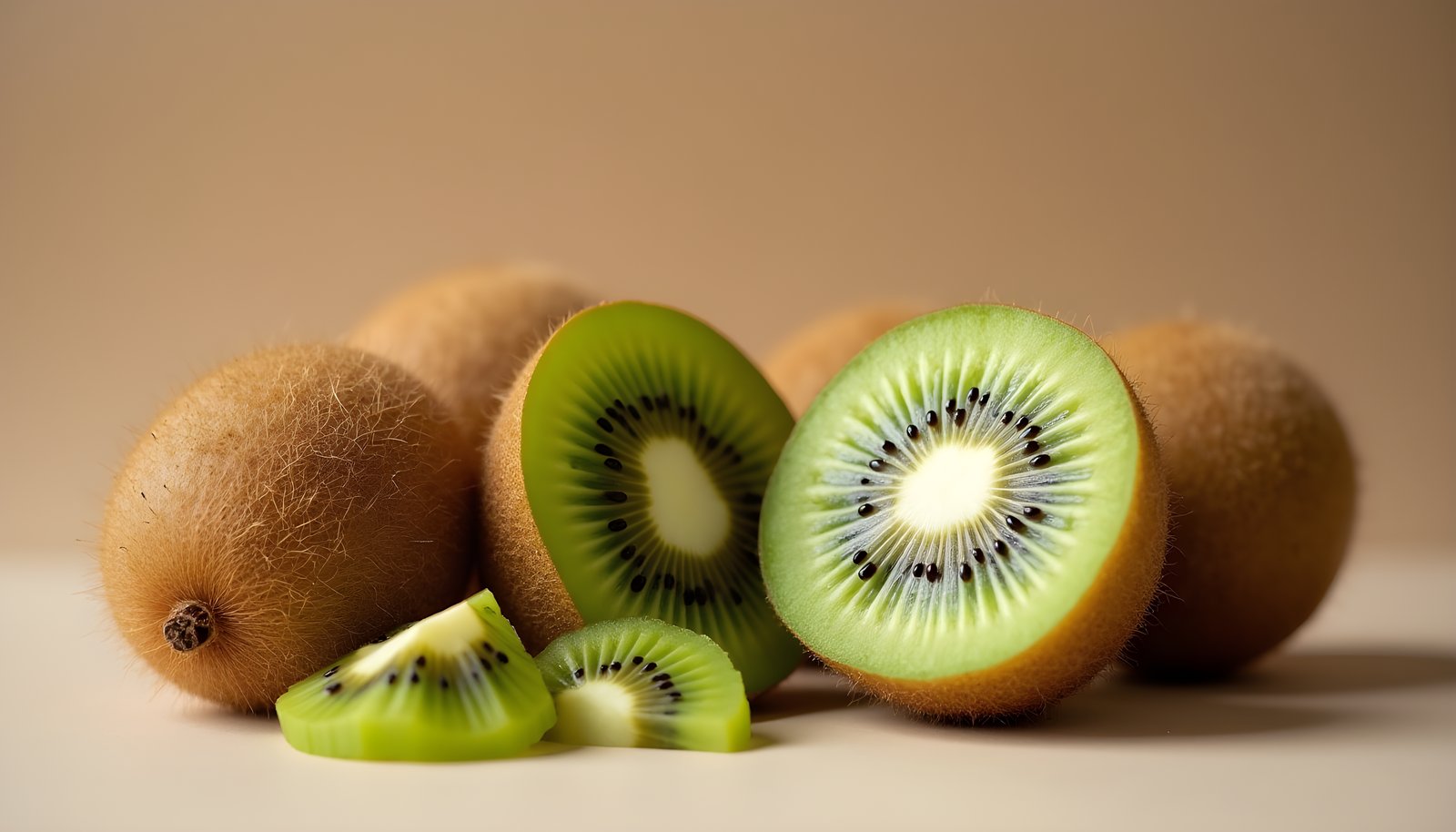
How much fiber in kiwi? About 2.2 grams in one green kiwi and 4.4 grams in two, based on USDA FoodData Central.
That two kiwi portion has a history. It’s exactly the amount a 2021 clinical trial tested against prunes and psyllium, the fiber in Metamucil, for chronic constipation, and kiwi held its own.
So the numbers look modest on paper, but this small fruit has real clinical research behind it for digestion.
How much fiber in kiwi by portion
USDA lists green kiwifruit at 3.0 grams of fiber per 100 grams, with 61 calories. Its standard serving of 148 grams equals about two medium fruits.
| Green kiwi | Weight | Fiber | % Daily Value | Calories |
|---|---|---|---|---|
| 1 medium kiwi | about 74 g | 2.2 g | 8% | 45 |
| 2 medium kiwis | 148 g | 4.4 g | 16% | 90 |
| 1 cup sliced (Dietary Guidelines) | 1 cup | 5.4 g | 19% | 110 |
| Per 100 grams | 100 g | 3.0 g | 11% | 61 |
The FDA sets the Daily Value for fiber at 28 grams and treats 20% or more as high. A cup of sliced kiwi lands just under that line, while one fruit counts as a modest source.
Monash University’s nutrition table for the same two fruit serve lists 5 to 6 grams of fiber, a bit higher than USDA. Fruit size and ripeness vary, so either figure is a fair estimate.
The constipation trial described below estimated about 6 grams a day from two peeled kiwis, which sits at the top of that range. For planning, 2 grams per fruit is a safe, conservative number.
Sugar and water in a kiwi
Kiwi is about 83% water by weight in USDA data. Two medium fruits carry around 13 grams of natural sugar along with their 4.4 grams of fiber.
Each fruit carries roughly 3 grams of sugar for every gram of fiber. Eaten whole, you get both together in one small, filling package.
Kiwi among the highest fiber fruits
The Dietary Guidelines rank fruits by fiber per standard portion. Kiwi sits in the upper half, behind berries and pears:
| Fruit (standard portion) | Fiber | Calories | Fiber per 100 calories |
|---|---|---|---|
| Guava, 1 cup | 8.9 g | 112 | 7.9 g |
| Raspberries, 1 cup | 8.0 g | 64 | 12.5 g |
| Blackberries, 1 cup | 7.6 g | 62 | 12.3 g |
| Pear, 1 medium | 5.5 g | 103 | 5.3 g |
| Kiwi, 1 cup sliced | 5.4 g | 110 | 4.9 g |
| Apple, 1 medium | 4.8 g | 104 | 4.6 g |
| Orange, 1 medium | 3.7 g | 73 | 5.1 g |
| Banana, 1 medium | 3.2 g | 112 | 2.9 g |
| Strawberries, 1 cup | 3.0 g | 49 | 6.1 g |
Guava leads the list at 8.9 grams per cup, though it’s harder to find in many stores. Raspberries and blackberries follow closely, with far fewer calories.
Per calorie, kiwi lands in the middle of the pack. It beats bananas and apples, roughly ties oranges and pears, and trails berries by a wide margin.
Mixing kiwi with berries gets you the best of both. A cup of sliced kiwi plus a cup of raspberries gives you 13.4 grams of fiber for 174 calories, nearly half the Daily Value in one fruit bowl.
Among the highest fiber foods overall, a cup of kiwi still can’t match legumes. Half a cup of cooked lentils has 7.8 grams and half a cup of navy beans has 9.6, per the Dietary Guidelines.
Curious how two kiwis stack up against the number you personally need? Our fiber calculator puts a figure on it in moments.
What the kiwi constipation trial found
The trial, published in the American Journal of Gastroenterology in 2021, enrolled US adults with chronic constipation or constipation predominant IBS. Monash University summarized the results on its FODMAP research blog.
Participants were randomly assigned to one of three daily treatments for four weeks:
- Two green kiwis, peeled
- 100 grams of prunes
- 12 grams of psyllium
Each option supplied roughly 6 grams of fiber a day. That’s a useful detail, because it means the comparison was fiber for fiber.
The full study ran eight weeks: two weeks of baseline tracking, four weeks of treatment and two weeks of follow up after people stopped. That design let researchers see changes against each person’s own starting point.
All three groups improved. Prunes did slightly better on stool frequency, while kiwi and prunes both improved stool consistency more than psyllium did, and 68% of the kiwi group reported being satisfied with it.
Straining eased and the feeling of incomplete emptying dropped in all three groups, with prunes showing the largest changes on both.
How much weight to put on the result
The study was exploratory, and 75 people completed every phase. That’s enough to show kiwi is a reasonable option, but not enough to call it better than the other two.
Even so, it’s a whole fruit going toe to toe with a fiber supplement in a randomized trial, and coming out comparable.
Kiwi for a sensitive gut
Monash University lists kiwifruit as low FODMAP at a serve of two fruits, about 150 grams. FODMAPs are fermentable carbohydrates that can trigger gas and bloating in people with irritable bowel syndrome.
That gives kiwi an edge over prunes for some people. Monash notes that the sorbitol in prunes may set off symptoms in people with IBS, a concern kiwi doesn’t share at that portion.
If you already follow a low FODMAP plan, two kiwis fit inside the portion Monash tested. Larger amounts aren’t covered by that listing, so build up from there with care.
Mayo Clinic recommends raising fiber slowly over a few weeks and drinking plenty of water, since fiber works best when it absorbs water. Two kiwis a day is an easy, gradual step.
If constipation is the reason you’re reaching for kiwi, our gut health guides lay out a fuller plan to support regularity.
Vitamin C and the rest of a kiwi’s nutrients
Kiwi is best known for vitamin C. The NIH Office of Dietary Supplements lists 64 mg in one medium kiwi, about 71% of the Daily Value, close to the 70 mg in a medium orange.
Kiwi is also lighter on calories than an orange for nearly the same vitamin C. One medium kiwi has about 45 calories, while the Dietary Guidelines put a medium orange at 73.
Two kiwis, by USDA’s count, provide about 137 mg. That covers the adult RDA of 90 mg for men and 75 mg for women with room to spare, and ODS notes that smokers need 35 mg more per day.
Per two fruit serving, USDA also lists:
- Vitamin K: 60 µg, about 50% of the Daily Value
- Copper: 0.19 mg, about 21% of the Daily Value
- Vitamin E: 2.2 mg, about 14% of the Daily Value
- Potassium: 462 mg, about 10% of the Daily Value
- Folate: 37 µg, about 9% of the Daily Value
The vitamin K figure is the surprise for many people. Half the Daily Value from two pieces of fruit is a lot for a nutrient more often linked with leafy green vegetables.
A two kiwi morning, by the numbers
Picture a weekday breakfast built around the trial’s portion. Two kiwis go into a bowl with a few other fiber sources:
| Item | Fiber | Calories |
|---|---|---|
| 2 medium kiwis | 4.4 g | 90 |
| ½ cup oat bran, cooked | 2.9 g | 44 |
| 1 tablespoon chia seeds | 4.1 g | 58 |
| Total | 11.4 g | 192 |
That bowl delivers about 41% of the Daily Value for under 200 calories, using USDA and Dietary Guidelines figures. The kiwis also bring more than a day’s vitamin C.
Want ways to use kiwi beyond eating it with a spoon? Our recipe eBooks fold it into bowls, salads and snacks packed with fiber.
How kiwi fits your daily fiber
Mayo Clinic recommends 25 grams of fiber a day for women and 38 grams for men up to age 50, and 21 and 30 grams after 50. Two kiwis cover about 18% of the women’s target and 12% of the men’s.
Small swaps add up too. Trade a medium banana for two kiwis and you gain about 1.2 grams of fiber while saving roughly 22 calories, using Dietary Guidelines and USDA figures.
Swap a cup of strawberries for a cup of sliced kiwi and the gain is bigger, about 2.4 grams more fiber, though the kiwi brings about 60 more calories.
Keep two kiwis a day going for a week and they add up to about 31 grams of fiber, a little more than one full day’s Daily Value spread over seven days.
That’s a real contribution from a snack that takes a minute to prepare. Pair it with beans or whole grains later in the day and the target becomes much easier to reach.
Where kiwi research is heading
The 2021 trial was small and short, and its authors framed it as exploratory. The open questions are practical ones: whether kiwi works as well over months as it did over four weeks, and which people respond best.
For now, the evidence supports a simple, low risk experiment. Two green kiwis a day for a few weeks is an easy way to see whether this fruit does for you what it did for most people in that study.
Kiwi and fiber: quick answers
How much fiber is in one kiwi?
About 2.2 grams in one medium green kiwi of roughly 74 grams. That’s around 8% of the Daily Value for about 45 calories.
Is kiwi high in fiber?
It’s a good source rather than a high one. Two kiwis give you about 4.4 grams, or 16% of the Daily Value, and a cup of sliced kiwi reaches about 19%.
How many kiwis a day help with constipation?
Two. A 2021 trial in the American Journal of Gastroenterology gave adults with chronic constipation two peeled green kiwis a day, and results were similar to prunes and psyllium.
Does kiwi have more fiber than a banana?
Yes, per calorie. Kiwi has about 4.9 grams of fiber per 100 calories, compared with about 2.9 grams for a banana.
Is kiwi low FODMAP?
Yes, at a serve of two fruits. Monash University lists about 150 grams of kiwifruit as low FODMAP.
How much vitamin C is in a kiwi?
About 64 mg in a medium kiwi, roughly 71% of the Daily Value. Two kiwis provide more than a full day’s needs for most adults.
How much sugar is in a kiwi?
About 6.7 grams in one medium kiwi, or 13 grams in two. That sugar comes with 2.2 grams of fiber per fruit.
Sources
- U.S. Department of Agriculture, Agricultural Research Service. “Kiwifruit, green, raw (168153).” FoodData Central, SR Legacy. 2019. fdc.nal.usda.gov
- U.S. Department of Agriculture and U.S. Department of Health and Human Services. “Food Sources of Dietary Fiber.” Dietary Guidelines for Americans, 2020 to 2025. dietaryguidelines.gov
- Lee, J. “Research update: Kiwifruit, psyllium and prunes, which one is better for constipation?” Monash University FODMAP blog. 2021. monashfodmap.com
- NIH Office of Dietary Supplements. “Vitamin C: Fact Sheet for Health Professionals.” 2025. ods.od.nih.gov
- Mayo Clinic Staff. “Dietary fiber: Essential for a healthy diet.” Mayo Clinic, 2025. www.mayoclinic.org
- U.S. Food and Drug Administration. “Daily Value on the Nutrition and Supplement Facts Labels.” 2024. www.fda.gov