
In this article
- The red berry behind the hype
- Goji berries fiber by the handful
- Soluble and insoluble fiber in goji
- Goji berries compared with other dried fruit
- Goji berry nutrition: protein, iron and a surprise
- The sugar side of the label
- Antioxidant fruit claims and the human studies
- Two cautions before you stock up
- Picking goji or another option
- Easy ways to work goji into your week
- One bowl to try today
- Goji berry fiber FAQ
- Sources
3.6 grams. That’s how much fiber a 28 gram handful of dried goji berries gives you, based on USDA FoodData Central, and it lines up almost exactly with a quarter cup of dried figs.
So goji berries fiber is genuine, at 13 grams per 100 grams, but it doesn’t set goji apart from the rest of the dried fruit shelf. Where goji does stand out is in a few other nutrients, including one eye related pigment.
The red berry behind the hype
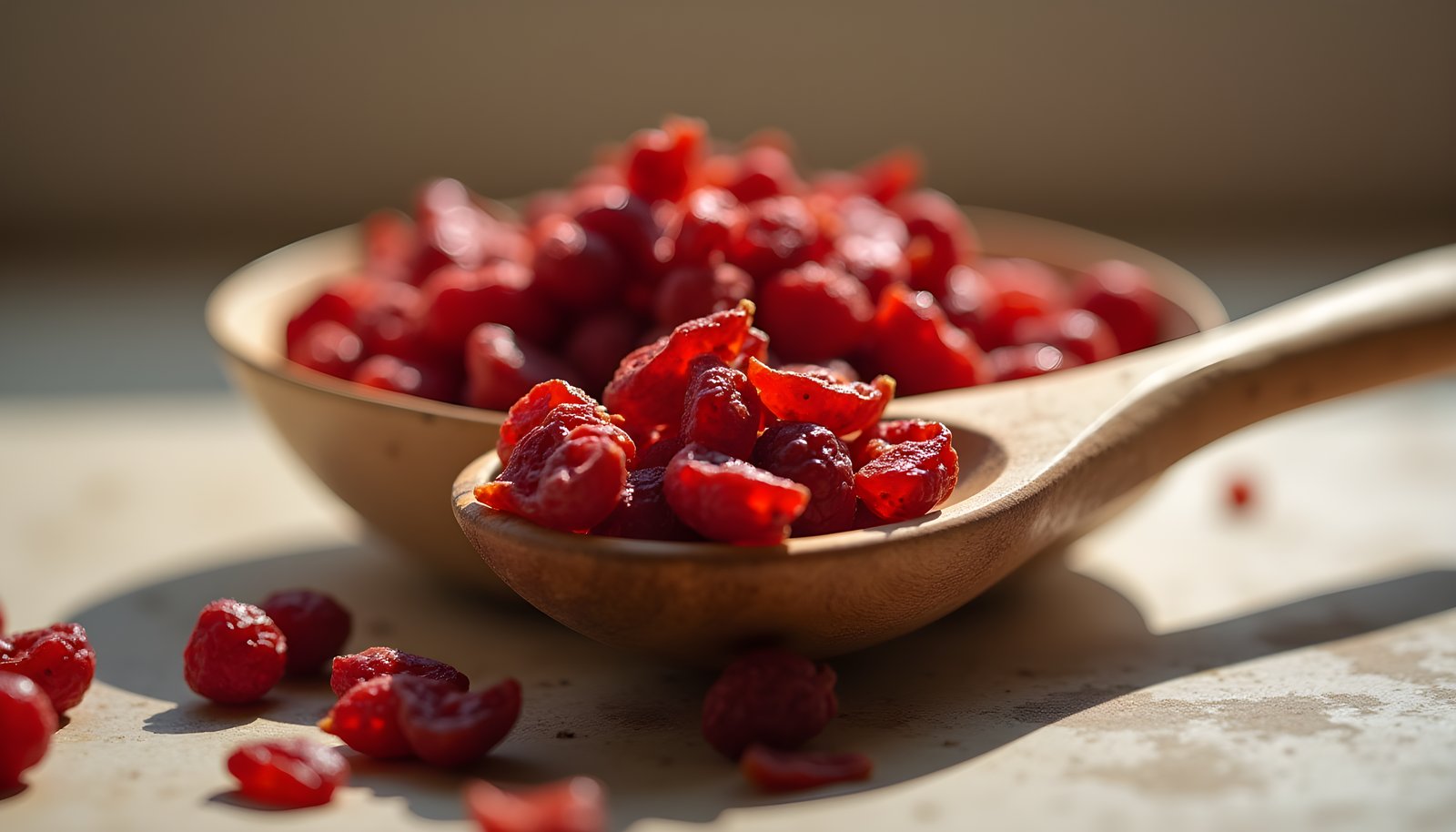
Goji berries, also called wolfberries, come from a shrub named Lycium barbarum. A 2025 review in Applied Sciences by Shi and colleagues pulls together recent research on the fruit’s nutrients and plant compounds, which is where much of the detail below comes from.
In most stores you’ll find goji dried, looking like a slightly chewy red raisin. Juices and powders exist too, but the dried berry is the form USDA has measured in detail.
Goji berries fiber by the handful
USDA’s entry for dried goji lists 13 grams of fiber per 100 grams, along with 349 calories and 45.6 grams of sugar. Here’s how that works out at the amounts people actually eat:
| Dried goji berries | Fiber | % of 28 g Daily Value | Calories | Sugars |
|---|---|---|---|---|
| 1 tablespoon (about 5.6 g) | 0.7 g | 3% | 20 | 2.6 g |
| 2 tablespoons (about 11 g) | 1.5 g | 5% | 39 | 5.1 g |
| 5 tablespoons (28 g) | 3.6 g | 13% | 98 | 12.8 g |
| 100 g | 13.0 g | 46% | 349 | 45.6 g |
USDA’s own serving is 5 tablespoons, or 28 grams, and the smaller rows are scaled from that. The percentages use the FDA’s 28 gram Daily Value for fiber.
A sprinkle on oatmeal is more like one or two tablespoons. That’s well under 2 grams of fiber, so goji works best as one part of a fiber rich bowl rather than the whole plan.
Want to see where 3.6 grams puts you for the day? Our fiber calculator works out your personal target in a few seconds.
Soluble and insoluble fiber in goji
The Shi review gathers values from several studies and finds that goji’s fiber leans insoluble. Reported ranges run from about 2.7 to 11.7 grams of insoluble fiber per 100 grams of dried fruit, compared with 0.9 to 5.5 grams of soluble fiber.
Harvard’s Nutrition Source explains that insoluble fiber doesn’t dissolve in water and helps food move through your digestive system. Soluble fiber does dissolve, and it can help lower blood glucose and cholesterol.
For a 28 gram handful, that split means most of your 3.6 grams is the bulking, insoluble kind. Oats, beans and chia are better picks if you want the gel forming soluble type.
Goji also carries water soluble polysaccharides, often shortened to LBPs, that researchers study separately from fiber. The review describes them as chains of sugars such as arabinose, glucose and galactose, with galactose often the main one.
Goji berries compared with other dried fruit
To put goji in context, here’s how it stacks up. Using the Dietary Guidelines food source list for the other fruits, these are the dried fruits you likely already know:
| Dried fruit | Portion | Fiber | Calories | Fiber per 100 calories |
|---|---|---|---|---|
| Figs, dried | 1/4 cup | 3.7 g | 93 | 4.0 g |
| Goji berries, dried | 28 g (5 tablespoons) | 3.6 g | 98 | 3.7 g |
| Peaches, dried | 1/4 cup | 3.3 g | 96 | 3.4 g |
| Pears, dried | 1/4 cup | 3.4 g | 118 | 2.9 g |
| Prunes | 1/4 cup | 3.1 g | 105 | 3.0 g |
| Dates | 1/4 cup | 3.0 g | 104 | 2.9 g |
Goji lands mid table, just behind figs and ahead of prunes and dates. Calories barely differ either, with every option landing between 93 and 118 per serving. If you’re buying dried fruit purely for fiber, a bag of figs or prunes does nearly the same job.
Fresh fruit beats all of them on fiber per calorie. A cup of raspberries gives 8.0 grams for 64 calories, which works out to about 12.5 grams per 100 calories, more than three times goji’s rate.
Choosing between dried fruits, powders and fiber supplements? Our comparison charts set the popular options out side by side.
Goji berry nutrition: protein, iron and a surprise
Fiber isn’t the whole story in goji berry nutrition. USDA’s numbers show a few areas where a 28 gram serving pulls more weight than you’d expect from dried fruit:
| Nutrient | Per 28 g serving | % Daily Value |
|---|---|---|
| Protein | 4.0 g | 8% |
| Iron | 1.9 mg | 11% |
| Vitamin C | 14 mg | 15% |
| Calcium | 53 mg | 4% |
| Sodium | 83 mg | 4% |
| Sugars | 12.8 g | not set |
Four grams of protein is high for a dried fruit, and the iron and vitamin C are useful extras. The sodium is a surprise too, at 298 milligrams per 100 grams, though a single handful stays modest.
Goji is also rich in zeaxanthin, a yellow carotenoid pigment that researchers study for eye health. The Shi review reports about 0.5 to 1.2 milligrams per gram of dried fruit, mostly in a bound form called zeaxanthin dipalmitate.
The sugar side of the label
Dried fruit concentrates sugar along with fiber, and goji is no exception. A 28 gram serving carries about 12.8 grams of sugar, which the review traces mainly to glucose and fructose.
Those are the fruit’s own sugars, not added ones, so they don’t count toward the FDA’s 50 gram Daily Value for added sugars. Still, check the ingredient list, since a plain bag should list goji berries and nothing else.
Pairing goji with nuts, seeds or yogurt stretches a small handful further. It also adds fiber and protein that the berries alone can’t match.
Antioxidant fruit claims and the human studies
Goji is sold as an antioxidant fruit, and lab work supports that it contains plenty of carotenoids and phenolic compounds. Human evidence is more limited.
The Shi review describes a randomized, placebo controlled trial in adults aged 65 to 70, where a milk based goji drink taken for 90 days raised blood antioxidant capacity while the placebo group didn’t change. Another small trial in older adults found lower C reactive protein, a marker of inflammation, after 30 days of daily goji juice.
Researchers have also reported higher macular pigment density after three months of goji intake. The review’s authors note that more human trials are needed before firm conclusions can be drawn.
The fiber superfood label is the weakest part of the pitch. Goji’s fiber is real, but it matches ordinary dried fruit rather than beating it.
Two cautions before you stock up
Memorial Sloan Kettering’s integrative medicine page on lycium reports a few cases of elevated INR, a blood clotting measure, in people taking warfarin who also consumed goji products. It advises people on warfarin or other anticoagulants to avoid goji.
The same page notes allergic reactions in some people with plant food or pollen allergies, linked to cross reactivity with lipid transfer proteins found in other foods.
If you’re increasing dried fruit to help with regularity, our gut health guides show you how to build fiber up gradually so your digestion keeps pace.
Picking goji or another option
- If you want the most fiber per calorie, choose fresh raspberries or blackberries over any dried fruit.
- If you want a shelf stable snack with fiber, goji, figs and prunes all land within about half a gram of each other per serving.
- If you want zeaxanthin and a bit of extra protein, goji earns its place in the mix.
- If you take warfarin, skip goji, as Memorial Sloan Kettering advises.
Easy ways to work goji into your week
Goji’s chewy texture and mild sweetness fit most places raisins do. These pairings use the Dietary Guidelines values for the partner foods:
- Trail mix: 28 grams of goji with an ounce of almonds gives about 7.1 grams of fiber.
- Grain or bean salad: two tablespoons of goji over half a cup of chickpeas comes to about 7.8 grams.
- Yogurt bowl: two tablespoons of goji plus a tablespoon of flaxseed adds about 4.3 grams to a food that has little fiber on its own.
- Baking: swap goji in for raisins in oat muffins or cookies for a tart red color.
Looking for more snacks and breakfast ideas built around dried fruit and seeds? Our recipe eBooks have plenty of easy, high fiber options.
One bowl to try today
Make a breakfast bowl with half a cup of cooked oat bran, one cup of raspberries, a tablespoon of chia seeds and two tablespoons of dried goji. Using the Dietary Guidelines values plus USDA’s goji data, that’s about 16.5 grams of fiber, well over half the Daily Value.
If you only change one thing, make it the raspberries. They supply about half the bowl’s fiber on their own, which shows how much fresh berries outpace any dried fruit.
The goji brings color, chew and a little sweetness, while the berries, seeds and oat bran do most of the fiber work. It’s an easy way to enjoy goji for what it does best.
Goji berry fiber FAQ
Are goji berries high in fiber?
They’re a good source. A 28 gram serving of dried goji has about 3.6 grams of fiber, or 13% of the Daily Value.
How much fiber is in a tablespoon of goji berries?
About 0.7 grams. That’s based on USDA’s 13 grams of fiber per 100 grams of dried goji.
Do goji berries have more fiber than prunes or dates?
Slightly more than prunes and dates per serving, and about the same as dried figs. A quarter cup of prunes has 3.1 grams versus 3.6 grams in 28 grams of goji.
Is goji fiber soluble or insoluble?
Mostly insoluble. Studies report roughly 2.7 to 11.7 grams of insoluble fiber per 100 grams, compared with 0.9 to 5.5 grams of soluble.
Are goji berries high in sugar?
Yes, like most dried fruit. USDA lists 45.6 grams of sugar per 100 grams, or about 12.8 grams in a 28 gram serving.
What nutrients make goji berries stand out?
Protein, iron and zeaxanthin. A 28 gram serving has 4 grams of protein and 11% of the Daily Value for iron.
Who should avoid goji berries?
People on warfarin or other blood thinners. Memorial Sloan Kettering also notes allergic reactions in some people with plant food or pollen allergies.
Sources
- U.S. Department of Agriculture, Agricultural Research Service. “Goji berries, dried (173032).” FoodData Central, SR Legacy. 2019. fdc.nal.usda.gov
- Shi X, Wang X, Zheng Y, Fu L. “Advances in the Study of Bioactive Compounds and Nutraceutical Properties of Goji Berry (Lycium barbarum L.).” Applied Sciences. 2025. www.mdpi.com
- Memorial Sloan Kettering Cancer Center. “Lycium.” About Herbs, Botanicals and Other Products. 2021. www.mskcc.org
- U.S. Department of Agriculture and U.S. Department of Health and Human Services. “Food Sources of Dietary Fiber.” Dietary Guidelines for Americans, 2020 to 2025. dietaryguidelines.gov
- U.S. Food and Drug Administration. “Daily Value on the Nutrition and Supplement Facts Labels.” 2024. www.fda.gov
- Harvard T.H. Chan School of Public Health. “Fiber.” The Nutrition Source. 2024. nutritionsource.hsph.harvard.edu