
For most healthy adults, 1–2 per day is well within bounds. Concerns generally only kick in past 5+ daily — usually around potassium (450mg per banana) for people on certain blood-pressure or kidney medications, not fiber.
How Much Fiber Is in a Banana?
A medium banana has 3.1g of fiber — about 11% of the daily value. But it changes with ripeness, size, and whether you eat the whole fruit or blend it. Here’s the full breakdown. Reading time: 5 min.

How Much Fiber Do You Actually Need?
Most people have no idea. Enter your age, sex, and activity level — get your personalized daily target in seconds.
- 📌 Key Takeaways
- A medium banana (118g, ~7") contains 3.1g of fiber — about 11% of the daily target.
- Total fiber stays similar across ripeness, but green bananas have ~5× more resistant starch than yellow ones.
- Banana fiber works out to roughly 2.6g per 100g, so size matters more than ripeness.
- Bananas are middle-of-pack for fiber per calorie — apples, pears, and raspberries deliver more.
- Pair with peanut butter, oats, or Greek yogurt for better blood-sugar and gut-health outcomes.
A medium banana provides 3.1 grams of fiber — roughly 11% of the daily recommended intake for an adult. That’s a meaningful contribution from a single piece of fruit, though bananas are an interesting case: their fiber composition shifts as they ripen, with green bananas containing significantly more resistant starch than yellow ones.
Below, a clear breakdown of how much fiber you’re actually getting per serving, how it changes by size and ripeness, and how bananas compare to other common fruits.
The short answer
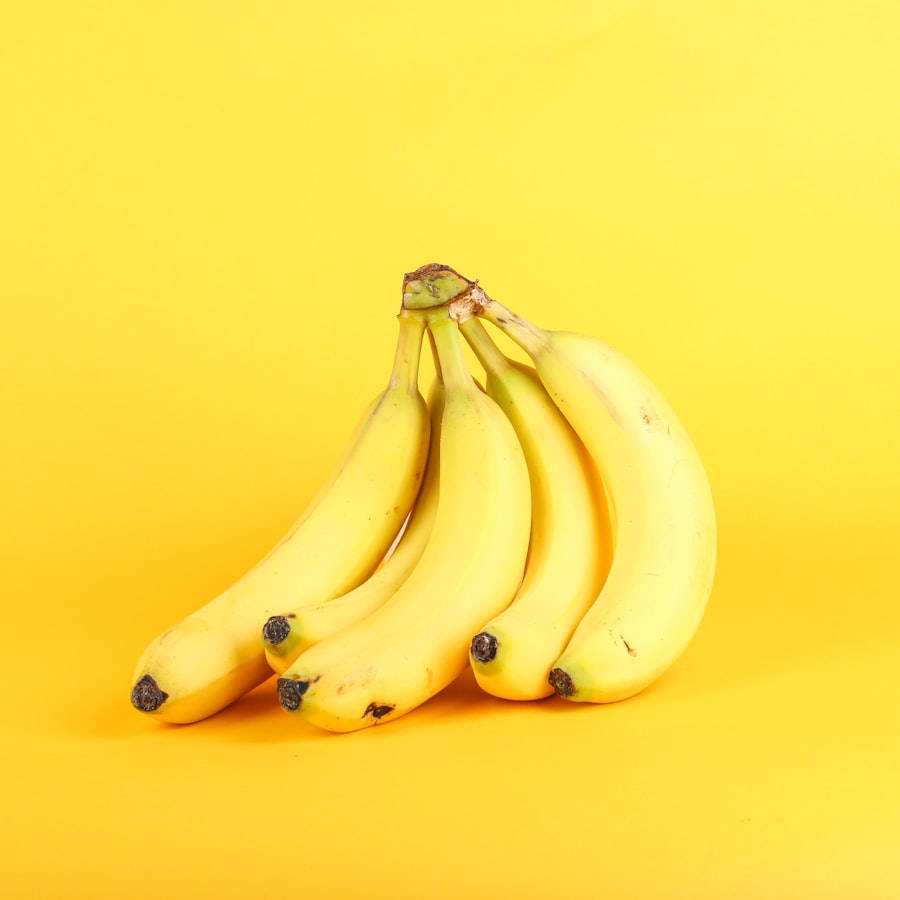
Per the USDA’s FoodData Central, a medium-sized Cavendish banana — about 7 inches long, weighing 118 grams — contains 3.1g of dietary fiber, 105 calories, and 14g of natural sugars. That fiber breaks down into roughly 1g soluble (mostly pectin) and 2g insoluble (cellulose and hemicellulose).
Size matters more than people assume. A small (6″) banana gives you 2.6g of fiber; a large (8–9″) gives 3.5g; an extra-large (9″+) tops out near 4g. If you want a precise number, weigh the fruit — banana fiber works out to about 2.6g per 100g regardless of size.
Advertisement
728 × 90
How ripeness changes the picture
Total fiber stays roughly constant as a banana ripens. What changes dramatically is the proportion of resistant starch — a type of starch that resists digestion in the small intestine and reaches the colon intact, where it ferments much like fiber and feeds beneficial gut bacteria.
- Green / firm bananas contain around 17g of resistant starch on top of their 3g of fiber. Functionally, they behave like a 20g fiber food — but they're starchy and not particularly sweet.
- Yellow, no spots — the standard supermarket banana — has about 5g of resistant starch alongside its 3g of fiber.
- Yellow with brown spots contains only about 1g of resistant starch. The rest has been converted into sugars: this is the most digestible, sweetest stage.
- Mostly brown bananas have less than 1g of resistant starch but the highest sweetness — best for baking or freezing for smoothies.
If you’re eating bananas specifically for gut health, slightly under-ripe is the strategic choice. Slice and freeze green bananas, then blend them into smoothies — frozen + blended is the easiest way to make them palatable.
Banana fiber by size and preparation
The number you’re quoted depends heavily on what you’re measuring. Whole bananas eaten as-is give the textbook number; mashed, chipped, or juiced versions can range from much higher to much lower per serving.
| Banana form | Serving | Fiber | Daily value | Calories |
|---|---|---|---|---|
|
Small (6″) |
100g |
2.6g |
9% DV |
~89 |
|
Medium (7″) |
118g |
3.1g |
11% DV |
~105 |
|
Large (8–9″) |
136g |
3.5g |
13% DV |
~121 |
|
Sliced (1 cup) |
150g |
3.9g |
14% DV |
~134 |
|
Mashed (1 cup) |
225g |
5.9g |
21% DV |
~200 |
|
Banana chips (dried, 1 oz) |
28g |
2.2g |
8% DV |
~147 |
|
Plantain, raw (1 cup sliced) |
148g |
3.5g |
13% DV |
~181 |
Three things people accidentally do that lower the fiber yield: peeling off the white stringy bits — these contain a meaningful chunk of the soluble fiber — drinking banana smoothies that strain out solids, and eating only banana chips that have been fried or heavily processed. The whole banana, eaten whole, gives you the full 3.1g.
Advertisement
728 × 90
How bananas compare to other fruits
Among common fruits, bananas sit roughly in the middle for fiber content. They give less than a medium pear (5.5g), an apple with skin (4.4g), or a cup of raspberries (8g) — but more than an orange (matched at 3.1g), grapes (1g/cup), watermelon (0.5g/cup), or pineapple (2.3g/cup).
The reputation for being “high-fiber” is mostly a function of how universally bananas are eaten. They’re a reliable, portable, inexpensive contributor to daily fiber intake — not a peak source. If you’re optimizing strictly for fiber per calorie, raspberries (8g per 64-calorie cup) win. Bananas are middle-of-pack on that metric but ahead on convenience.
What pairs best for blood sugar and gut health
Banana with peanut butter, or banana with oats, isn’t just culturally common — it’s nutritionally complementary. The protein and fat slow the absorption of banana sugars, the soluble fiber from oats compounds with banana’s pectin, and you end up with a snack that delivers 6–8g of fiber and noticeably better blood-sugar response than a banana alone.
The upgraded version is banana, Greek yogurt, and ground flaxseed: roughly 9g of fiber, complete protein, and live fermented dairy cultures all in one bowl. For people on the IBS / FODMAP spectrum, this combination is generally well-tolerated when the banana is yellow (not over-ripe) and the serving is one medium banana or less.
Common questions
Are bananas good for constipation?
Yes, but specifically ripe ones. Ripe bananas contain pectin, a soluble fiber that helps regulate stool consistency and feeds beneficial bacteria. Green bananas can occasionally have the opposite short-term effect because of their high resistant starch content.
Are bananas low FODMAP?
Yellow, unripe-to-just-ripe bananas are FODMAP-friendly at one medium per serving. Over-ripe (mostly brown) bananas accumulate fructose and become high-FODMAP — limit to about 1/3 of a banana if you’re sensitive.
Do bananas have more fiber than apples?
No. A medium banana has 3.1g; a medium apple with skin has 4.4g. Apples beat bananas on fiber per calorie too. Bananas win on convenience and, when green, on resistant starch.
How many bananas a day is too many?
What about banana flour?
Green-banana flour is essentially concentrated resistant starch — about 50% by weight. One tablespoon delivers around 6g of resistant starch. It’s an unusually efficient way to get prebiotic fiber into baking or smoothies.
Recipes
30 Days of Plants
From the IFGFY shop
38 plant-forward recipes, including 6 with bananas
A month of recipes built to hit 30+ different plant species per week — the strongest dietary signal for gut microbiome diversity in the American Gut Project
★★★★★ 4.7 · 124 pages · PDF + EPUB
Advertisement
728 × 90
Bottom line
A medium banana gives you 3.1g of fiber — about 11% of your daily target. Green bananas add a substantial bonus in the form of resistant starch, while ripe ones offer easier digestion and higher pectin. Bananas aren’t an exceptional fiber source compared to berries, pears, or legumes — but they’re consistent, portable, and pair beautifully with other fiber-rich foods. Use them as a daily contributor, not a sole strategy.

Advertisement
300 × 600
You May Also Like
- Bestseller
- Mini Guide
The 30-Day Gut Reset Protocol
$49
$79
“The 30-day reset finally gave me predictable digestion. I’d tried everything — this was the first thing that explained why.“

Sarah K.
Joined Mar 2026 · 2,840 students
Advertisement
300 × 250
- Our Shop
Practical guides, written by us
PDF + EPUB downloads, no subscription. Researched, edited, and field-tested with real readers — not ghostwritten or AI-generated.
- Bestseller
🌿
- Volume 01
The Fiber Field Guide
By the IsFiberGoodForYou editors
- Foundations
The Fiber Field Guide
A 96-page primer on every type of fiber — what it does, where to find it, and how much you actually need.
- 📄 96 page
- 📥 PDF + EPUB
$14
$22
- New
🍽️
- Volume 02
30 Days of Plants
Recipes & weekly plans
- Recipes
30 Days of Plants
A month of meals built to hit 30+ plant species per week. Shopping lists, prep schedules, swaps for picky eaters.
- 📄 124 pages
- 🥗 38 recipes
$18
- Bundle
📚
- Save 25%
The Complete Library
Both ebooks + future updates
- Bundle
The Complete Library
Both ebooks above, plus every future title we publish through 2026. Free updates as research evolves.
- 📚 2 books + future
- ♻️ Lifetime updates
$24
$32
30-day refund, no questions asked. See the full shop →
The Weekly Fiber Digest
New articles and research roundups, every Thursday.
No spam. Unsubscribe anytime.