
In this article
- Dark chocolate fiber by cacao percentage
- Why the percentage tracks the fiber
- A snack aisle reality check
- How much chocolate it takes to count as a good source
- Sugar for every gram of fiber
- Minerals in an ounce of dark chocolate
- The saturated fat and sugar side
- Dark chocolate and gut health
- Antioxidant chocolate and the blood sugar study
- Myth and fact about chocolate fiber
- Small ways to get more from a square
- One change to make this week
- Dark chocolate fiber: what readers ask
- Sources
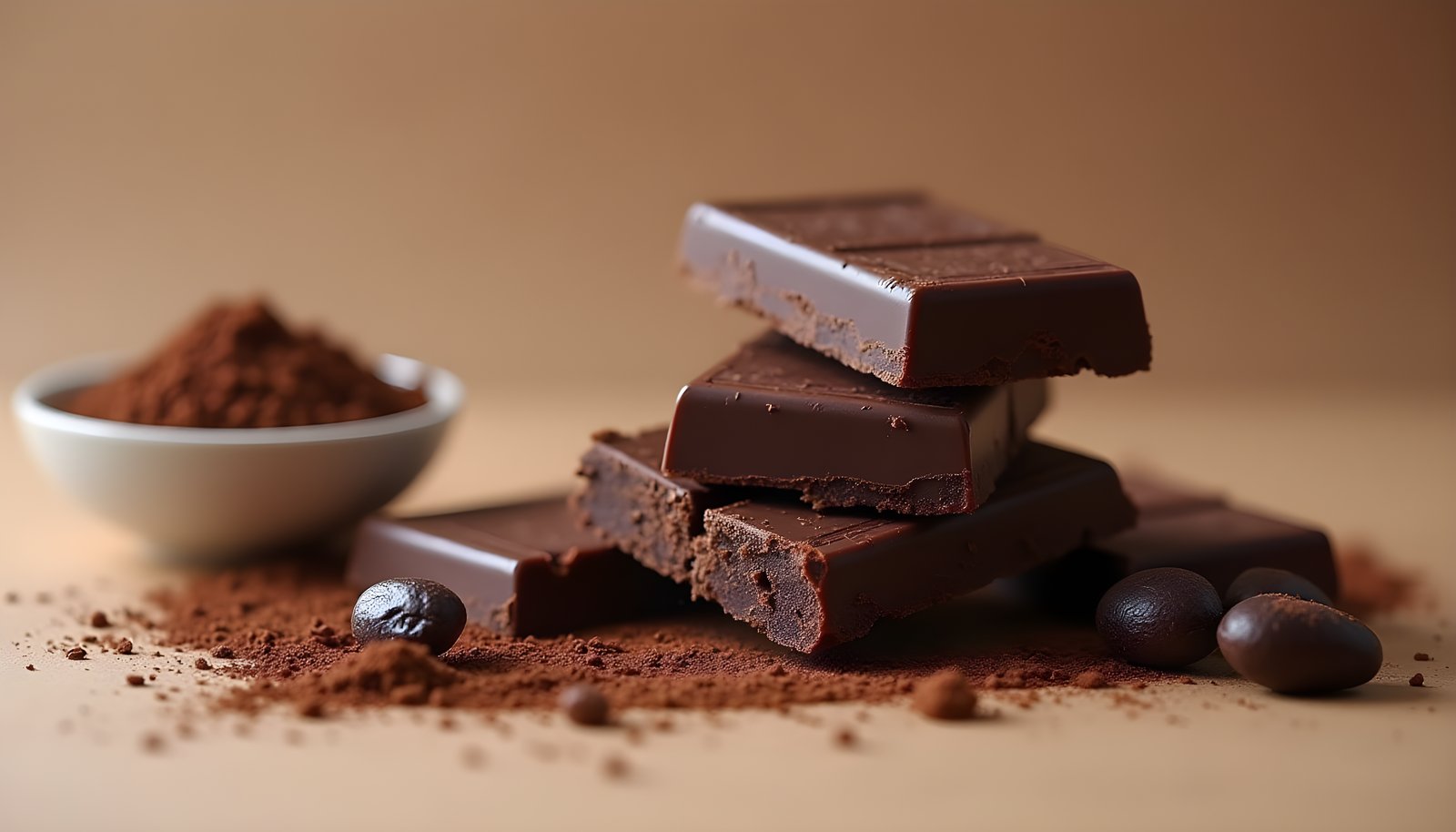
You’re standing in the candy aisle with two bars in your hand, one marked 55% and one marked 78%. On fiber alone, the higher number wins easily: USDA FoodData Central lists about 3.1 grams per ounce for 70 to 85% dark chocolate and about 2.0 grams for the 45 to 59% range.
That gap keeps growing as you move down the shelf. Milk chocolate drops to about 1 gram an ounce, and white chocolate barely registers.
Below you’ll find dark chocolate fiber at every cacao level, how it stacks up against other snacks, what the minerals and sugar look like, and what the newest research on chocolate and blood sugar actually found.
Dark chocolate fiber by cacao percentage
USDA splits dark chocolate into three cacao bands and keeps separate records for semisweet, milk and white chocolate. Here’s one ounce (28 grams) of each:
| Chocolate, 1 oz (USDA) | Fiber | Calories | Sugars |
|---|---|---|---|
| Dark, 70 to 85% cacao | 3.1 g | 170 | 6.8 g |
| Dark, 60 to 69% cacao | 2.3 g | 164 | 10.4 g |
| Dark, 45 to 59% cacao | 2.0 g | 155 | 13.6 g |
| Semisweet | 1.7 g | 136 | 15.5 g |
| Milk chocolate | 1.0 g | 152 | 14.6 g |
| White chocolate | 0.06 g | 153 | 16.7 g |
Only the darkest band tops 3 grams per ounce.
Calories barely move across the table, staying between 136 and 170 an ounce. What changes is how much of that ounce is fiber and how much is sugar.
Not sure where 3 grams leaves you for the day? Our fiber calculator gives you a personal target from your age and sex in a few seconds.
Why the percentage tracks the fiber
The fiber in chocolate comes from the cacao bean itself. A bar labeled 78% devotes more of its weight to cacao, so it carries more of that fiber with it.
USDA’s sugar numbers show the other side of the trade. Per 100 grams, total sugars fall from 47.9 grams in 45 to 59% chocolate to 36.7 grams at 60 to 69% and 24.0 grams at 70 to 85%.
White chocolate is the outlier. USDA lists just 0.2 grams of fiber per 100 grams against 59 grams of sugar, so it behaves like candy with no meaningful fiber at all.
A snack aisle reality check
An ounce of the darkest chocolate costs about 170 calories. Here’s what that same rough calorie budget buys you elsewhere, using USDA values:
| Snack (USDA) | Fiber | Calories |
|---|---|---|
| Dark chocolate 70 to 85%, 1 oz | 3.1 g | 170 |
| Almonds, 1 oz | 3.5 g | 164 |
| Chia seeds, 1 oz | 9.8 g | 138 |
| Raspberries, 2 cups (246 g) | 16.0 g | 128 |
| Milk chocolate, 1 oz | 1.0 g | 152 |
Dark chocolate holds its own against almonds, a snack people pick partly for fiber. It can’t compete with fruit or chia, which bring several times the fiber for fewer calories.
So treat a square of dark chocolate as a dessert that happens to contribute, and lean on whole plant foods for the bulk of your grams.
How much chocolate it takes to count as a good source
Under FDA labeling rules, a food is a good source of fiber when a serving provides 2.8 to 5.5 grams.
Using USDA figures, here’s how much of each chocolate you’d need to eat to hit that mark:
| Chocolate | Amount for 2.8 g fiber | Calories at that amount |
|---|---|---|
| Dark, 70 to 85% | 26 g (just under 1 oz) | 154 |
| Dark, 60 to 69% | 35 g (about 1.2 oz) | 203 |
| Dark, 45 to 59% | 40 g (about 1.4 oz) | 219 |
| Milk chocolate | 82 g (almost 3 oz) | 440 |
| White chocolate | about 1.4 kg | over 7,500 |
The darkest band gets there in less than an ounce. Milk chocolate needs nearly three ounces and 440 calories, which turns a fiber snack into a full candy bar habit.
Sugar for every gram of fiber
Another way to compare bars is to divide the sugar by the fiber. The lower the number, the more fiber you get for each gram of sugar you eat.
| Chocolate (USDA, per 100 g) | Sugars | Fiber | Grams of sugar per gram of fiber |
|---|---|---|---|
| Dark, 70 to 85% | 24.0 g | 10.9 g | 2.2 |
| Dark, 60 to 69% | 36.7 g | 8.0 g | 4.6 |
| Dark, 45 to 59% | 47.9 g | 7.0 g | 6.8 |
| Semisweet | 54.5 g | 5.9 g | 9.2 |
| Milk chocolate | 51.5 g | 3.4 g | 15.1 |
| White chocolate | 59.0 g | 0.2 g | about 295 |
The jump from milk to the darkest dark is close to sevenfold. Even moving from a 55% bar to a 65% bar cuts the ratio by about a third.
This ratio is a handy shortcut when two bars list the same calories. Pick the one with the smaller sugar number and the larger fiber number, and you’ve picked the better fiber bar.
Minerals in an ounce of dark chocolate
Fiber is a modest part of the story. The 70 to 85% band is also dense in several minerals, measured against FDA Daily Values:
- Copper: 0.50 mg, about 56% DV
- Manganese: 0.55 mg, about 24% DV
- Iron: 3.4 mg, about 19% DV
- Magnesium: 65 mg, about 15% DV
- Zinc: 0.94 mg, about 9% DV
These numbers drop with the cacao percentage too: the 45 to 59% band lists 41 mg of magnesium per ounce, and milk chocolate about 18 mg.
The saturated fat and sugar side
Darker chocolate cuts sugar but keeps plenty of fat. An ounce of 70 to 85% chocolate carries 6.9 grams of saturated fat, about 35% of the 20 gram Daily Value.
Sugar runs the other direction. That same ounce has 6.8 grams of sugar, less than half of milk chocolate’s 14.6 grams.
Both numbers explain why portion size matters more with chocolate than with most fiber foods. One ounce fits easily into a day, while a whole 100 gram bar brings nearly 600 calories and almost 25 grams of saturated fat.
Dark chocolate and gut health
The fiber in dark chocolate works like fiber from other foods. Mayo Clinic notes that dietary fiber adds bulk to stool and softens it, which makes it easier to pass and supports regular bowel movements.
Three grams is still a small share of a day’s fiber. Harvard’s Nutrition Source puts the average American at only about 15 grams a day, so chocolate works best as one small piece of a bigger plan.
If you’re raising fiber to calm an unpredictable gut, our gut health guides walk you through a pace your digestion can handle.
Antioxidant chocolate and the blood sugar study
Dark chocolate is often sold as an antioxidant chocolate because cacao is rich in polyphenols, a family of plant compounds. The largest recent look at this came from Harvard researchers in The BMJ in December 2024.
They followed about 192,000 adults in three long running cohorts for more than 30 years. People who ate at least five servings of dark chocolate a week had a 21% lower risk of type 2 diabetes than those who rarely or never ate it.
Milk chocolate showed no such link, and higher milk chocolate intake was tied to long term weight gain. The researchers suggested that dark chocolate’s polyphenols might offset some effects of its sugar and fat.
These are associations from observational data, and the people studied ate relatively little chocolate overall. The findings support choosing dark over milk, not eating more chocolate.
Myth and fact about chocolate fiber
Myth: Any bar labeled “dark” is a decent fiber source.
Fact: The label covers a wide range. USDA’s 45 to 59% band gives 2.0 grams an ounce, about two thirds of what the 70 to 85% band provides, with twice the sugar.
If you want a dark chocolate with more fiber, check the cacao percentage first and the fiber line on the nutrition panel second. Bars with fillings or add ins can land well above or below USDA’s plain chocolate numbers, so the panel is the final word.
Small ways to get more from a square
A few pairings turn a little chocolate into a more fiber rich treat:
- Shave half an ounce of 70 to 85% chocolate over a cup of raspberries for about 9.5 grams of fiber in roughly 150 calories.
- Melt a square into oatmeal instead of stirring in brown sugar.
- Chop dark chocolate into a trail mix with almonds and pumpkin seeds.
- Dip pear or apple slices into a small bowl of melted dark chocolate.
Looking for more desserts and breakfasts that put dark chocolate to work? Our recipe eBooks are full of easy, high fiber ideas.
One change to make this week
Next time you buy chocolate, pick a bar at 70% cacao or higher and break it into one ounce portions as soon as you open it. You’ll get about 3 grams of fiber and a solid dose of copper and iron in each piece, with less than half the sugar of a milk chocolate ounce.
Dark chocolate fiber: what readers ask
Is dark chocolate high in fiber?
Dark chocolate is a modest fiber source. An ounce of 70 to 85% dark chocolate has about 3.1 grams, while lower percentages give 2.0 to 2.3 grams.
How much fiber is in a square of dark chocolate?
It depends on the bar’s square size. A 10 gram square of 70 to 85% dark chocolate has about 1.1 grams of fiber, based on USDA’s 10.9 grams per 100 grams.
Does milk chocolate have fiber?
Yes, but only a little. USDA lists about 1 gram per ounce of milk chocolate, roughly a third of what the darkest dark chocolate provides.
Does white chocolate have any fiber?
Almost none. USDA lists just 0.2 grams per 100 grams, which works out to well under a tenth of a gram per ounce.
Is cacao fiber the same as the fiber in cocoa powder?
Both come from the cacao bean, but the amounts differ a lot. USDA lists about 37 grams of fiber per 100 grams of natural cocoa powder, more than three times the 10.9 grams in 70 to 85% dark chocolate.
Is dark chocolate good for gut health?
It can help a little. Its fiber adds bulk to stool like other dietary fiber, but an ounce supplies only about 3 grams, so fruits, beans and whole grains do most of the work.
How much dark chocolate should I eat a day?
There’s no official target, but one ounce is a practical portion. It gives about 3 grams of fiber and 170 calories, along with about 35% of the Daily Value for saturated fat.
Sources
- U.S. Department of Agriculture, Agricultural Research Service. “FoodData Central” (Chocolate, dark, 45 to 59% cacao solids 170271; 60 to 69% 170272; 70 to 85% 170273; Candies, semisweet chocolate 167976; milk chocolate 167587; white chocolate 167571; cocoa, dry powder, unsweetened 169593; almonds 170567; chia seeds 170554; raspberries 167755). 2026. fdc.nal.usda.gov
- U.S. Food and Drug Administration. “Daily Value on the Nutrition and Supplement Facts Labels.” 2024. fda.gov
- Electronic Code of Federal Regulations. “21 CFR 101.54: Nutrient content claims for good source, high, more, and high potency.” 2026. ecfr.gov
- Harvard T.H. Chan School of Public Health. “Eating dark chocolate linked with reduced risk of type 2 diabetes.” 2024. hsph.harvard.edu
- Mayo Clinic Staff. “Dietary fiber: Essential for a healthy diet.” Mayo Clinic. 2025. mayoclinic.org
- Harvard T.H. Chan School of Public Health. “Fiber.” The Nutrition Source. 2024. nutritionsource.hsph.harvard.edu