Our 6 Top Picks for Bloating
Ranked for gentleness and results. Star ratings are from Amazon shoppers.
Metamucil Premium Blend
Psyllium blend that reliably restored regularity within a week.
$$$
A psyllium husk blend with added inulin and wheat dextrin, delivering 5g of fiber per serving. It’s USP verified and mixes smoothly, and our testers saw consistent regularity within four to seven days. Flavored versions contain aspartame, and the inulin can cause gas in sensitive stomachs, so start with a half dose.
Bellway Daily Fiber
Acacia-forward blend with no day-one bloating for our testers.
$$$
Built for sensitive guts, this blend pairs psyllium and flax with acacia, the gentle fiber that does most of the tolerability work. It delivers 8g of fiber per serving, is NSF tested and has a pleasant flavor. None of our testers had day-one bloating. Expect to pay about 50% more per serving than Metamucil.
NOW Foods Psyllium Husk Powder
Pure psyllium, no additives, about 75 servings per pound.
$$$
Pure psyllium husk with no sweeteners, flavors or fillers, delivering 6g of fiber per serving and roughly 75 servings per pound, the best value on our list. It’s GMP certified but carries no USP or NSF seal. It can turn gritty if mixed slowly, so stir fast and drink right away; orange juice helps.
Thorne FiberMend
PHGG and kiwifruit blend, NSF Certified for Sport.
$$$
A practitioner-grade blend of partially hydrolyzed guar gum (PHGG), green kiwifruit, larch arabinogalactan and prune fiber, with 7g of fiber per serving. PHGG is one of the gentlest fibers for bloating. It’s NSF Certified for Sport and cGMP manufactured, but it’s also the most expensive pick on our list.
Heather’s Tummy Fiber Acacia
Single-ingredient acacia, Monash low-FODMAP certified.
$$$
Single-ingredient acacia fiber with 6g per serving, from a company founded by an IBS patient. It’s Monash University low-FODMAP certified, which matters if fermentable carbs trigger your bloating. It’s tasteless and dissolves clear in water or stirs into food without changing the taste, making it one of the easiest fibers to take daily.
Benefiber Original
Wheat dextrin that dissolves invisibly in any drink.
$$$
Wheat dextrin that dissolves invisibly in hot or cold drinks, so you won’t notice it in coffee or tea. The tradeoff is fiber: just 3g per serving, the lowest on our list, and a thinner research base than psyllium or acacia. It’s made from wheat, so check the label if you avoid wheat or gluten.
Which Types of Fiber Supplements Are Best for Bloating?
Not all fiber behaves the same way in your gut, and for bloating the difference matters. Fiber that ferments quickly gives gut bacteria a fast meal, and gas is the by-product. Fiber that ferments slowly, or forms a gentle gel, tends to ease bloating instead of adding to it.
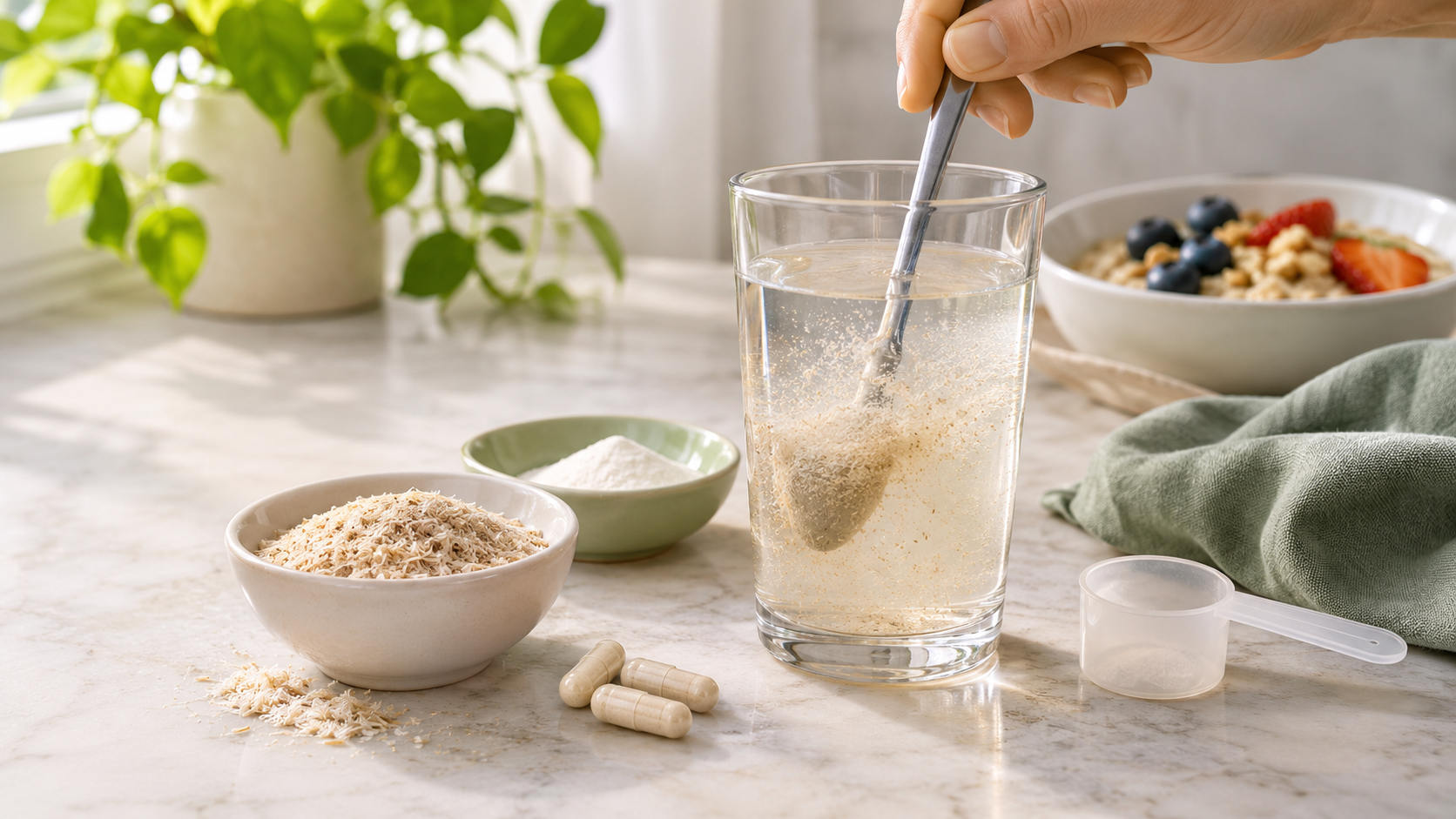
Psyllium husk is the most studied option. It is soluble and gel-forming, holds water to soften stool, and ferments slowly, so it helps with the constipation that often sits behind bloating. Most people tolerate it well when they start with a small dose.
Acacia fiber (gum arabic) is one of the gentlest choices. It ferments very slowly and is tasteless, which is why it shows up in products made for sensitive stomachs and IBS.
Partially hydrolyzed guar gum (PHGG) dissolves completely and is low-FODMAP. Research in IBS suggests it can improve both bloating and bowel habits with few side effects.
Wheat dextrin dissolves invisibly and is easy to take, but it delivers less fiber per serving and contains wheat.
Inulin and FOS (chicory root fiber) are prebiotics that ferment fast. They feed good bacteria, but they are the most likely to cause gas, so people prone to bloating may want to skip them or use a very small amount.
Whatever you choose, start with half a serving, raise it over one to two weeks, and drink plenty of water. If bloating is persistent or painful, talk to your doctor before adding a supplement.