
In this article
- Butternut squash fiber, raw vs baked
- Butternut squash nutrition: the vitamin A standout
- How butternut compares with other winter squash and starchy vegetables
- Butternut squash myths vs facts
- A butternut squash dinner, counted
- Stretching one squash across the week
- What butternut squash fiber does for digestion
- Easy ways to cook butternut squash
- Roast one this week
- Butternut squash questions people ask
- Sources
Butternut squash often gets filed under starchy comfort food, the kind of side you eat in autumn and feel slightly guilty about. The numbers say otherwise: a cup of baked cubes holds about 6.6 grams of fiber for roughly 82 calories, plus more than a full day’s vitamin A.
That puts butternut squash fiber in the same range as Brussels sprouts and well ahead of most root vegetables. The catch, if you can call it one, is that the amount depends heavily on how you cook it.
Butternut squash fiber, raw vs baked
USDA FoodData Central lists raw butternut squash at 2.0 grams of fiber per 100 grams and baked butternut squash at 3.2 grams. Baking drives off water, which concentrates the squash, so each bite carries more fiber.
The cup measurements show the effect even more clearly, since baked cubes shrink and pack tightly.
| Butternut squash form | Serving | Fiber | % DV (28 g) | Calories |
|---|---|---|---|---|
| Raw, cubed | 1 cup (140 g) | 2.8 g | 10% | 63 |
| Baked, cubed | 1/2 cup (103 g) | 3.3 g | 12% | 41 |
| Baked, cubed | 1 cup (205 g) | 6.6 g | 24% | 82 |
| Raw | 100 g | 2.0 g | 7% | 45 |
| Baked | 100 g | 3.2 g | 11% | 40 |
A cup of baked squash has more than twice the fiber of a cup of raw cubes. Part of that is the cup itself: 205 grams of baked squash fit in the space that holds only 140 grams raw.
Calories follow the same pattern. A baked cup has about 82 calories compared with 63 raw, simply because there’s more squash in it, while 100 grams of baked squash actually comes in slightly lower than 100 grams raw.
If you make soup, the fiber stays with the squash. Blending doesn’t remove it, so a bowl made mostly from roasted squash keeps nearly all of its fiber, depending on how much broth you add.
Butternut squash nutrition: the vitamin A standout
Fiber is only part of the reason butternut squash belongs on your plate. Based on USDA’s record for baked butternut squash, one cup of cubes (205 g) provides about:
- Vitamin A: 1,144 mcg RAE, about 127% of the Daily Value
- Vitamin C: 31 mg, about 34% DV
- Magnesium: 59 mg, about 14% DV
- Potassium: 582 mg, about 12% DV
- Calcium: about 84 mg
- Protein: about 2 grams
That vitamin A figure stands out. The NIH Office of Dietary Supplements explains that vitamin A is important for normal vision, the immune system, reproduction, and growth and development.
Most of the vitamin A in butternut squash comes as beta-carotene, the orange pigment the NIH describes as the most common provitamin A carotenoid in foods. The NIH explains that your body turns provitamin A carotenoids like this one into vitamin A.
The NIH lists winter squash among its food sources of vitamin A, alongside sweet potatoes and carrots. That makes butternut squash one of the easiest vitamin A foods to work into a weeknight meal.
Raw butternut squash also brings vitamin E (about 2.0 mg, 13% DV, per raw cup) and vitamin B6 (13% DV), so it rounds out more of the plate than its simple flavor suggests.
How butternut compares with other winter squash and starchy vegetables
The Dietary Guidelines’ Food Sources of Dietary Fiber list gives an easy way to compare butternut with other orange and starchy vegetables, cup for cup.
| Food (1 cup) | Fiber | Calories |
|---|---|---|
| Pumpkin, canned | 7.1 g | 83 |
| Butternut squash, baked | 6.6 g | 82 |
| Sweet potato, baked | 6.3 g | 190 |
| Parsnips, cooked | 6.2 g | 110 |
| Winter squash, cooked (average) | 5.7 g | 76 |
| Carrots, cooked | 4.8 g | 54 |
| Potato, baked with skin (1 medium) | 3.9 g | 161 |
Butternut lands near the top of the group, just behind canned pumpkin. It matches baked sweet potato on fiber with well under half the calories, which makes it a useful swap when you want something sweet and creamy.
Compared with the Dietary Guidelines’ average for cooked winter squash, at 5.7 grams per cup, baked butternut comes out about a gram ahead. It also beats a medium baked potato by more than 2.5 grams.
Carrots make an interesting comparison too. They’re the other orange vegetable most people reach for, but a cup of cooked carrots has about 4.8 grams of fiber, so butternut gives you roughly 1.8 grams more per cup for about 28 extra calories.
For anyone watching calories closely, butternut’s best feature is the ratio. Per 100 calories, baked butternut squash delivers about 8 grams of fiber, compared with about 3.3 grams for baked sweet potato, using the Dietary Guidelines’ cup figures.
Mayo Clinic puts daily fiber needs at about 21 to 25 grams for women and 30 to 38 grams for men. One cup of baked butternut covers roughly 26 to 31% of a woman’s target and 17 to 22% of a man’s.
Curious how your own daily target compares? Our fiber calculator gives you a personal number in seconds.
Butternut squash myths vs facts
Myth: butternut squash is too starchy to be a good vegetable choice
A cup of baked butternut has about 22 grams of carbohydrate, and 6.6 grams of that is fiber. With only around 4 grams of sugar and 82 calories, it’s far lighter than a cup of baked sweet potato, at 190 calories.
Myth: you have to eat it raw to get the most out of it
For fiber, the opposite is true per cup. Baked butternut has more than twice the fiber of raw cubes in the same measuring cup, and its vitamin A per cup climbs as well, from about 745 mcg raw to 1,144 mcg baked.
Myth: canned or frozen squash isn’t worth buying
Canned pumpkin, a close cousin, lists 7.1 grams of fiber per cup on the Dietary Guidelines’ list, the highest in the table above. Plain canned or frozen winter squash is a convenient way to get similar fiber with no peeling.
A butternut squash dinner, counted
Picture a cozy weeknight bowl: a cup of roasted butternut cubes, half a cup of cooked lentils and a handful of greens, finished with a drizzle of tahini. The squash brings about 6.6 grams of fiber.
The lentils add about 7.8 grams, according to the Dietary Guidelines, so the bowl reaches roughly 14 grams of fiber before you count the greens. That’s more than half of a 21 to 25 gram target for women in one meal.
You also get well over a day’s vitamin A and about a third of your vitamin C from the squash alone. A bowl like this proves that comfort food and high fiber food can be the same thing.
Stretching one squash across the week
Roasting a whole squash or a large bag of pre-cut cubes gives you several cups at once, so one session in the oven can cover a lot of meals. Here’s one way to use a batch:
- Monday: roasted cubes as a side with chicken or fish
- Tuesday: a lentil and squash grain bowl
- Wednesday: blended into a quick soup with broth and onion
- Thursday: stirred into chili or a pot of black beans
- Friday: mashed with a little butter as a stand-in for mashed potatoes
At about 6.6 grams of fiber per cup, a cup a day from Monday to Friday adds up to roughly 33 grams of fiber across the week from squash alone.
What butternut squash fiber does for digestion
The fiber in butternut squash supports regular digestion like fiber from other vegetables. Mayo Clinic explains that fiber increases stool weight and size and softens it, which makes it easier to pass and helps prevent constipation.
Mayo Clinic also notes that fiber rich foods tend to be more filling and are linked with steadier blood sugar and healthier cholesterol levels. A naturally sweet, filling side like butternut squash makes those benefits easy to reach.
As you add more fiber to your meals, Mayo Clinic recommends doing it gradually and drinking plenty of water so your digestive system can adjust comfortably.
If you’re looking for a gentler way to build a gut friendly routine, our guides walk you through it step by step.
Easy ways to cook butternut squash
- Roast cubes at high heat with olive oil, salt and a pinch of cinnamon or chili
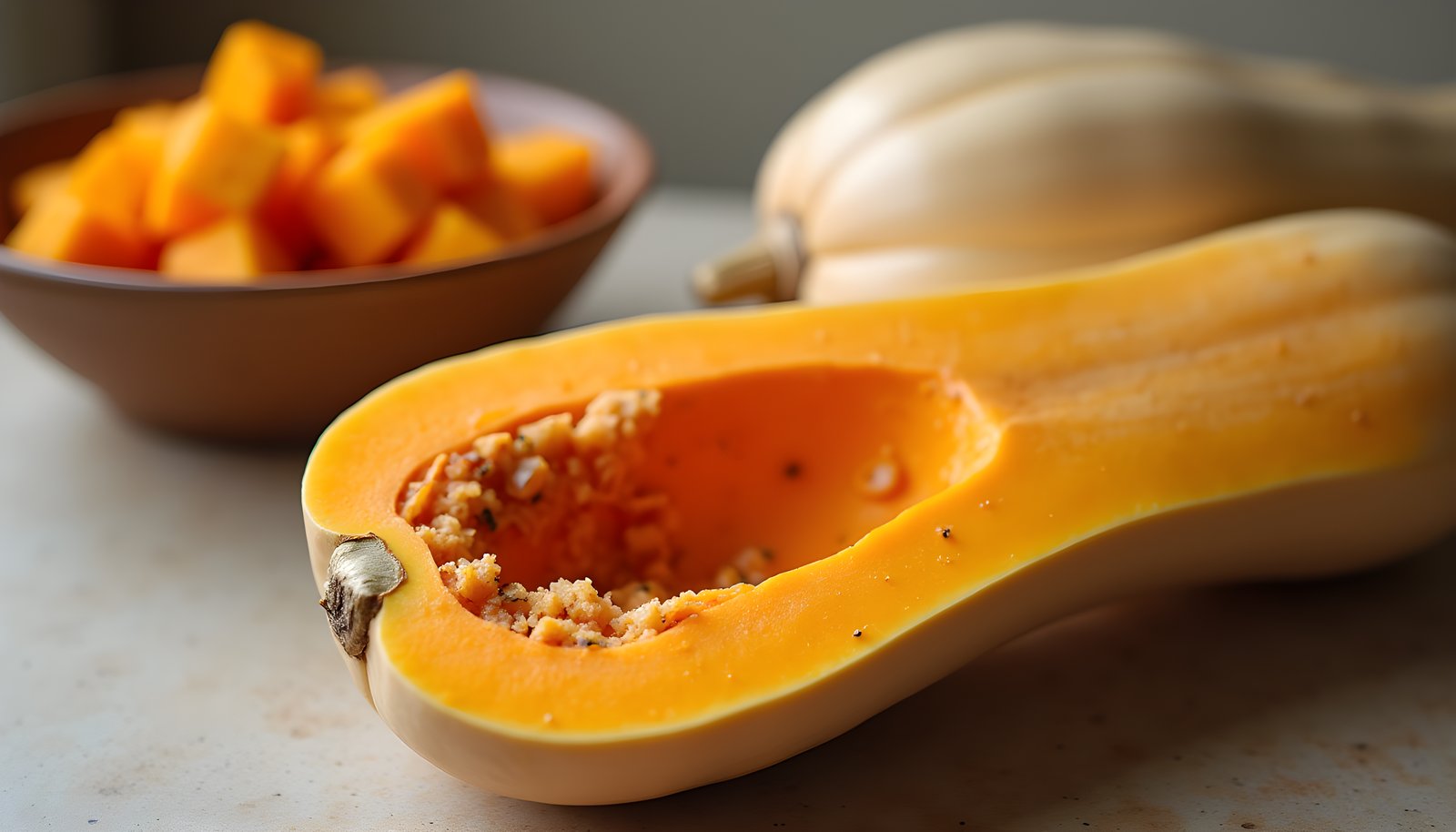
- Halve the squash, scoop out the seeds and bake cut side down until soft
- Blend roasted squash with broth and onion for a smooth soup
- Mash baked squash as a side in place of mashed potatoes
- Stir roasted cubes into risotto, pasta, grain bowls or chili
- Buy pre-cut fresh or frozen cubes to skip the peeling
Peeling a whole butternut is the hardest part of the job, which is why pre-cut cubes are worth considering on busy weeks. Either way, the fiber in each cup stays the same.
Want more ideas for cozy, fiber rich meals? Our recipe eBooks are packed with easy dishes for every season.
Roast one this week
Pick up one butternut squash, or a bag of pre-cut cubes, and roast the whole thing at once. You’ll have several cups ready for bowls, soups and sides, each one carrying about 6.6 grams of fiber and more than a day’s vitamin A.
Butternut squash questions people ask
Is butternut squash high in fiber?
Yes. A cup of baked butternut squash cubes has about 6.6 grams of fiber, close to a quarter of the 28 gram Daily Value.
Does cooking butternut squash increase fiber?
Per cup and per gram, yes. Baking removes water, so USDA lists 3.2 grams of fiber per 100 grams baked compared with 2.0 grams raw.
Is butternut squash better than sweet potato?
For fiber per calorie, yes. A cup of baked butternut has 6.6 grams of fiber and about 82 calories, while a cup of baked sweet potato has 6.3 grams and 190 calories.
How much vitamin A is in butternut squash?
About 1,144 mcg RAE in a cup of baked cubes, roughly 127% of the Daily Value, mostly from beta-carotene.
Is butternut squash good for weight loss?
It can help. It’s filling, fiber rich and lower in calories than many starchy sides, at about 82 calories per baked cup.
Is butternut squash low carb?
Not strictly. A baked cup has about 22 grams of carbohydrate, with 6.6 grams of fiber, so it fits better in a moderate carb eating pattern.
How many calories are in butternut squash?
About 63 calories in a cup of raw cubes and about 82 in a cup of baked cubes, according to USDA.
Sources
- USDA Agricultural Research Service. FoodData Central: SR Legacy Squash, winter, butternut, raw (169295); Squash, winter, butternut, cooked, baked, without salt (169296). 2019. fdc.nal.usda.gov
- U.S. Department of Agriculture and U.S. Department of Health and Human Services. “Food Sources of Dietary Fiber.” Dietary Guidelines for Americans, 2020 to 2025. dietaryguidelines.gov
- U.S. Food and Drug Administration. “Daily Value on the Nutrition and Supplement Facts Labels.” 2024. fda.gov
- National Institutes of Health Office of Dietary Supplements. “Vitamin A and Carotenoids: Fact Sheet for Consumers.” 2025. ods.od.nih.gov
- Mayo Clinic Staff. “Dietary fiber: Essential for a healthy diet.” Mayo Clinic. 2025. mayoclinic.org