
In this article
- Jicama fiber per serving
- What kind of fiber is in jicama?
- Jicama nutrition at a glance
- How jicama compares with other root vegetables and crunchy snacks
- Jicama myths and facts
- A jicama slaw, counted
- Jicama on a low carb plate
- What jicama fiber does for digestion
- A quick checklist for eating more jicama
- What jicama research still needs to show
- Jicama questions people ask
- Sources
Yes, and more than its watery crunch would suggest. A cup of raw sliced jicama carries about 5.9 grams of fiber for just 46 calories, which beats a cup of raw carrots by more than 2 grams.
Jicama is about 90% water, so most people assume it’s a light, refreshing filler with little to offer. That assumption misses where jicama fiber really stands among crunchy raw vegetables: close to the top.
Jicama fiber per serving
USDA FoodData Central lists raw jicama (also called yam bean, from the plant Pachyrhizus erosus) at 4.9 grams of fiber per 100 grams. A cup of sliced jicama weighs about 120 grams.
| Raw jicama serving | Weight | Fiber | % DV (28 g) | Calories |
|---|---|---|---|---|
| 1/2 cup sliced | 60 g | 2.9 g | 10% | 23 |
| 1 cup sliced | 120 g | 5.9 g | 21% | 46 |
| 2 cups sliced | 240 g | 11.8 g | 42% | 91 |
| Per 100 grams | 100 g | 4.9 g | 18% | 38 |
Those numbers are for raw jicama, which is how most people eat it. USDA also has a record for boiled jicama, but it doesn’t report a fiber value, so the raw figures are the reliable ones to use.
A two cup snack bowl brings you to nearly 12 grams of fiber for under 100 calories. Few foods you can eat by the handful come close to that.
What kind of fiber is in jicama?
Part of what makes jicama interesting is the type of carbohydrate it stores. A 2022 study in Food Science & Nutrition analyzed jicama roots at different stages of growth and confirmed the presence of inulin, a type of fructan (a chain of fructose units).
The same study found other fructooligosaccharides (shorter fructose chains, often shortened to FOS) forming as the roots developed. The authors note that FOS are considered a prebiotic, meaning a carbohydrate that feeds beneficial gut bacteria.
Two details matter here. First, the researchers found that inulin levels changed as the roots matured, so the amount in any jicama you buy will vary. Second, they didn’t test prebiotic effects in people; that point rests on earlier research they cite.
So the fair summary is this: jicama contains inulin and related fructans, and those compounds are of real nutritional interest. How much they do for your gut from a typical serving hasn’t been measured directly.
Jicama nutrition at a glance
Fiber leads the way, but jicama carries a few other nutrients worth knowing. Based on USDA’s raw jicama record, one cup sliced (120 g) provides about:
- Calories: 46
- Carbohydrate: 10.6 grams, including 5.9 grams of fiber
- Sugars: about 2.2 grams
- Vitamin C: 24 mg, about 27% of the Daily Value
- Potassium: 180 mg, about 4% DV
- Copper: 0.06 mg, about 6% DV
- Protein: under 1 gram, and almost no fat
Vitamin C is the standout after fiber. Getting more than a quarter of the Daily Value from a cup of crunchy sticks is a nice return for a food most people buy for texture.
The rest of the list is modest. Jicama isn’t a mineral powerhouse, and that’s fine: its strengths are fiber, vitamin C and a lot of volume for very few calories.
How jicama compares with other root vegetables and crunchy snacks
The Dietary Guidelines’ Food Sources of Dietary Fiber list makes the comparison simple. Here’s how a cup of raw jicama lines up against other vegetables people reach for as crunchy snacks or sides.
| Food (1 cup) | Fiber | Calories |
|---|---|---|
| Jicama, raw | 5.9 g | 46 |
| Broccoli, cooked | 5.2 g | 54 |
| Kohlrabi, cooked | 4.9 g | 36 |
| Carrots, raw | 3.6 g | 52 |
| Turnip, cooked | 3.1 g | 34 |
| Red bell pepper, raw | 3.1 g | 39 |
| Cabbage, cooked | 2.8 g | 34 |
| Radishes, raw (USDA) | 1.9 g | 19 |
Jicama leads every food in this table. Against raw carrots, the classic snack stick, it gives you about 2.3 extra grams of fiber for fewer calories.
Among root vegetables, jicama is a lighter choice than the starchy ones. Parsnips have a bit more fiber per cup (6.2 grams) on the Dietary Guidelines list, but they come with 110 calories, more than twice what jicama has.
Per 100 calories, raw jicama delivers roughly 12.8 grams of fiber. Raw carrots land near 6.9 grams and raw red pepper near 7.9 grams by the same math.
Mayo Clinic puts daily fiber needs at about 21 to 25 grams for women and 30 to 38 grams for men. A single cup of jicama covers roughly a quarter of a woman’s target and up to a fifth of a man’s.
Want to see exactly where your own number lands? Our fiber calculator works out a personal daily target in seconds.
Jicama myths and facts
Myth: jicama is basically crunchy water
It’s about 90% water, yet a cup still holds 5.9 grams of fiber. That’s more than a cup of cooked cabbage, turnips or raw bell pepper on the Dietary Guidelines list.
Myth: jicama is starchy like a potato
A cup of raw jicama has about 10.6 grams of carbohydrate, and more than half of that is fiber. A medium baked potato, by comparison, has 161 calories and 3.9 grams of fiber, according to the Dietary Guidelines.
Myth: sweet-tasting jicama must be high in sugar
Jicama tastes mildly sweet, but USDA lists only about 2.2 grams of sugar per cup. That’s well under 5% of the FDA’s 50 gram Daily Value for added sugars, and jicama’s sugar is naturally present, not added.
A jicama slaw, counted
Say you shred a cup of jicama, a cup of raw carrots and a cup of sliced raw red bell pepper into a lime and cilantro slaw. Using the Dietary Guidelines’ cup figures, that bowl carries about 12.6 grams of fiber for roughly 137 calories before dressing.
Jicama contributes almost half of that fiber on its own. Split the slaw between two people as a side and each serving still brings more than 6 grams, about the same as a cup of cooked parsnips with far fewer calories.
Jicama on a low carb plate
Because so much of its carbohydrate is fiber, jicama fits well on lower carb menus. Subtract the 5.9 grams of fiber from 10.6 grams of total carbohydrate and a cup comes to about 4.7 grams of net carbs.
That makes jicama sticks a handy stand-in for chips or crackers with dips. Half a cup lowers that to roughly 2.4 grams of net carbs.
The 2022 study also estimated jicama’s glycemic index in the lab and concluded it can be classified as a low glycemic index food. Those were in vitro estimates rather than tests in people, and the authors said more studies are needed on how jicama’s carbohydrates are digested.
Mayo Clinic notes that fiber, especially soluble fiber, can help slow the absorption of sugar and improve blood sugar levels. Pairing jicama with a meal is one easy way to add fiber that works in that direction.
What jicama fiber does for digestion
Fiber from jicama works much like fiber from other vegetables. Mayo Clinic explains that fiber adds weight and size to stool and softens it, which makes it easier to pass and lowers the chance of constipation.
Mayo Clinic also links high fiber diets with healthier cholesterol levels and with feeling full on fewer calories. A crunchy, low calorie food with this much fiber helps on both counts.
If your meals are usually low in fiber, a big bowl of jicama is a sudden jump. Mayo Clinic notes that adding too much fiber too quickly can cause gas, bloating and cramping, so build up gradually over a few weeks and drink plenty of water.
If you’d like a step by step plan for adding fiber without the discomfort, our gut health guides walk you through it.
A quick checklist for eating more jicama
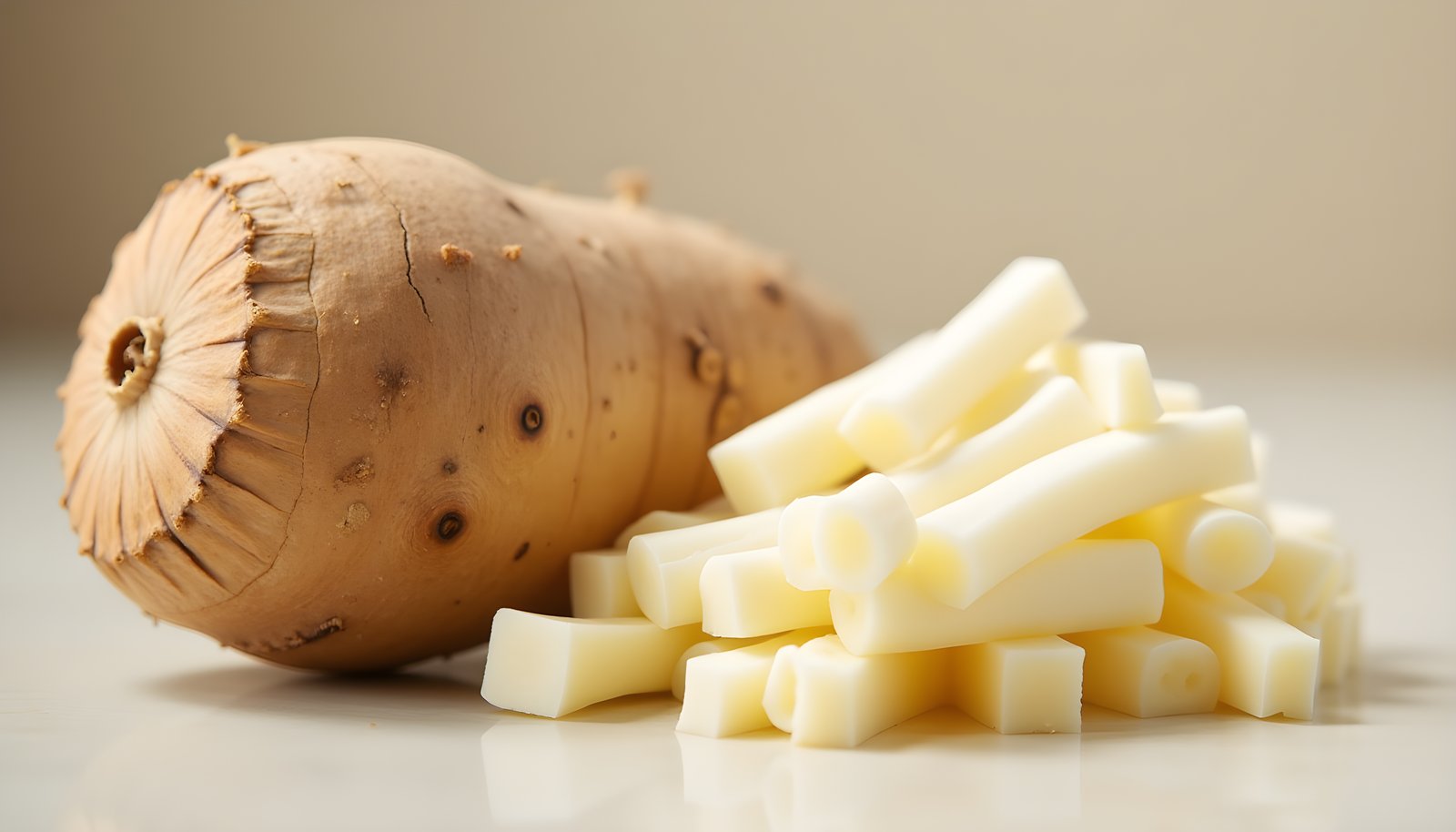
- Peel the brown skin before slicing, since the crisp white flesh is the part people eat
- Cut into sticks for dipping in hummus, guacamole or salsa
- Grate or julienne into slaws with cabbage and carrots
- Dice into fruit salads, grain bowls or fish tacos for crunch
- Toss sticks with lime juice and chili powder for a classic street-style snack
Pairing jicama with bean dips stacks the fiber quickly. Half a cup of chickpeas adds about 6.3 grams, according to the Dietary Guidelines, so a cup of jicama sticks plus that much chickpea in a hearty bowl of hummus reaches about 12 grams.
Looking for more fresh, crunchy recipes like these? Our recipe eBooks are full of easy high fiber meals and snacks.
What jicama research still needs to show
The fiber numbers are solid: USDA’s data puts a cup of raw jicama at about 5.9 grams. The open question is how much of jicama’s inulin and FOS reaches your gut in a typical serving, since the 2022 study found those levels shift as the root grows.
Studies that measure fructan content in jicama sold in stores, and that test its effects on gut bacteria and blood sugar in people, would fill that gap. Until then, eat it for what’s already proven: a lot of fiber and vitamin C for very few calories.
Jicama questions people ask
Is jicama high in fiber?
Yes. A cup of raw sliced jicama has about 5.9 grams of fiber, roughly 21% of the 28 gram Daily Value, for 46 calories.
Is jicama a prebiotic food?
It contains inulin and other fructooligosaccharides, which are considered prebiotics. A 2022 study confirmed inulin in jicama roots, but its prebiotic effects in people haven’t been tested directly.
Does jicama have more fiber than carrots?
Yes. A cup of raw jicama has about 5.9 grams of fiber, while a cup of raw carrots has about 3.6 grams, according to the Dietary Guidelines.
How many net carbs are in jicama?
About 4.7 grams per cup. A cup of raw jicama has roughly 10.6 grams of carbohydrate, and 5.9 grams of that is fiber.
What vitamins are in jicama?
Vitamin C is the main one. A cup of raw jicama has about 24 mg, around 27% of the Daily Value, plus small amounts of potassium, copper and folate.
Is jicama a root vegetable?
Yes. Jicama is the edible root of the yam bean plant, Pachyrhizus erosus, and most people eat it raw.
Can jicama cause gas?
It can if you add a lot of fiber at once. Mayo Clinic notes that increasing fiber too quickly can cause gas and bloating, so add jicama gradually and drink plenty of water.
Sources
- USDA Agricultural Research Service. FoodData Central: SR Legacy Yambean (jicama), raw (170073); Yambean (jicama), cooked, boiled, drained, without salt (170074). 2019. fdc.nal.usda.gov
- U.S. Department of Agriculture and U.S. Department of Health and Human Services. “Food Sources of Dietary Fiber.” Dietary Guidelines for Americans, 2020 to 2025. dietaryguidelines.gov
- U.S. Food and Drug Administration. “Daily Value on the Nutrition and Supplement Facts Labels.” 2024. fda.gov
- González-Vázquez M, et al. “Polysaccharides of nutritional interest in jicama (Pachyrhizus erosus) during root development.” Food Science & Nutrition. 2022. pmc.ncbi.nlm.nih.gov
- Mayo Clinic Staff. “Dietary fiber: Essential for a healthy diet.” Mayo Clinic. 2025. mayoclinic.org