
In this article
- Spaghetti squash fiber per cup
- Spaghetti squash vs pasta: where the difference really is
- How spaghetti squash ranks among squash and other fiber vegetables
- Spaghetti squash nutrition at a glance
- Spaghetti squash as a low carb squash
- Spaghetti squash myths vs facts
- A higher fiber spaghetti squash bowl, counted
- What spaghetti squash fiber does for digestion
- Try one upgrade tonight
- Spaghetti squash questions people ask
- Sources
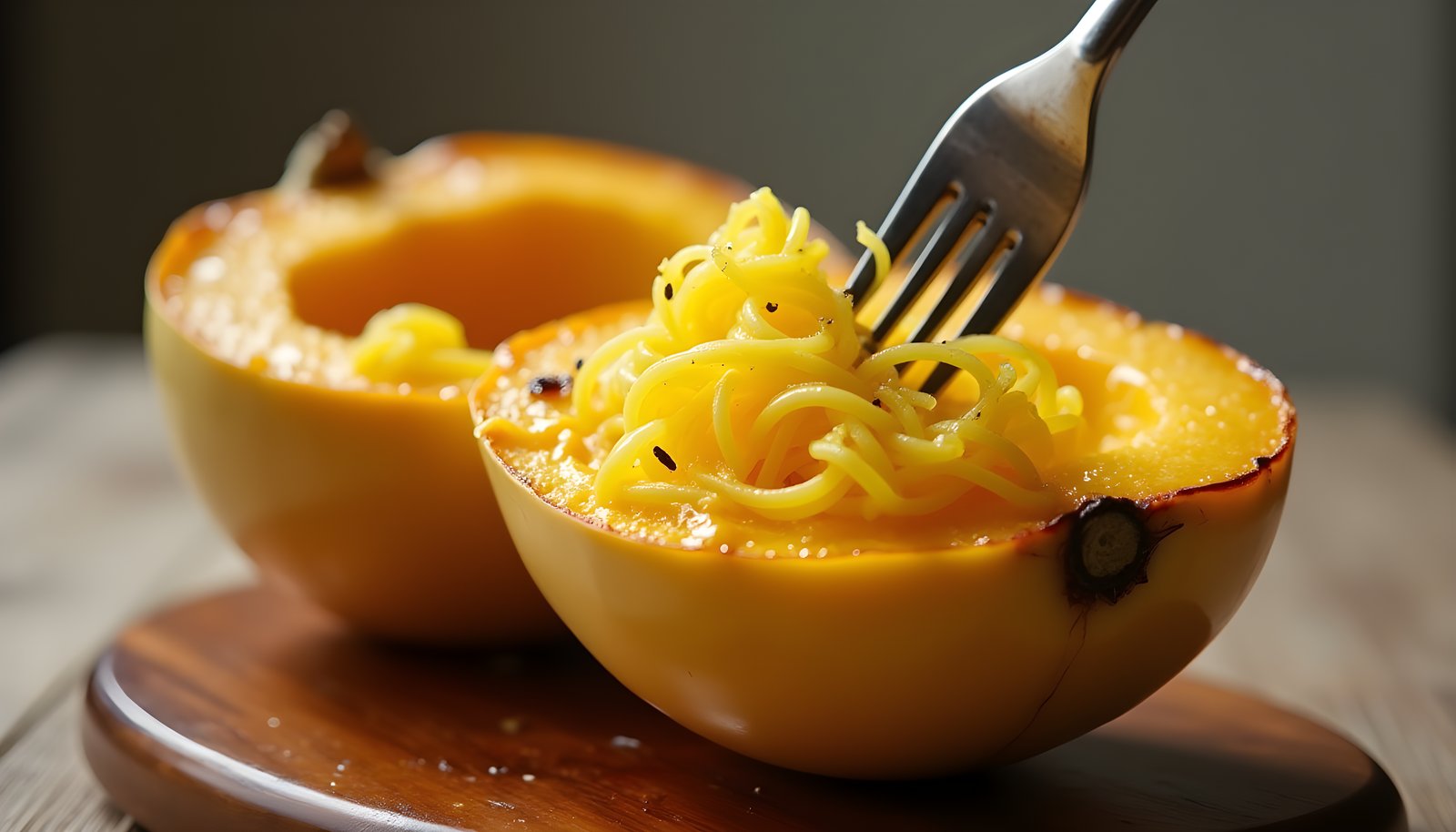
You’ve just pulled a roasted spaghetti squash from the oven, raked the flesh into golden strands and piled them under marinara. It looks like pasta, it twirls like pasta, and it saves you a lot of calories. But is it giving you much fiber?
Honestly, not a lot. A cup of cooked strands has about 2.2 grams of fiber, around 8% of the Daily Value, for roughly 42 calories. Spaghetti squash fiber is modest on its own, so the real win is what the squash lets you add to the bowl.
Spaghetti squash fiber per cup
USDA FoodData Central lists cooked spaghetti squash (boiled or baked, without salt) at 1.4 grams of fiber per 100 grams. A packed cup of strands weighs about 155 grams.
| Spaghetti squash form | Serving | Fiber | % DV (28 g) | Calories |
|---|---|---|---|---|
| Cooked strands | 1/2 cup (78 g) | 1.1 g | 4% | 21 |
| Cooked strands | 1 cup (155 g) | 2.2 g | 8% | 42 |
| Cooked strands | 2 cups (310 g) | 4.3 g | 15% | 84 |
| Raw, cubed | 1 cup (101 g) | 1.5 g | 5% | 31 |
| Cooked | 100 g | 1.4 g | 5% | 27 |
Raw and cooked spaghetti squash land in nearly the same place by weight, at 1.5 and 1.4 grams per 100 grams. The cup numbers differ mostly because a packed cup of cooked strands (155 g) weighs more than a cup of raw cubes (101 g).
Because the strands are so light, you might eat two cups as a main dish. That portion gets you to about 4.3 grams of fiber for under 90 calories, which is a respectable start rather than a high fiber meal.
Spaghetti squash vs pasta: where the difference really is
If you’re cooking spaghetti squash, chances are it’s standing in for pasta. USDA’s numbers show that the swap changes calories and carbs dramatically, while fiber stays roughly the same.
| Per cup, cooked | Spaghetti squash (155 g) | Enriched pasta (132 g) |
|---|---|---|
| Calories | 42 | 209 |
| Carbohydrate | 10.0 g | 40.7 g |
| Fiber | 2.2 g | 2.4 g |
| Net carbs | 7.8 g | 38.3 g |
| Protein | 1.0 g | 7.7 g |
Cup for cup, regular enriched pasta has about the same fiber as spaghetti squash, around 2.4 grams. The squash wins by a wide margin on calories, with about a fifth of the energy, and on net carbs, with about a fifth of the digestible carbohydrate.
Pasta does carry far more protein, nearly 8 grams per cup compared with about 1 gram. If you make the swap, it’s worth adding a protein source to keep the meal filling.
Measured another way, spaghetti squash gives you about 5.2 grams of fiber per 100 calories, while enriched pasta gives about 1.1 grams. So it’s fiber dense for its calories, even if a single cup doesn’t carry much.
How spaghetti squash ranks among squash and other fiber vegetables
Among winter squash, spaghetti squash sits at the low end for fiber. The Dietary Guidelines’ Food Sources of Dietary Fiber list shows how far ahead some of its relatives are.
| Food (1 cup, cooked) | Fiber | Calories |
|---|---|---|
| Pumpkin, canned | 7.1 g | 83 |
| Parsnips | 6.2 g | 110 |
| Winter squash (average) | 5.7 g | 76 |
| Broccoli | 5.2 g | 54 |
| Turnip | 3.1 g | 34 |
| Rutabaga | 3.1 g | 51 |
| Spaghetti squash (USDA) | 2.2 g | 42 |
Butternut squash shows the gap clearly. USDA lists a cup of baked butternut cubes at about 6.6 grams of fiber, three times what you get from a cup of spaghetti squash strands.
The average cooked winter squash on the list has about 2.6 times the fiber of spaghetti squash per cup, though it also has more calories. Canned pumpkin has more than three times as much.
Spaghetti squash is closer to the lighter root vegetables like turnips and rutabaga, which each sit around 3 grams per cup. It’s one of the lowest calorie options in the group, but it isn’t one of the fiber vegetables you’d lean on to hit a target.
Mayo Clinic puts daily fiber needs at about 21 to 25 grams for women and 30 to 38 grams for men. One cup of spaghetti squash covers roughly 9 to 10% of a woman’s target and 6 to 7% of a man’s.
So which squash should you buy? If fiber is your main goal, pick butternut squash or canned pumpkin, both of which carry roughly three times the fiber per cup. If you want the lightest possible base for a pasta-style meal, spaghetti squash is the better fit, as long as you add fiber elsewhere.
Not sure what your own target should be? Our fiber calculator works out a personal daily number in seconds.
Spaghetti squash nutrition at a glance
Spaghetti squash is a light food across the board. Based on USDA’s cooked record, one cup (155 g) provides about:
- Calories: 42
- Carbohydrate: 10 grams, with 2.2 grams of fiber
- Sugars: about 3.9 grams
- Pantothenic acid: 0.55 mg, about 11% of the Daily Value
- Vitamin B6: 0.15 mg, about 9% DV
- Niacin: 1.3 mg, about 8% DV
- Manganese: 0.17 mg, about 7% DV
- Vitamin C: 5.4 mg, about 6% DV
None of those numbers is a headline, and that’s an honest picture of this squash. It brings small amounts of several B vitamins and minerals rather than a big dose of any one nutrient.
It also differs from orange winter squash in one clear way: vitamin A. USDA lists only about 9 mcg RAE per cooked cup, around 1% of the Daily Value, so it doesn’t share the vitamin A richness of butternut squash, which USDA puts at more than a full day’s worth per baked cup.
Spaghetti squash as a low carb squash
For low carb eating, spaghetti squash is a strong pick. A cooked cup has about 10 grams of carbohydrate, and subtracting 2.2 grams of fiber leaves roughly 7.8 grams of net carbs.
Compare that with about 38 grams of net carbs in a cup of cooked enriched pasta. Two cups of squash still come in under 16 grams of net carbs, less than half of a single cup of pasta.
Its mild flavor is part of the appeal on a low carb menu. The strands take on whatever sauce or seasoning you use, so they work under marinara, pesto, a stir-fry sauce or simply olive oil and garlic.
That gives you room on the plate. You can spend some of the carbs you saved on higher fiber additions like beans, lentils or extra vegetables, which is where this meal can really pick up fiber.
Spaghetti squash myths vs facts
Myth: spaghetti squash is a high fiber pasta replacement
It’s a low calorie replacement, but its fiber is about the same as regular pasta’s, roughly 2.2 grams per cup compared with 2.4 grams. The fiber has to come from what you serve with it.
Myth: all winter squash has the same nutrition
Spaghetti squash has about 2.2 grams of fiber per cup, while the Dietary Guidelines list average cooked winter squash at 5.7 grams. Vitamin A differs even more, since spaghetti squash has very little.
Myth: roasting destroys spaghetti squash fiber
USDA’s cooked record lists 1.4 grams of fiber per 100 grams, almost identical to 1.5 grams raw. Cooking changes the texture into strands, not the fiber content in any meaningful way.
A higher fiber spaghetti squash bowl, counted
Start with two cups of cooked spaghetti squash, about 4.3 grams of fiber. Add half a cup of cooked lentils stirred into the sauce, which the Dietary Guidelines list at about 7.8 grams.
Toss in a cup of cooked broccoli for another 5.2 grams. The bowl now holds about 17.3 grams of fiber before you count the sauce, which is four times what the squash brings on its own.
That’s the trick with spaghetti squash: it’s the base, not the fiber source. Treat it like a light canvas and build the fiber on top.
Want more ideas for building filling, vegetable-forward meals? Our recipe eBooks are full of easy, high fiber dishes.
What spaghetti squash fiber does for digestion
Even modest amounts of fiber add up across a day. Mayo Clinic explains that fiber increases the weight and size of stool and softens it, making it easier to pass and helping prevent constipation.
Mayo Clinic also notes that high fiber foods tend to be more filling and are linked with healthier cholesterol and steadier blood sugar. A bowl of squash topped with beans and vegetables brings in more of those benefits than squash alone.
If you’re adding a lot of fiber to a meal that used to be plain pasta, give your gut time. Mayo Clinic recommends increasing fiber gradually and drinking plenty of water.
If your digestion needs a gentler approach, our gut health guides walk you through it step by step.
Try one upgrade tonight
Next time you make spaghetti squash, stir half a cup of lentils or chickpeas into the sauce before you pour it over the strands. Half a cup of chickpeas adds about 6.3 grams of fiber, according to the Dietary Guidelines, which more than doubles the fiber in two cups of squash without changing the dish you already like.
Spaghetti squash questions people ask
Is spaghetti squash a good source of fiber?
It’s a modest source. A cup of cooked spaghetti squash has about 2.2 grams of fiber, around 8% of the 28 gram Daily Value.
Does spaghetti squash have more fiber than pasta?
No, they’re about the same. A cup of cooked spaghetti squash has about 2.2 grams of fiber and a cup of cooked enriched pasta has about 2.4 grams, but the squash has about a fifth of the calories.
How many net carbs are in spaghetti squash?
About 7.8 grams per cooked cup. It has roughly 10 grams of carbohydrate and 2.2 grams of fiber.
Is spaghetti squash good for weight loss?
It can help you cut calories. A cooked cup has about 42 calories compared with about 209 in a cup of cooked enriched pasta.
How many calories are in spaghetti squash?
About 42 calories in a cup of cooked strands and about 31 in a cup of raw cubes, according to USDA.
Which squash has the most fiber?
Spaghetti squash is near the bottom. The Dietary Guidelines list canned pumpkin at 7.1 grams per cup and average cooked winter squash at 5.7 grams.
What nutrients are in spaghetti squash?
Small amounts of several. A cooked cup has about 11% of the Daily Value for pantothenic acid, 9% for vitamin B6 and 8% for niacin.
Sources
- USDA Agricultural Research Service. FoodData Central: SR Legacy Squash, winter, spaghetti, raw (169298); Squash, winter, spaghetti, cooked, boiled, drained, or baked, without salt (169299); Pasta, cooked, enriched, without added salt (169737). 2019. fdc.nal.usda.gov
- U.S. Department of Agriculture and U.S. Department of Health and Human Services. “Food Sources of Dietary Fiber.” Dietary Guidelines for Americans, 2020 to 2025. dietaryguidelines.gov
- U.S. Food and Drug Administration. “Daily Value on the Nutrition and Supplement Facts Labels.” 2024. fda.gov
- Mayo Clinic Staff. “Dietary fiber: Essential for a healthy diet.” Mayo Clinic. 2025. mayoclinic.org