
In this article
- Acorn squash fiber, raw vs baked vs mashed
- Acorn squash nutrition per cup
- Winter squash fiber compared
- Acorn squash as a healthy carb
- Acorn squash and blood sugar
- An acorn squash dinner, counted
- What acorn squash fiber does for digestion
- Even a half cup counts
- Getting the most from acorn squash
- Acorn, butternut or spaghetti: a quick rule
- Acorn squash questions people ask
- Sources
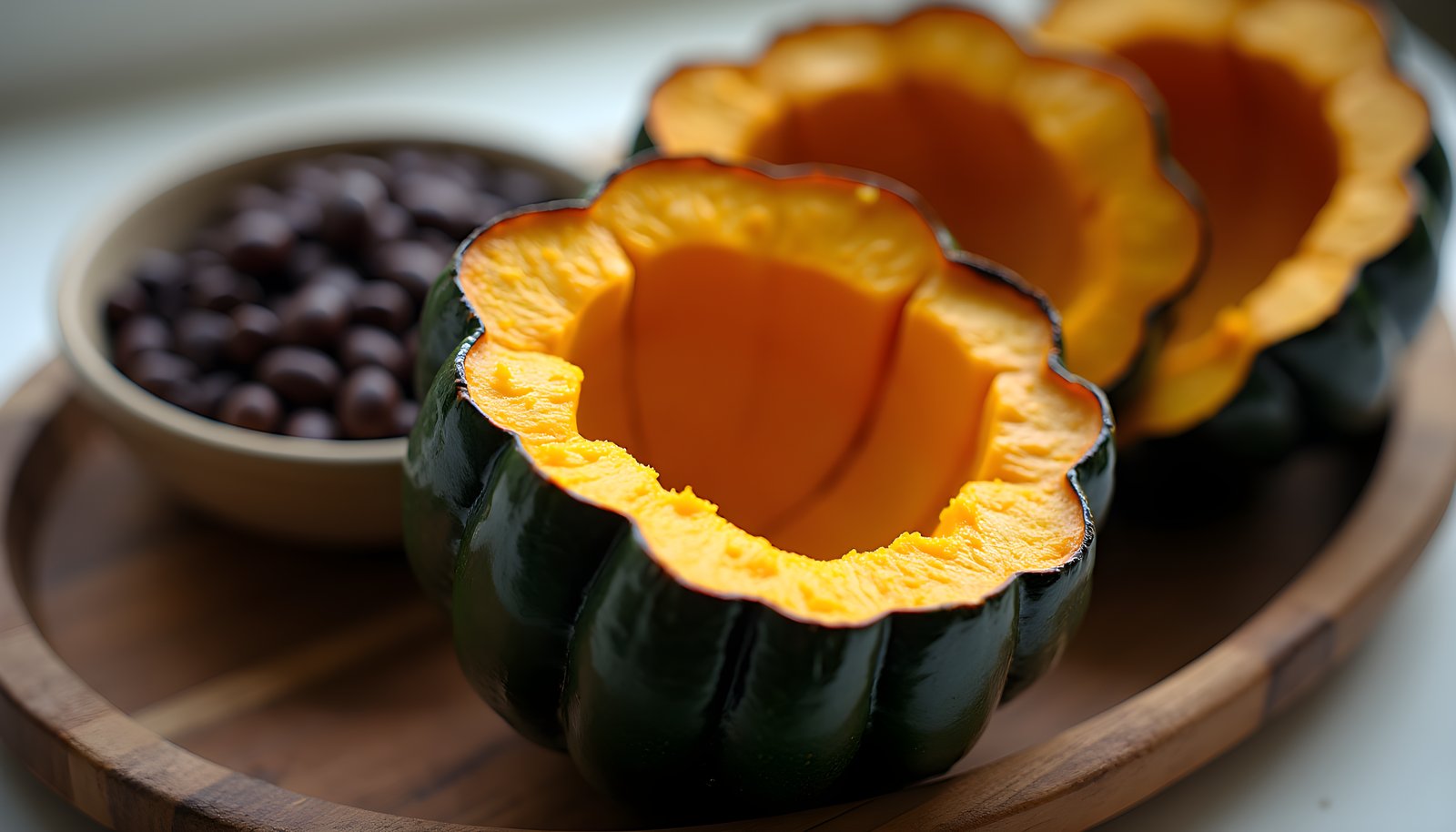
You halve an acorn squash, scoop out the seeds, and slide both halves cut side down into the oven. Once it’s tender, a cup of those soft, golden cubes holds about 9 grams of fiber, roughly a third of the Daily Value, for about 115 calories.
That makes acorn squash fiber one of the strongest numbers among the winter squashes. It also brings about 896 mg of potassium per cup, roughly 19% of the Daily Value, which helps it earn a place among healthy carbs.
Acorn squash fiber, raw vs baked vs mashed
USDA FoodData Central lists baked acorn squash at 4.4 grams of fiber per 100 grams and 56 calories. Raw acorn squash comes in much lower per gram, at 1.5 grams and 40 calories per 100 grams.
| Acorn squash | Serving | Fiber | % DV (28 g) | Calories |
|---|---|---|---|---|
| Raw, cubes | 1 cup (140 g) | 2.1 g | 8% | 56 |
| Baked, cubes | 1/2 cup (103 g) | 4.5 g | 16% | 58 |
| Baked, cubes | 1 cup (205 g) | 9.0 g | 32% | 115 |
| Baked | 100 g | 4.4 g | 16% | 56 |
| Boiled, mashed | 100 g | about 3 g | about 10% | 34 |
The baked figure is much higher per gram than the raw one. Cooking changes the weight of the squash, and USDA’s baked record also comes from a separate analysis, so the two aren’t a direct before and after.
For everyday cooking, the baked number is the one to use. Acorn squash is usually roasted rather than eaten raw, and a cup of cubes is a realistic side dish portion.
Boiling and mashing gives you a softer, wetter texture and a lower figure per 100 grams, about 3 grams. If fiber is your priority, roasting is the better route.
Acorn squash nutrition per cup
Beyond the fiber, a cup of baked acorn squash cubes (205 g) provides about:
- Thiamin (vitamin B1): 0.34 mg, about 28% of the Daily Value
- Vitamin B6: 0.40 mg, about 24% DV
- Vitamin C: 22 mg, about 24% DV
- Manganese: 0.50 mg, about 22% DV
- Magnesium: 88 mg, about 21% DV
- Potassium: 896 mg, about 19% DV
- Iron: 1.9 mg, about 11% DV
- Folate: 39 mcg, about 10% DV
- Calcium: 90 mg, about 7% DV
Magnesium stands out. The NIH Office of Dietary Supplements explains that magnesium helps regulate muscle and nerve function, blood sugar and blood pressure, and that it’s needed to make protein, bone and DNA.
One surprise is vitamin A. A cup of baked acorn squash has only about 43 mcg RAE, about 5% DV, even though its flesh is orange. Butternut squash, by contrast, has over 1,100 mcg in the same cup.
Winter squash fiber compared
Not all winter squash is equal for fiber. Here are cooked figures for common types, from USDA and the Dietary Guidelines.
| Winter squash, cooked | Serving | Fiber | Calories | Fiber per 100 calories |
|---|---|---|---|---|
| Acorn, baked | 1 cup (205 g) | 9.0 g | 115 | 7.8 g |
| Butternut, baked | 1 cup (205 g) | 6.6 g | 82 | 8.0 g |
| Winter squash, cooked (DGA) | 1 cup | 5.7 g | 76 | 7.5 g |
| Pumpkin, canned (DGA) | 1 cup | 7.1 g | 83 | 8.6 g |
| Spaghetti, cooked | 1 cup (155 g) | 2.2 g | 42 | 5.2 g |
Acorn squash wins per cup by a wide margin, about 2.4 grams more than butternut. Butternut is a touch ahead per calorie because it’s lower in calories, and it’s far richer in vitamin A.
Canned pumpkin, a close cousin, sits between the two at 7.1 grams per cup. It’s an easy way to get winter squash fiber when you don’t want to roast a whole squash.
Spaghetti squash is the outlier. It’s very low in calories but carries only about a quarter of acorn squash’s fiber per cup, so it works better as a pasta swap than as a fiber source.
Acorn squash as a healthy carb
A cup of baked acorn squash has about 30 grams of carbohydrate, and 9 of those grams are fiber. That leaves roughly 21 grams of net carbs.
That’s similar to other starchy sides, but the fiber share is unusually high. Here’s how it compares with the Dietary Guidelines figures for other common carb sides.
| Starchy side | Serving | Fiber | Calories |
|---|---|---|---|
| Acorn squash, baked (USDA) | 1 cup | 9.0 g | 115 |
| Sweet potato, cooked | 1 cup | 6.3 g | 190 |
| Corn, cooked | 1 cup | 4.0 g | 134 |
| Potato, baked with skin | 1 medium | 3.9 g | 161 |
| Brown rice, cooked (Mayo Clinic) | 1 cup | 3.5 g | not listed |
| Plantains, cooked | 1 cup | 3.1 g | 215 |
Cup for cup, acorn squash brings more fiber than a cooked sweet potato for about 75 fewer calories, and more than twice the fiber of a baked potato. Brown rice, a classic whole grain choice, delivers well under half as much.
Mayo Clinic notes that fiber, especially soluble fiber, can slow the absorption of sugar and help improve blood sugar levels. Swapping a starchy side for acorn squash is one simple way to raise the fiber share of a meal.
Mayo Clinic suggests 21 to 25 grams of fiber a day for women and 30 to 38 grams for men. One cup of baked acorn squash covers about 36 to 43% of a woman’s target.
Wondering where your own target falls? Our fiber calculator gives you a personal number in seconds.
Acorn squash and blood sugar
Because acorn squash is starchy, people managing blood sugar sometimes wonder whether it belongs on the plate. The fiber is part of the answer.
Mayo Clinic explains that soluble fiber can help slow the absorption of sugar, and that a healthy diet that includes insoluble fiber may also lower the risk of type 2 diabetes. A side that’s nearly a third fiber by carbohydrate weight fits that pattern better than the other starchy sides in the table above.
Portion still matters. A cup of baked cubes has about 21 grams of net carbs, so pairing it with protein, beans or non starchy vegetables keeps the meal balanced.
An acorn squash dinner, counted
Say you bake one acorn squash, split it between two plates, and fill each half with a scoop of black beans and a little cooked barley. A cup of the squash on each plate brings 9 grams of fiber.
The Dietary Guidelines list half a cup of black beans at 7.5 grams and half a cup of cooked barley at 3.0 grams. Each plate lands near 19.5 grams of fiber, close to a woman’s full daily target in one meal.
Skip the beans and barley and the squash still carries a third of the Daily Value on its own. Add them and dinner does most of the day’s fiber work.
Want more stuffed squash and sheet pan ideas? Our recipe eBooks are packed with easy, high fiber meals.
What acorn squash fiber does for digestion
Fiber from acorn squash works like fiber from other vegetables. Mayo Clinic explains that fiber increases the weight and size of stool and softens it, which makes it easier to pass and lowers the risk of constipation.
Mayo also notes that high fiber foods tend to be more filling than low fiber foods. A cup of acorn squash brings real bulk to a plate for a moderate number of calories.
Nine grams in a single side is a big jump if you’re used to a low fiber diet. Mayo Clinic recommends adding fiber gradually over a few weeks and drinking plenty of water, since adding it too fast can cause gas, bloating and cramping.
If your gut needs a slower start, our guides walk you through building up your fiber step by step.
Even a half cup counts
You don’t need a full cup for acorn squash to matter. Half a cup of baked cubes has about 4.5 grams of fiber for 58 calories.
That’s a little more than half a cup of cooked bulgur or edamame, which the Dietary Guidelines list at 4.1 grams each. Tucked into a salad, a soup or a grain bowl, a half cup of leftover squash quietly adds a sixth of the day’s Daily Value.
Bake one squash on Sunday and you have several of those half cup portions ready for the week.
Getting the most from acorn squash
- Bake it rather than boil it, since USDA’s baked figure is higher per gram
- Cut it in half from stem to tip and scoop out the seeds before roasting
- Cube leftovers and add them to grain bowls, salads or soups
- Fill the halves with beans, lentils or whole grains to stack the fiber
- Season with spices, herbs or a little olive oil instead of heavy sweet toppings
Acorn, butternut or spaghetti: a quick rule
If you want the most fiber per serving, choose acorn squash. A cup of baked cubes gives about 9 grams.
If you want vitamin A as well as fiber, choose butternut, which trades about 2 grams of fiber per cup for roughly 25 times the vitamin A. If you want the lightest possible base for sauce, choose spaghetti squash, and add fiber from beans or vegetables alongside it.
Acorn squash questions people ask
Is acorn squash high in fiber?
Yes. A cup of baked acorn squash cubes has about 9 grams of fiber, roughly 32% of the 28 gram Daily Value, according to USDA.
Does acorn squash have more fiber than butternut squash?
Yes, per cup. Baked acorn squash has about 9.0 grams per cup and baked butternut about 6.6 grams.
Is acorn squash a healthy carb?
Yes. A cup has about 30 grams of carbohydrate, and 9 of those are fiber, leaving about 21 grams of net carbs plus potassium and magnesium.
How many calories are in acorn squash?
About 115 calories in a cup of baked cubes and about 56 calories per 100 grams.
Is acorn squash good for digestion?
Its fiber helps. Mayo Clinic explains that fiber adds bulk and softness to stool, and a cup of acorn squash supplies about 9 grams.
Does acorn squash have vitamin A?
Only a little. A cup of baked acorn squash has about 43 mcg RAE, roughly 5% of the Daily Value, far less than butternut.
Can you eat acorn squash skin?
Yes, it softens when roasted, so eating it is a matter of preference. USDA’s figures in this article are for the flesh only.
Sources
- USDA Agricultural Research Service. FoodData Central: SR Legacy Squash, winter, acorn, raw (168472); acorn, cooked, baked (169293); acorn, cooked, boiled, mashed (169294); butternut, cooked, baked (169296); spaghetti, cooked (169299). 2019. fdc.nal.usda.gov
- U.S. Department of Agriculture and U.S. Department of Health and Human Services. “Food Sources of Dietary Fiber.” Dietary Guidelines for Americans, 2020 to 2025. dietaryguidelines.gov
- U.S. Food and Drug Administration. “Daily Value on the Nutrition and Supplement Facts Labels.” 2024. fda.gov
- National Institutes of Health Office of Dietary Supplements. “Magnesium: Fact Sheet for Consumers.” 2021. ods.od.nih.gov
- Mayo Clinic Staff. “Dietary fiber: Essential for a healthy diet.” Mayo Clinic. 2025. mayoclinic.org