
In this article
- Does crab have fiber?
- Crab fiber and nutrition by species
- Seafood nutrition: what crab brings
- Imitation crab: the only crab that lists fiber
- Where crab fits in a week of seafood
- Back at the picnic table
- High fiber sides for crab
- Crab dishes that bring their own fiber
- Crab shells, chitosan and where the research stands
- Crab and fiber: common questions
- Sources
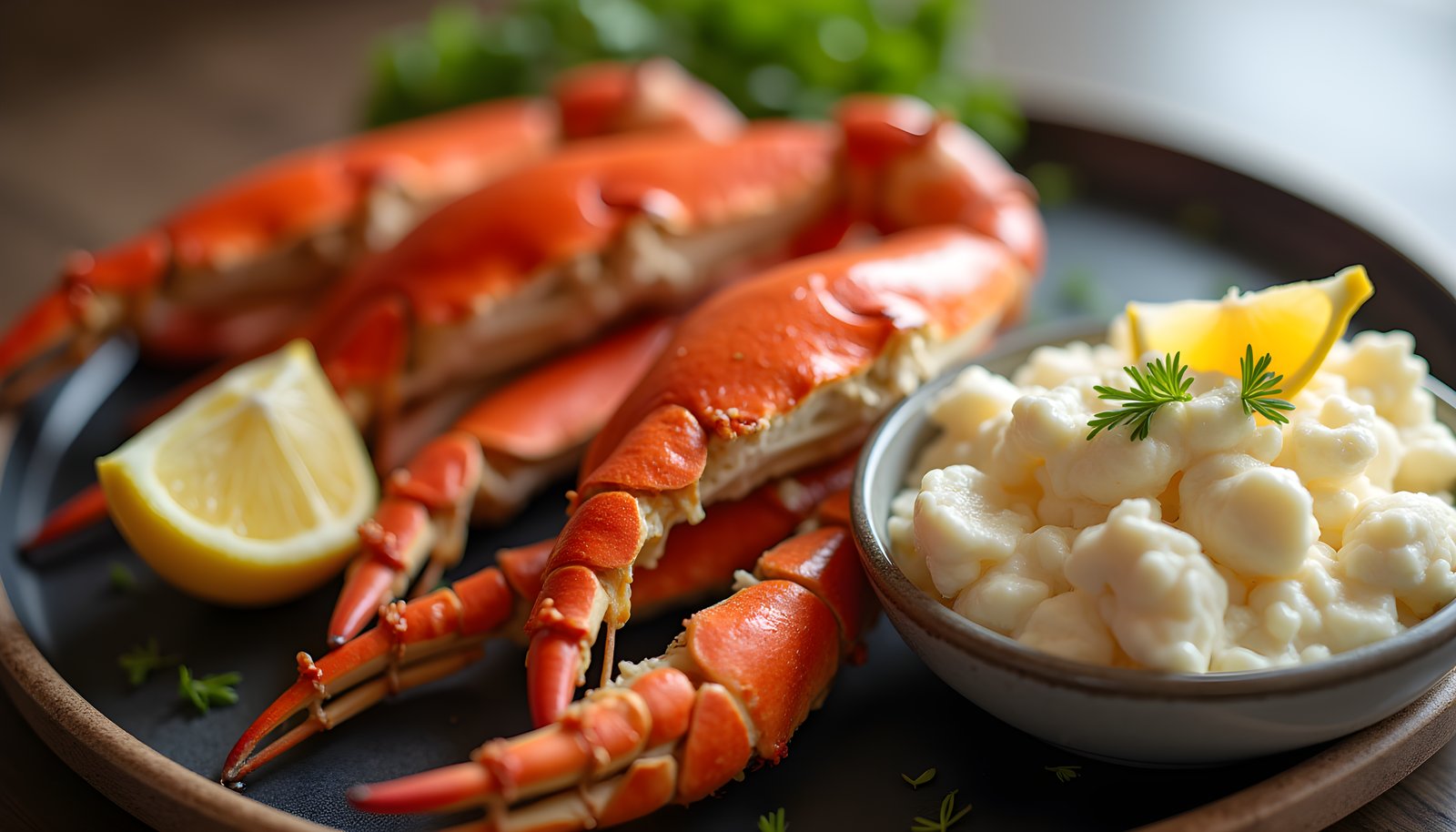
Picture a summer picnic table covered in newspaper, a pile of steamed blue crabs and a mallet at every seat. The crab itself brings plenty of protein, B12 and minerals to that table.
What it brings in crab fiber is 0 grams. Unless the corn, beans or slaw arrive with the crabs, the whole feast can end with almost no fiber at all.
Does crab have fiber?
No. Harvard’s Nutrition Source describes fiber as a carbohydrate the body can’t digest, found in plant foods. Crab meat is shellfish muscle, so it contains none.
USDA FoodData Central lists 0 grams of fiber for cooked blue, Dungeness, queen (snow) and Alaska king crab. A home recipe crab cake record also shows zero.
Crab meat is almost free of carbohydrate too, which is part of why it’s so lean. Nearly all its calories come from protein.
Crab fiber and nutrition by species
These are cooked 3 ounce (85 gram) portions, steamed or boiled, from USDA records:
| Crab, cooked, 3 oz | Calories | Protein | Fat | Cholesterol | Sodium | Fiber |
|---|---|---|---|---|---|---|
| Blue crab | 71 | 15.2 g | 0.6 g | 83 mg | 336 mg | 0 g |
| Alaska king crab | 83 | 16.4 g | 1.3 g | 45 mg | 911 mg | 0 g |
| Dungeness crab | 94 | 19.0 g | 1.1 g | 65 mg | 321 mg | 0 g |
| Queen (snow) crab | 98 | 20.2 g | 1.3 g | 60 mg | 587 mg | 0 g |
Every species stays under 100 calories and about 1.3 grams of fat per portion. Dungeness and snow crab give the most protein, at 19 to 20 grams.
Sodium is where the species split apart. Dungeness and blue crab carry about 320 to 340 mg, while Alaska king crab reaches 911 mg, about 40% of the 2,300 mg Daily Value in one modest serving.
Cholesterol is moderate across the board, from about 15% to 28% of the 300 mg Daily Value.
Seafood nutrition: what crab brings
Crab is low in calories but dense in a handful of nutrients. Here’s what 3 ounces of cooked crab supplies as a share of the Daily Value:
| Nutrient | Blue crab | Dungeness crab | Alaska king crab |
|---|---|---|---|
| Vitamin B12 | 118% | 368% | 407% |
| Copper | 77% | 69% | 112% |
| Selenium | 66% | 74% | 62% |
| Zinc | 29% | 42% | 59% |
Alaska king crab delivers more than four days’ worth of vitamin B12 in one portion, and over a full day of copper. Copper is a mineral the body needs only in small amounts, so crab covers it quickly.
Selenium is the other standout. Every species covers roughly 60% to 75% of the Daily Value per portion, more than many land meats do in the same amount.
King crab also carries about 0.35 grams of the omega-3 fats EPA and DHA per 3 ounces. Blue crab has less, at about 0.14 grams.
Need a personal fiber number before you plan the sides? Our fiber calculator sets one for you in moments.
Imitation crab: the only crab that lists fiber
Imitation crab, made from a fish paste called surimi, flips the usual pattern. Its USDA record lists about 0.4 grams of fiber per 3 ounces, a trace that real crab doesn’t have.
That small trace comes with real trade-offs. The same portion has only 6.5 grams of protein, less than half of what blue crab offers, plus 12.8 grams of carbohydrate and 5.3 grams of sugar.
| Crab product | Portion | Calories | Protein | Carbs | Sodium | Fiber |
|---|---|---|---|---|---|---|
| Blue crab, steamed | 3 oz | 71 | 15.2 g | 0 g | 336 mg | 0 g |
| Imitation crab (surimi) | 3 oz | 81 | 6.5 g | 12.8 g | 450 mg | 0.4 g |
| Crab cake, home recipe | 1 cake (100 g) | 155 | 20.2 g | 0.5 g | 330 mg | 0 g |
The home recipe crab cake keeps most of crab’s protein, with 20 grams per cake. It also brings 7.5 grams of fat and 150 mg of cholesterol, half the Daily Value.
Imitation crab does have one edge. It carries about 17 mg of cholesterol per portion, roughly a fifth of what blue crab has, though its sodium runs higher at 450 mg.
None of these is a real fiber source.
Where crab fits in a week of seafood
The FDA and EPA place crab on their Best Choices list of fish and shellfish, the group lower in mercury. Shrimp and lobster sit on the same list.
The Dietary Guidelines for Americans recommend at least 8 ounces of seafood a week on a 2,000 calorie diet. Two 4 ounce servings of crab would cover that on their own.
The FDA also notes that fish provide protein, vitamin B12, vitamin D, selenium, iron and zinc. Fiber isn’t on that list, which is why the plate around the seafood matters so much.
Back at the picnic table
Return to that crab feast. A spread of nothing but steamed crabs and a cold drink adds up to zero fiber.
Now add a cup of sweet corn kernels, either cut from the cob or in a salad, for 4.0 grams. Toss half a cup of black beans into that corn salad and you’re up to 11.5 grams.
Finish with a cup of raw red pepper strips for dipping and the plate reaches about 14.6 grams. The crabs are still the main event.
If your digestion slows down on protein heavy days with few plants, our gut health guides cover simple ways to keep things regular.
High fiber sides for crab
Bright, fresh sides pair well with sweet crab meat. These values come from the Dietary Guidelines for Americans list of fiber sources:
| Side | Portion | Fiber |
|---|---|---|
| Artichoke, cooked | 1 cup | 9.6 g |
| Black beans, cooked | 1/2 cup | 7.5 g |
| Avocado | 1/2 cup | 5.0 g |
| Broccoli, cooked | 1 cup | 5.2 g |
| Corn | 1 cup | 4.0 g |
| Green beans | 1 cup | 4.0 g |
| Potato, baked with skin | 1 medium | 3.9 g |
| Red bell pepper, raw | 1 cup | 3.1 g |
| Asparagus, cooked | 1 cup | 2.9 g |
Artichoke and crab work well together, and a cup of artichoke alone brings 9.6 grams. Avocado adds 5 grams per half cup and works in crab salads, rolls and bowls.
Harvard estimates that most Americans get only about 15 grams of fiber a day. A crab dinner built around two or three of these sides can match that in a single meal.
Looking for crab cakes, salads and seafood bowls that bring their own fiber? Our recipe eBooks have high fiber versions worth trying.
Crab dishes that bring their own fiber
Crab meat mixes easily into dishes, which makes it simple to pair with plants. These ideas use the side values above, with 3 ounces of crab per serving:
- Crab and avocado salad: crab over greens with half a cup of avocado, half a cup of black beans and a cup of red pepper, for about 15.6 grams of fiber.
- Crab stuffed artichoke: a cup of artichoke filled or topped with crab, for about 9.6 grams.
- Crab stir fry: crab tossed with a cup of broccoli and a cup of asparagus, for about 8.1 grams.
- Crab and corn salad: crab with a cup of corn and half a cup of black beans, for about 11.5 grams.
Each of these keeps crab’s protein, at 15 to 20 grams depending on the species, while adding about 8 to 16 grams of fiber.
The extra fiber matters beyond the number. Harvard’s Nutrition Source links a high fiber intake with a lower risk of heart disease, and notes that fiber helps regulate the body’s use of sugars, helping keep hunger in check after a light seafood meal.
Picking crab at the counter
If you’re watching sodium, Dungeness and blue crab are the lighter picks, at about a third of the sodium in Alaska king crab per portion. Snow crab sits in between at 587 mg.
If protein is your main goal, choose real crab over imitation. Blue crab gives more than twice the protein of surimi for fewer calories, and Dungeness or snow crab gives about three times as much.
Crab shells, chitosan and where the research stands
The shell is the one part of a crab with a fiber-like material. Chitosan, a manufactured polysaccharide sold as a supplement, is prepared commercially from crustacean shells.
According to the NIH Office of Dietary Supplements, chitosan is marketed for weight loss on the idea that it binds some dietary fat in the gut. A Cochrane review of 13 trials found an average loss of 1.7 kg more than placebo, but most studies were of poor quality, and the better trials showed minimal effects.
Because it comes from shellfish, people with a shellfish allergy could theoretically react to it. For now, the evidence points back to the plate: crab for protein and minerals, and plant foods for fiber.
Crab and fiber: common questions
Does crab have fiber?
No. USDA records for cooked blue, Dungeness, snow and king crab all list 0 grams of fiber, because fiber only comes from plant foods.
Does imitation crab have fiber?
Only a trace. Imitation crab made from surimi lists about 0.4 grams of fiber per 3 ounces, along with 12.8 grams of carbohydrate and less than half the protein of real crab.
Is crab healthy?
Yes, in most forms. Three ounces of blue crab has 71 calories, 15 grams of protein and more than a day’s vitamin B12, with almost no fat.
Which crab has the most sodium?
Alaska king crab is highest among the USDA records, at about 911 mg per 3 ounces, roughly 40% of the Daily Value. Dungeness has about 321 mg.
Is crab high in cholesterol?
It’s moderate. Cooked crab has about 45 to 83 mg of cholesterol per 3 ounces, which is 15% to 28% of the Daily Value.
Is crab a good seafood choice for low mercury?
Yes. The FDA and EPA list crab among their Best Choices, the group of fish and shellfish lower in mercury.
Do crab cakes have fiber?
A home recipe crab cake lists 0 grams of fiber in USDA data. Adding a side like corn or black beans is the easiest way to bring fiber to the meal.
Sources
- U.S. Department of Agriculture, Agricultural Research Service. “Crustaceans, crab, blue, cooked, moist heat (174205); Crustaceans, crab, alaska king, cooked, moist heat (174202); Crustaceans, crab, dungeness, cooked, moist heat (172007); Crustaceans, crab, queen, cooked, moist heat (172008); Crustaceans, crab, alaska king, imitation, made from surimi (174203); Crustaceans, crab, blue, crab cakes, home recipe (171967).” FoodData Central. 2026. fdc.nal.usda.gov
- U.S. Food and Drug Administration. “Advice about Eating Fish.” 2024. www.fda.gov
- National Institutes of Health, Office of Dietary Supplements. “Dietary Supplements for Weight Loss: Fact Sheet for Health Professionals.” 2026. ods.od.nih.gov
- U.S. Food and Drug Administration. “Daily Value on the Nutrition and Supplement Facts Labels.” 2024. www.fda.gov
- Harvard T.H. Chan School of Public Health. “Fiber.” The Nutrition Source. nutritionsource.hsph.harvard.edu
- U.S. Department of Agriculture and U.S. Department of Health and Human Services. “Food Sources of Dietary Fiber.” Dietary Guidelines for Americans, 2020 to 2025. www.dietaryguidelines.gov