
In this article
- Raw foods diet fiber in a typical day
- The raw foods that carry the most fiber
- Raw vegetables fiber and the volume problem
- What a raw diet leaves out: beans and grains
- Uncooked foods and digestion
- Raw vegan nutrition: where the gaps show up
- How a raw diet compares with a cooked plant-based diet
- Building a higher raw day without the downsides
- What research still needs to answer
- Raw food diets and fiber: what people ask
- Sources
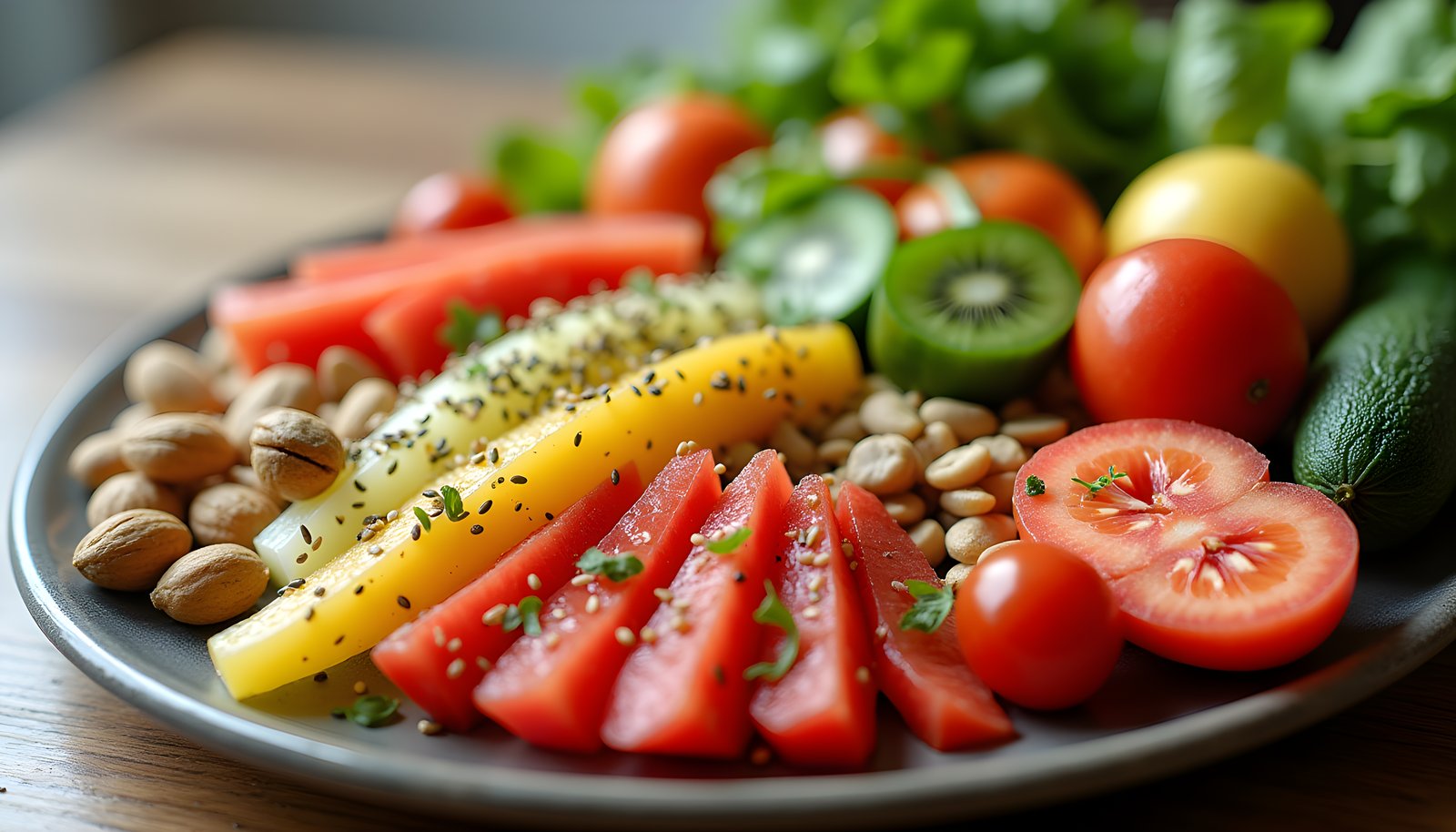
Raw foods diet fiber is almost never the problem. A simple day of raw fruit, vegetables, nuts and seeds can deliver more than 50 grams of fiber, roughly double what Mayo Clinic suggests for most women.
The twist is what comes with all that fiber. The same day can add up to fewer than 1,000 calories, and the biggest survey of long-term raw eaters found that many lost far more weight than expected.
Below you’ll find how a raw day stacks up, which foods carry the fiber, what happens to digestion when most of your food is uncooked, and the nutrients a raw vegan plan tends to miss.
Raw foods diet fiber in a typical day
Here’s a realistic raw food day built from USDA and Dietary Guidelines figures. Nothing is cooked, and every item is a common raw diet staple.
| Meal | Food | Fiber | Calories |
|---|---|---|---|
| Breakfast | Chia pudding (2 Tbsp chia seeds) | 8.2 g | 116 |
| Breakfast | Raspberries, 1 cup | 8.0 g | 64 |
| Snack | Apple with skin, 1 medium | 4.8 g | 104 |
| Snack | Almonds, 1 oz | 3.5 g | 164 |
| Lunch | Romaine, 2 cups shredded | 2.0 g | 16 |
| Lunch | Red bell pepper, 1 cup chopped | 3.1 g | 39 |
| Lunch | Carrots, 1 cup chopped | 3.6 g | 52 |
| Lunch | Avocado, 1/2 cup | 5.0 g | 120 |
| Lunch | Ground flaxseed, 1 Tbsp | 2.8 g | 55 |
| Dinner | Pumpkin seeds, 1 oz | 5.2 g | 126 |
| Dessert | Pear, 1 medium | 5.5 g | 103 |
| Total | 51.7 g | 959 |
That’s 51.7 grams of fiber for under 1,000 calories, or about 5.4 grams per 100 calories.
To reach a normal energy intake on raw food, you’d need to eat roughly twice this much, which would push fiber toward 100 grams. The usual way to close that gap on a raw plan is with energy dense foods like nuts, seeds and dried fruit.
The raw foods that carry the most fiber
On a raw plan, a few food groups do almost all the fiber work. Seeds and berries stand out because they pack a lot of fiber into a small serving.
| Raw food | Serving | Fiber | Calories |
|---|---|---|---|
| Chia seeds | 1 Tbsp | 4.1 g | 58 |
| Raspberries | 1 cup | 8.0 g | 64 |
| Pear | 1 medium | 5.5 g | 103 |
| Pumpkin seeds | 1 oz | 5.2 g | 126 |
| Avocado | 1/2 cup | 5.0 g | 120 |
| Apple with skin | 1 medium | 4.8 g | 104 |
| Carrots, chopped | 1 cup | 3.6 g | 52 |
| Almonds | 1 oz | 3.5 g | 164 |
| Red bell pepper, chopped | 1 cup | 3.1 g | 39 |
Berries and pears give you the most fiber per calorie, which helps if you want to feel full on less. Nuts and seeds are the opposite: their fiber comes with a lot of energy, which is exactly why raw eaters who struggle to keep weight on tend to lean on them.
Leafy greens rank lower than their reputation suggests when eaten raw, simply because a cup of loose leaves weighs so little. They’re still worth eating for their vitamins, just not as your main fiber source.
Raw vegetables fiber and the volume problem
Cooking barely changes the fiber in a gram of vegetable. USDA data show raw and boiled carrots at 2.8 and 3.0 grams per 100 grams, and raw and boiled kale at 4.1 and 4.0.
What changes is volume. Raw greens are bulky and full of air, so a cup holds far less food than a cup of the same vegetable cooked down.
| Vegetable | Raw cup | Cooked cup |
|---|---|---|
| Spinach | 0.7 g (30 g of leaves) | 4.3 g |
| Broccoli | 2.4 g | 5.2 g |
| Cauliflower | 2.1 g | 4.9 g |
| Carrots | 3.6 g | 4.8 g |
To match one cup of cooked spinach, you’d need about six cups of raw leaves. That’s why raw diets lean so heavily on salads, smoothies and blended soups: it takes a lot of chewing or blending to get the same amount of food.
Not sure how your own daily fiber target compares with a raw day like this? Our fiber calculator works out a personal number in seconds.
What a raw diet leaves out: beans and grains
Some of the richest fiber foods in the Dietary Guidelines list need cooking. Half a cup of cooked lentils has 7.8 grams, navy beans 9.6 grams and split peas 8.2 grams, and none of them work raw.
Dried kidney beans are a clear example of why. They contain a lectin called phytohaemagglutinin, and Kansas State University food scientists note that as few as four or five undercooked red kidney beans can cause severe vomiting.
Raw diets work around this with sprouted grains and seeds, but sprouting doesn’t replace a bowl of beans. The result is a fiber mix that’s dominated by fruit, vegetables, nuts and seeds, with much less of the fiber that comes from legumes and whole grains.
Uncooked foods and digestion
Raw plant cell walls are intact and firm, which is why raw vegetables take longer to chew. Cooking softens those walls without removing much fiber, so cooked vegetables are usually easier to digest.
A sudden jump to a high fiber raw diet often brings gas, bloating and cramps. Mayo Clinic advises adding fiber gradually over a few weeks and drinking plenty of water so your digestive system can adjust.
- Blend or finely chop tougher vegetables like kale and broccoli to make them easier to break down.
- Massage raw kale with a little lemon juice or oil to soften the leaves.
- Mix raw and cooked foods while your gut adjusts, rather than switching overnight.
- Spread fiber across the day instead of eating one huge salad.
Smoothies versus pressed juices
Blending is one of the most useful raw food tools for fiber. A smoothie keeps all the fiber from the fruit, greens and seeds that go into it, just broken into smaller pieces.
Pressed juice is a different story, because the pulp that holds most of the fiber is left behind in the machine. If juice is part of your raw routine, treat it as a drink and get your fiber from whole or blended foods.
If your digestion needs help settling into more fiber, our gut health guides take you through it one step at a time.
Raw vegan nutrition: where the gaps show up
The best research on long-term raw eaters comes from the Giessen Raw Food Study in Germany. A survey of 513 people who had eaten mostly raw food for an average of 3.7 years found an average weight loss of 9.9 kg in men and 12 kg in women since starting the diet.
About 15% of the men and 25% of the women were underweight, with a body mass index below 18.5. Roughly 30% of women under 45 reported missing some or all of their periods, and the problems were more common in people eating more than 90% raw.
The authors concluded that a very strict raw food diet can’t be recommended long term. Later work from the same group found mixed heart markers: lower LDL cholesterol and triglycerides, but also lower HDL cholesterol and raised homocysteine, an amino acid that rises when vitamin B12 runs low.
Raw foods do keep more of some heat sensitive vitamins. Raw kale has 93 mg of vitamin C per 100 grams, while boiled kale has 18 mg, so the diet isn’t short on everything.
How a raw diet compares with a cooked plant-based diet
| Factor | Mostly raw | Mostly cooked plant-based |
|---|---|---|
| Fiber | Very high (51.7 g in our sample day) | High, especially with beans and whole grains |
| Main fiber sources | Fruit, vegetables, nuts, seeds | Beans, whole grains, vegetables, fruit |
| Calories | Hard to eat enough | Easier to meet needs |
| Vitamin C | Higher | Some lost to cooking |
| Protein and iron | Lower without legumes | Easier with beans and lentils |
| Digestion | More gas and bulk at first | Usually gentler |
For fiber, a mostly cooked plant-based diet does the job with less effort. You get beans and whole grains back, and you can still keep plenty of raw fruit and salads in the mix.
Building a higher raw day without the downsides
You don’t have to go all in to get the benefits of more raw produce. Many people do well with a raw breakfast and lunch and a cooked dinner built around beans or whole grains.
Picture a day that starts with chia pudding and raspberries, includes a big raw salad with avocado at lunch, and ends with soup made with a cup of cooked lentils, which Mayo Clinic puts at 15.5 grams. That lands around 45 grams of fiber, with the protein and calories from the lentils filling the gaps a fully raw day leaves.
Want more ideas for meals that mix raw and cooked plant foods? Our recipe eBooks are full of easy, high-fiber combinations.
What research still needs to answer
Most of what we know about raw food diets comes from a handful of small or cross-sectional studies, many of them from the 1990s and early 2000s. They describe raw eaters at one point in time rather than following them as they change their diet.
Researchers still need larger, longer studies that track fiber intake, gut bacteria, bone health and weight together in people eating mostly raw. Until then, the fiber side of the diet looks strong, while the calorie and nutrient side is where the open questions sit.
Raw food diets and fiber: what people ask
Do raw foods have more fiber than cooked foods?
Not per gram. USDA data show raw and boiled carrots at 2.8 and 3.0 grams of fiber per 100 grams, and kale barely changes either. Cooked vegetables often show more fiber per cup because they shrink.
How much fiber do you get on a raw vegan diet?
Often 50 grams or more. A day of raw fruit, vegetables, nuts and seeds can reach about 52 grams in under 1,000 calories, and eating enough food to meet energy needs pushes it higher.
Is too much fiber on a raw diet a problem?
It can be at first. Large jumps in fiber can cause gas, bloating and cramps, so Mayo Clinic suggests adding fiber gradually and drinking plenty of water.
Why do people lose weight on a raw food diet?
Raw foods are bulky and low in calories, so it’s hard to eat enough. In the Giessen Raw Food Study, women lost an average of 12 kg and men 9.9 kg after starting the diet.
Can you eat beans on a raw food diet?
Not most dried beans. Kidney beans contain a lectin that cooking destroys, and as few as four or five undercooked beans can cause severe vomiting, so raw eaters rely on sprouts instead.
Are raw vegetables harder to digest?
Often, yes. Raw cell walls are firm and intact, while cooking softens them without removing much fiber, so cooked vegetables tend to be gentler on the gut.
Is a partly raw diet a good way to get more fiber?
Yes. Adding raw fruit, salads, nuts and seeds to a diet that still includes cooked beans and whole grains gives you plenty of fiber without the calorie and nutrient gaps of a fully raw plan.
Sources
- U.S. Department of Agriculture, Agricultural Research Service. “FoodData Central” (raw and boiled carrots, kale, spinach, broccoli, cauliflower; romaine; red bell pepper; almonds; chia, flax and pumpkin seeds). 2019. fdc.nal.usda.gov
- U.S. Department of Agriculture and U.S. Department of Health and Human Services. “Food Sources of Dietary Fiber,” Dietary Guidelines for Americans, 2020 to 2025. 2020. dietaryguidelines.gov
- Koebnick C, et al. “Consequences of a long-term raw food diet on body weight and menstruation: results of a questionnaire survey.” Annals of Nutrition and Metabolism. 1999. pubmed.ncbi.nlm.nih.gov
- Justus Liebig University Giessen, Institute of Nutritional Science. “Giessen Raw Food Study.” Accessed 2026. uni-giessen.de
- Mayo Clinic Staff. “Dietary fiber: Essential for a healthy diet.” Mayo Clinic. 2024. mayoclinic.org
- Blakeslee K. “Cooking Dry Beans Safely.” Kansas State University. 2017. k-state.edu