
In this article
- What a fiber stack actually is
- What each fiber supplement does
- Start with one base fiber
- Ramp up over two weeks
- Timing: before or with meals
- Water is part of the dose
- Space fiber away from your medications
- Adding a second fiber
- Myth vs fact: more fibers means more benefits
- Which stack fits you
- Signs your stack needs adjusting
- Fiber stack questions
- Sources
Most people who take fiber supplements grab a tub, stir a scoop into whatever is handy and hope for the best. Optimizing your fiber stack means picking the right fiber for your goal, building the dose up slowly, taking it before or with meals with a full glass of water, and keeping it at least 2 hours away from your medications.
Those few habits matter more than the brand you buy. Here’s how to set up a stack that actually does what you want, without the bloating that makes people quit.
What a fiber stack actually is
Your fiber stack is simply every fiber supplement you take, and how you take it: the type, the amount, the time of day and what you take it with. For many people the best stack is one product. For others it’s a base fiber plus one more chosen for a specific job.
The point of thinking about it as a stack is to stop stacking by accident. A fiber gummy, a fiber bar and a psyllium drink can add up to a lot of fiber that all does the same thing, or that mostly just produces gas.
What each fiber supplement does
A 2017 review by Lambeau and McRorie in the Journal of the American Association of Nurse Practitioners sorted fiber supplements by how they behave in the gut. Two traits drive most of the benefits:
- Gel-forming viscosity in the small intestine. This is what’s linked to lower cholesterol and steadier blood sugar.
- Resisting fermentation while holding water in the large intestine. This is what softens stool and makes a fiber work as a laxative.
Here’s how common supplement fibers stacked up in that review:
| Fiber | How it behaves | What the evidence shows |
|---|---|---|
| Psyllium | Gel-forming, holds water, resists fermentation | Best supported: constipation, diarrhea, IBS, LDL cholesterol (6 to 24% lower in studies) and blood sugar |
| Inulin | Fermented by gut bacteria, not gel-forming | Feeds gut bacteria; no laxative or cholesterol benefit shown; more gas |
| Partially hydrolyzed guar gum | Lower viscosity after processing | Smaller benefit than psyllium in one metabolic syndrome study |
| Wheat dextrin | Soluble, low viscosity | Limited support; one study linked it to drier stool |
| Methylcellulose | Non-fermented, holds water | Sold for constipation, but few controlled trials |
| Calcium polycarbophil | Synthetic, holds water | Did not lower LDL cholesterol in the trial cited |
One caveat worth knowing: the review’s authors disclosed ties to Procter & Gamble, which makes the psyllium brand Metamucil. The research they summarize on psyllium is extensive, but that’s useful context when you weigh it.
Start with one base fiber
If you’re building a stack from scratch, start with one gel-forming fiber, and for most people that’s psyllium. The same review counted more than 24 controlled studies with over 1,500 people taking 6 to 15 grams a day, most often 10 grams.
Starting with one product also lets you tell what’s working. If you begin with three at once and your stomach complains, you won’t know which one to drop.
Not sure how much total fiber you need from food and supplements combined? Our fiber calculator gives you a personal target in seconds.
Ramp up over two weeks
The fastest way to quit a fiber supplement is to start at the full dose. Lambeau and McRorie suggest building up gradually, for example:
- Week 1: one dose a day.
- Week 2: two doses a day.
- Week 3 onward: add a third dose only if your goal calls for it and your gut is comfortable.
This gives your digestive system time to adjust and cuts down on bloating and cramping, which are what make a lot of people give up.
Timing: before or with meals
In the studies that found cholesterol and blood sugar benefits, psyllium was taken before meals, in doses like 3.5 grams twice a day or 5 grams three times a day.
The review’s authors advise taking a gel-forming fiber with meals when blood sugar is the goal. The gel slows how quickly the food around it is absorbed, so it needs to be in your gut at the same time as the meal.
If regularity is your only goal, timing matters less. Pick a time you’ll stick to every day, ideally away from your medication schedule.
Water is part of the dose
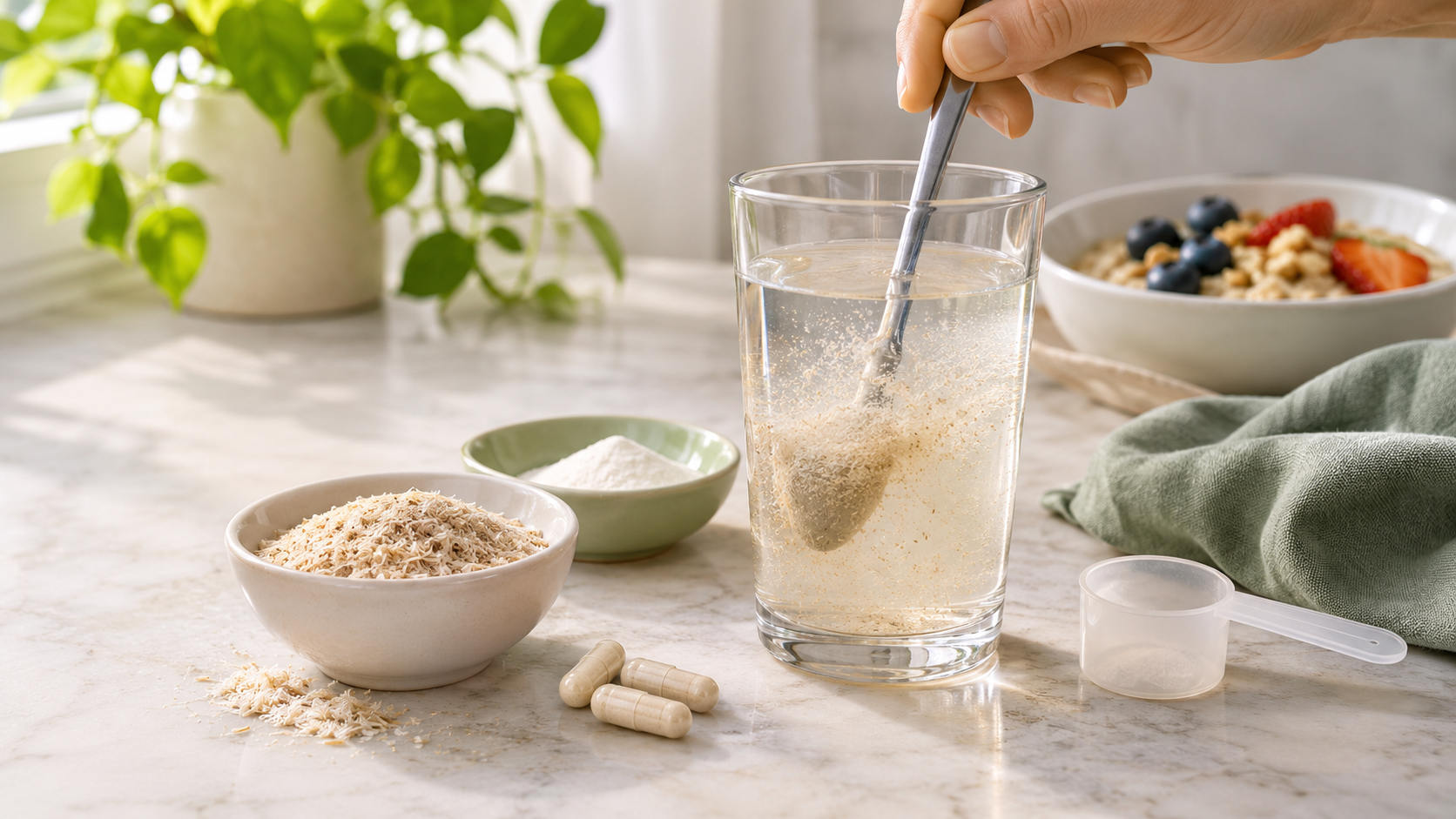
For psyllium, take each dose with at least 8 ounces of water or other liquid. If you use the powder, mix it into cold water, stir quickly and drink it right away before it thickens.
This isn’t just about comfort. Without enough liquid, psyllium can swell and block the throat or esophagus. People who have trouble swallowing or a narrowed esophagus shouldn’t take it.
Space fiber away from your medications
Fiber can change how well other medicines are absorbed. The standard guidance for psyllium is to take it at least 2 hours before or 2 hours after other oral medications.
A simple way to manage it: if you take medicine in the morning, take fiber before lunch and dinner instead. If you’re on several prescriptions, ask your pharmacist to help you map out the timing.
Adding a second fiber
Once your base fiber is settled, a second fiber makes sense only if it does a different job. A common pairing is psyllium plus a prebiotic like inulin, chosen to feed gut bacteria rather than to help with regularity.
If you add inulin, go easy. A 2010 University of Minnesota trial by Bonnema and colleagues found up to 10 grams a day of native inulin and up to 5 grams a day of oligofructose were well tolerated in healthy adults, with gas the most common complaint.
Add the second fiber the same way you added the first: one small dose a day, then build. And count fiber from bars, gummies and fortified foods, which often contain inulin listed as chicory root fiber.
Myth vs fact: more fibers means more benefits
Myth: The more types of fiber you stack, the more benefits you get.
Fact: The benefits depend on what a fiber does, not how many you take. In the Lambeau and McRorie review, fibers without gel-forming viscosity didn’t lower cholesterol, and fermentable fibers like inulin didn’t work as laxatives.
Stacking three fermentable fibers mostly stacks the gas. One well-chosen fiber at the right dose usually beats a handful of products at small doses.
Which stack fits you
- If your goal is regularity: psyllium, built up to the dose on the label, with a full glass of water each time.
- If your goal is cholesterol: psyllium before meals, in divided doses through the day, alongside whatever your doctor has prescribed.
- If your goal is steadier blood sugar: psyllium taken with meals, so the gel is there when the food is.
- If your goal is feeding gut bacteria: a base fiber plus a small dose of inulin, kept under about 10 grams a day.
- If you have a sensitive gut or IBS: start with psyllium alone at a low dose and hold off on fermentable fibers like inulin.
Want a step by step plan for your gut? Our mini courses walk you through building fiber up without the discomfort.
Signs your stack needs adjusting
Mild gas, bloating and changes in bowel habits are common in the first couple of weeks. If they don’t settle, drop back to the last dose that felt fine and hold there longer before stepping up.
Stop and talk to your healthcare provider if you have:
- Rectal bleeding or blood in your stool.
- Constipation lasting 7 days or longer, or no bowel movement after taking it.
- Stomach pain, nausea, vomiting or a change in bowel habits lasting 2 weeks or more.
Get medical help right away for chest pain, vomiting, or trouble swallowing or breathing after a dose, or signs of an allergic reaction like hives, wheezing or swelling of the face or throat.
Fiber stack questions
What is a fiber stack?
A fiber stack is the set of fiber supplements you take, plus how much, when and with what. It can be one product or two that do different jobs.
Which fiber supplement should I start with?
Psyllium has the most clinical research behind it, with benefits shown for constipation, diarrhea, IBS, cholesterol and blood sugar. Most people can start there and add something else only if they need it.
When is the best time to take fiber supplements?
Before or with meals. Studies that found cholesterol and blood sugar benefits from psyllium dosed it before meals, and taking a gel-forming fiber with food helps it blunt blood sugar rises.
How much water should I drink with a fiber supplement?
At least 8 ounces with each dose of psyllium. Without enough liquid it can swell and block the throat.
How long should I wait between fiber and my medications?
For psyllium, take it at least 2 hours before or 2 hours after other oral medicines, since fiber can affect how they are absorbed. Ask your pharmacist about your specific medicines.
Can I take psyllium and inulin together?
You can, but they do different things. Psyllium forms a gel and holds water; inulin is fermented by gut bacteria and is more likely to cause gas. If you add inulin, keep it to about 10 grams a day or less.
How long does it take a fiber supplement to work?
For bowel regularity, psyllium usually produces a bowel movement within 12 to 72 hours. Cholesterol and blood sugar effects in studies were measured over weeks to months.
Sources
- Lambeau KV, McRorie JW Jr. “Fiber supplements and clinically proven health benefits: How to recognize and recommend an effective fiber therapy.” Journal of the American Association of Nurse Practitioners, 2017. pmc.ncbi.nlm.nih.gov
- Bonnema AL, Kolberg LW, Thomas W, Slavin JL. “Gastrointestinal tolerance of chicory inulin products.” Journal of the American Dietetic Association, 2010. experts.umn.edu
- WebMD. “Psyllium Oral: Uses, Side Effects, Interactions.” webmd.com