
In this article
- Packaged produce fiber: why the cut doesn’t take it away
- Pre cut fruits fiber and other packaged forms, side by side
- What a week in the clamshell does change
- Bagged salads nutrition: steady fiber, fading vitamin C
- Myth vs fact: convenience foods and fiber
- A packaged produce checklist for more fiber
- Making packaged produce count toward your day
- Your next trip to the store
- Packaged produce and fiber: common questions
- Sources
A clamshell of cut pineapple tends to carry a quiet reputation as the lazy, lesser version of the whole fruit. For fiber, that reputation doesn’t hold up.
Packaged produce fiber stays close to fresh because fiber is part of the plant’s cell walls, and a knife or a plastic tub doesn’t remove cell walls. The real differences between fresh and packaged produce show up somewhere else: in the vitamins that fade with time, in syrups that get added, and in peels that get thrown away before the food ever reaches you.
Packaged produce fiber: why the cut doesn’t take it away
Dietary fiber is the structural material of a plant: cellulose, hemicellulose, pectin and related compounds that your digestive enzymes can’t break down. Slicing a melon into cubes changes its shape, not its chemistry, so a cup of cubes holds the same fiber as a cup cut at home.
A large review of fresh, frozen and canned produce from the University of California, Davis, reached the same conclusion for processed forms. Fiber showed little change through processing as long as the produce stayed intact, while peeled products came out lower.
That’s the pattern to remember. Packaging is rarely the problem, but anything that removes part of the food, like skins, can be.
Pre cut fruits fiber and other packaged forms, side by side
The table below uses USDA FoodData Central values per 100 grams, so each row compares the same weight of food. Fresh comes first, followed by common packaged versions.
| Food and form | Fiber per 100 g | Calories | Sugar |
|---|---|---|---|
| Peaches, fresh | 1.5 g | 39 | 8.4 g |
| Peaches, canned in juice | 1.3 g | 44 | 10.3 g |
| Peaches, canned in light syrup | 1.3 g | 54 | 13.3 g |
| Peaches, dried | 8.2 g | 239 | 41.7 g |
| Strawberries, fresh | 2.0 g | 32 | 4.9 g |
| Strawberries, frozen, unsweetened | 2.1 g | 35 | 4.6 g |
| Strawberries, frozen, sweetened | 1.9 g | 96 | 24 g |
| Corn, raw | 2.0 g | 86 | 6.3 g |
| Corn, canned, drained and rinsed | 1.7 g | 64 | not listed |
Fresh, frozen and canned forms all land within a few tenths of a gram of each other. The bigger shifts are in the sugar column, where syrup or added sugar does the work.
Dried fruit looks like a fiber jackpot only because the water is gone. Weight for weight it’s concentrated, but so are its sugar and calories.
Where the peel comes in
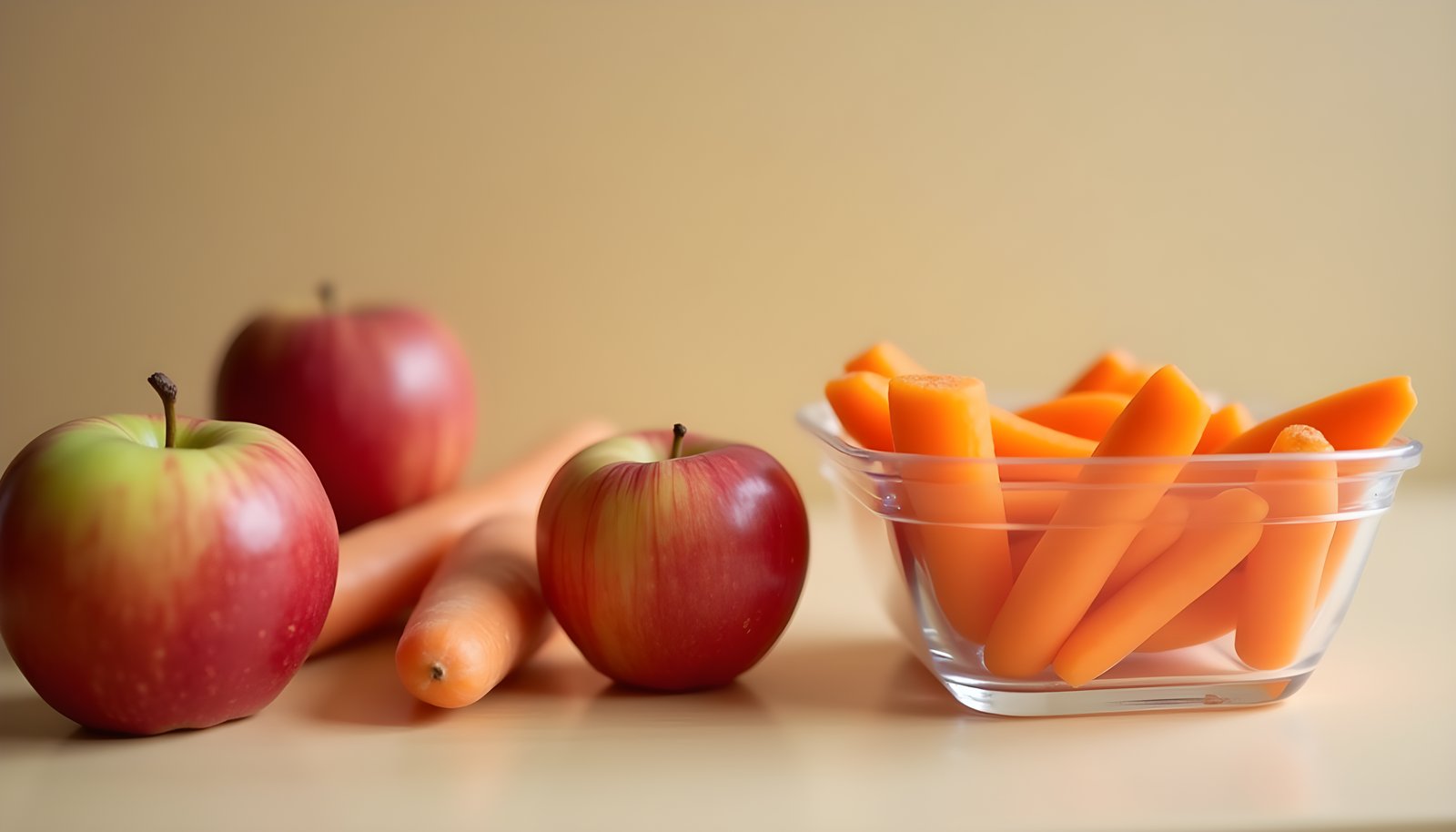
Baby carrots are peeled and shaped, yet they still match regular carrots at about 2.9 grams per 100 grams. Canned peaches, which are usually peeled, run a little lower than fresh at 1.3 grams against 1.5.
So peeling isn’t automatically a big loss, but it rarely helps. For fruit where most people eat the skin, like apples and pears, pre-sliced versions that keep the skin on are the better fiber pick.
What a week in the clamshell does change
If fiber holds steady, the next question is what does fade. A 2006 study in the Journal of Agricultural and Food Chemistry split pineapples, mangoes, cantaloupes, watermelons, strawberries and kiwifruit in half, cut one half and left the other whole, then stored both at 5°C (41°F) for nine days.
Losses of the main antioxidants were small. After six days, the cut fruit had lost the following share of its vitamin C:
- Strawberries, mango and watermelon: under 5%
- Pineapple: about 10%
- Kiwifruit: 12%
- Cantaloupe: 25%
Carotenoids, the yellow and orange pigments, dropped as much as 25% in pineapple but held steady in kiwifruit and watermelon. Phenolics, a family of plant antioxidants, didn’t drop in any of the cut fruit.
The lead researcher, Maria Gil, put it plainly: minimal processing had almost no effect on the main antioxidants. Cut fruit tends to spoil in appearance, getting soft and losing color, long before its nutrition takes a serious hit.
Picking up a fruit tray to hit a daily number? Our fiber calculator shows you how many grams to aim for based on your age and sex.
Bagged salads nutrition: steady fiber, fading vitamin C
Leafy greens are mostly water, so their fiber per cup is modest no matter how they’re sold. Here’s what a cup of common salad greens gives you, according to USDA FoodData Central:
| Salad green | Fiber per 100 g | Approximate fiber per cup |
|---|---|---|
| Kale, raw | 4.1 g | 0.9 g (21 g cup) |
| Spinach, raw | 2.2 g | 0.7 g (30 g cup) |
| Romaine, shredded | 2.1 g | 1.0 g (47 g cup) |
| Green leaf lettuce | 1.3 g | 0.5 g (36 g cup) |
| Iceberg, shredded | 1.2 g | 0.9 g (72 g cup) |
Bagging doesn’t change those numbers. Vitamin C is where bagged greens differ, because leaves keep breathing after harvest and use it up as they sit.
A 2017 study in Food Chemistry stored 11 kinds of salad leaves in the dark at 4°C (39°F) for 10 days. They lost an average of 59% of their vitamin C, with baby iceberg lettuce losing 86% while wild rocket and mizuna showed no significant drop.
Spinach was one of the more fragile greens. Juvenile spinach kept about 30% of its vitamin C after 10 days and mature spinach only about 10%, and spinach also lost some during commercial washing.
Do pre-washed bags need rinsing?
No, not if the bag says it’s pre-washed or ready to eat. The FDA says those greens can be used without washing again, and if you do rinse them, keep them away from unclean surfaces and utensils.
Buy pre-cut and bagged produce only when it’s refrigerated or packed in ice, and keep it in a fridge at 40°F or colder at home, per the FDA. Using bags within a few days of purchase also gets you more of the vitamin C.
Myth vs fact: convenience foods and fiber
Myth: Convenience foods built from produce are always lower in fiber than the fresh version.
Fact: The produce itself keeps its fiber, so plain pre-cut fruit, frozen vegetables and baby carrots are fiber equals of fresh. The drop comes from what else goes into the package.
Fruit packed in light syrup has the same fiber as fruit packed in juice but about 3 grams more sugar per 100 grams. Sweetened frozen strawberries carry about five times the sugar of unsweetened ones and nearly three times the calories, for slightly less fiber.
Fruit juice is the other big gap. Mayo Clinic points out that whole fruit gives you more fiber than juice, so a packaged cup of cut fruit beats a bottle of juice made from the same fruit.
Weighing a shelf of fruit cups, bars and snack packs against each other? Our comparison charts set the popular options next to each other so the differences are easy to see.
A packaged produce checklist for more fiber
Use these quick checks in the produce aisle and the freezer section:
- Read the ingredient line. If it lists only the fruit or vegetable, the fiber matches fresh.
- Pick fruit packed in water or its own juice over syrup.
- Choose unsweetened frozen fruit for smoothies and oatmeal.
- Look for pre-sliced apples and pears with the skin still on.
- Grab darker greens, like kale and spinach blends, over plain iceberg when you want more fiber per bite.
- Check that pre-cut items are refrigerated or on ice, and use them within a few days.
- Treat dried fruit as a concentrated snack, with a small handful as the portion.
Need fresh ideas for turning a bag of greens or a tray of cut fruit into real meals? Our recipe eBooks are full of quick, high-fiber dishes that start with produce like this.
Making packaged produce count toward your day
Mayo Clinic puts daily fiber targets at about 25 grams for women and 38 grams for men. Packaged produce can cover a real share of that with almost no prep.
Here’s how a day of grab-and-go produce adds up, using USDA FoodData Central values:
| Packaged item | Amount | Fiber |
|---|---|---|
| Baby carrots | 85 g | 2.5 g |
| Frozen unsweetened strawberries, thawed | 1 cup (221 g) | 4.6 g |
| Canned peaches in juice | 1 cup (248 g) | 3.2 g |
| Bagged romaine | 1 cup shredded (47 g) | 1.0 g |
| Total | 11.3 g |
That’s 11.3 grams, close to half of a 25 gram target, without peeling or chopping a thing. Add a serving of beans or whole grains and the rest of the day gets easy.
A bag of baby carrots on the counter or a tub of cut melon at eye level in the fridge can do more for your fiber than a whole melon that never gets sliced. The fiber grams are the same either way, so the version you’ll actually eat wins.
Mayo Clinic also suggests adding fiber gradually and drinking plenty of water as you go, which helps your digestion adjust to the extra bulk.
Your next trip to the store
Before you set a packaged fruit or vegetable in your cart, turn it over and read the ingredients. If the only thing listed is the food, you’re getting the same fiber as fresh, and the time you save is a bonus.
Packaged produce and fiber: common questions
Does pre-cut fruit have less fiber than whole fruit?
No. Cutting doesn’t remove fiber, which is part of the fruit’s cell walls. A cup of pre-cut pineapple or melon has the same fiber as a cup you cut at home, unless the skin was removed from a fruit you’d normally eat with the skin.
Are bagged salads as nutritious as a whole head of lettuce?
For fiber, yes. Bagged greens can lose vitamin C during storage, with one study finding an average 59% loss across 11 salad types after 10 days at 4°C, so use bags within a few days.
Do baby carrots have less fiber than regular carrots?
No. USDA data lists baby carrots at about 2.9 grams of fiber per 100 grams, essentially the same as regular raw carrots at 2.8 grams.
Is canned fruit in syrup lower in fiber?
Not really. Canned peaches in light syrup and in juice both have about 1.3 grams of fiber per 100 grams, but the syrup version has about 3 more grams of sugar.
Should I rewash pre-washed bagged greens?
No. The FDA says greens labeled pre-washed or ready to eat can be used without washing again, and rewashing them risks cross-contamination from your sink or cutting board.
Is frozen fruit a good source of fiber?
Yes. Unsweetened frozen strawberries have about 2.1 grams of fiber per 100 grams, the same as fresh, so they work well in smoothies and oatmeal.
Which convenience foods are lowest in fiber?
Fruit juice is the biggest drop, since whole fruit has more fiber than juice. Sweetened frozen fruit and fruit in syrup also add sugar without adding any fiber.
Sources
- Gil MI, Aguayo E, Kader AA. “Quality changes and nutrient retention in fresh-cut versus whole fruits during storage.” Journal of Agricultural and Food Chemistry. 2006. doi.org
- Dewhirst RA, Clarkson GJJ, Rothwell SD, Fry SC. “Novel insights into ascorbate retention and degradation during the washing and post-harvest storage of spinach and other salad leaves.” Food Chemistry. 2017. pmc.ncbi.nlm.nih.gov
- Rickman JC, Bruhn CM, Barrett DM. “Nutritional comparison of fresh, frozen, and canned fruits and vegetables II. Vitamin A and carotenoids, vitamin E, minerals and fiber.” Journal of the Science of Food and Agriculture. 2007. ucanr.edu
- U.S. Department of Agriculture, Agricultural Research Service. “FoodData Central.” 2026. fdc.nal.usda.gov
- U.S. Food and Drug Administration. “Selecting and Serving Produce Safely.” 2024. fda.gov
- Mayo Clinic Staff. “Dietary fiber: Essential for a healthy diet.” Mayo Clinic. 2024. mayoclinic.org