
In this article
- Seasonal fruits high fiber guide: the year at a glance
- Spring: blackberries, kiwifruit and the first strawberries
- Summer fruits fiber: berry season and the melon trap
- Fall: pears, apples, cranberries and pomegranates
- Winter fruits fiber: why the cold months aren’t a gap
- Fiber per calorie: which seasonal fruits work hardest
- A seasonal produce guide checklist for your shopping list
- Filling the off season with frozen fruit
- One step to take this week
- Seasonal fruit and fiber: what people ask
- Sources
A lot of people believe fruit fiber is a summer thing, and that winter leaves you with nothing but bananas. The USDA’s seasonal produce guide tells a different story: pears, kiwifruit, grapefruit and pomegranates are all listed for winter, and a medium pear alone brings 5.5 grams of fiber.
Summer still wins on raw numbers. A cup of raspberries carries 8.0 grams, the top seasonal fruits high fiber pick on the list, but every season has at least one fruit that clears 4 grams per serving.
Below you’ll find the season by season breakdown, a fiber per calorie ranking, and a simple shopping checklist that keeps your fruit fiber steady from January to December.
Seasonal fruits high fiber guide: the year at a glance
Season lists come from the USDA SNAP-Ed Seasonal Produce Guide, which groups produce by when it’s most available in the United States. Fiber numbers come from the Dietary Guidelines food sources table and USDA FoodData Central.
| Season | Top fiber pick | Strong runners-up |
|---|---|---|
| Spring | Blackberries, 7.6 g per cup | Kiwifruit 5.4 g per cup, apricots 3.1 g per cup, strawberries 3.0 g per cup |
| Summer | Raspberries, 8.0 g per cup | Blackberries 7.6 g, pears 5.5 g per medium fruit, blueberries 3.6 g per cup |
| Fall | Raspberries, 8.0 g per cup | Pears 5.5 g, apples 4.8 g, cranberries 4.0 g per chopped cup |
| Winter | Pears, 5.5 g per medium fruit | Kiwifruit 5.4 g per cup, grapefruit 5.0 g per fruit, apples 4.8 g |
Two patterns stand out. Berries own the warm months, and pears are the quiet constant, appearing on the guide’s summer, fall and winter lists.
A few fruits, like apples, bananas, lemons, limes and plantains, appear in all four seasons. They’re useful anchors, though not all of them are fiber heavy.
Spring: blackberries, kiwifruit and the first strawberries
Spring is when the guide starts listing berries again, and blackberries are the standout. A cup gives you 7.6 grams of fiber for just 62 calories.
Kiwifruit is the other spring heavyweight. One cup of sliced kiwi carries 5.4 grams, more than a medium apple, and it’s listed again in fall and winter, so it’s one of the easiest fruits to keep on rotation.
Strawberries, apricots and rhubarb
Strawberries arrive in spring with 3.0 grams per cup at only 49 calories. That’s modest per cup, but you can eat a large bowl without much of a calorie cost.
A cup of fresh apricots adds 3.1 grams. Rhubarb, which cooks treat as a fruit even though it’s a stalk, gives 2.2 grams per diced cup for about 26 calories, plus 105 milligrams of calcium.
Rhubarb is very tart, so most recipes add sugar. Pairing it with strawberries in a compote lets the berries carry some of the sweetness and adds fiber from both.
Summer fruits fiber: berry season and the melon trap
Summer has the longest fruit list in the guide, more than twenty entries. That variety is great, but fiber varies wildly across it.
| Summer fruit | Portion | Fiber | Calories |
|---|---|---|---|
| Raspberries | 1 cup | 8.0 g | 64 |
| Blackberries | 1 cup | 7.6 g | 62 |
| Pear | 1 medium | 5.5 g | 103 |
| Blueberries | 1 cup | 3.6 g | 84 |
| Apricots | 1 cup | 3.1 g | 74 |
| Cherries | 1 cup | 2.9 g | 87 |
| Mango | 1 cup | 2.6 g | 99 |
| Peach | 1 peach (147 g) | 2.2 g | 57 |
| Cantaloupe | 1 cup cubes | 1.4 g | 54 |
| Grapes | 1 cup | 1.4 g | 104 |
| Watermelon | 1 cup | 0.6 g | 46 |
Melons are the trap. They feel like a generous serving of fruit, yet a cup of watermelon has 0.6 grams, about one thirteenth of the fiber in a cup of raspberries.
Melons and grapes are still great for hydration and flavor. If fiber is your goal, though, let them share the bowl with berries rather than replace them.
Stone fruit in the middle
Peaches, plums, apricots and cherries sit in a middle tier. A 147 gram peach gives 2.2 grams, while fresh plums carry about 1.4 grams per 100 grams, so a single small plum adds roughly a gram.
Two peaches that size give 4.4 grams, close to what a single pear delivers.
Fall: pears, apples, cranberries and pomegranates
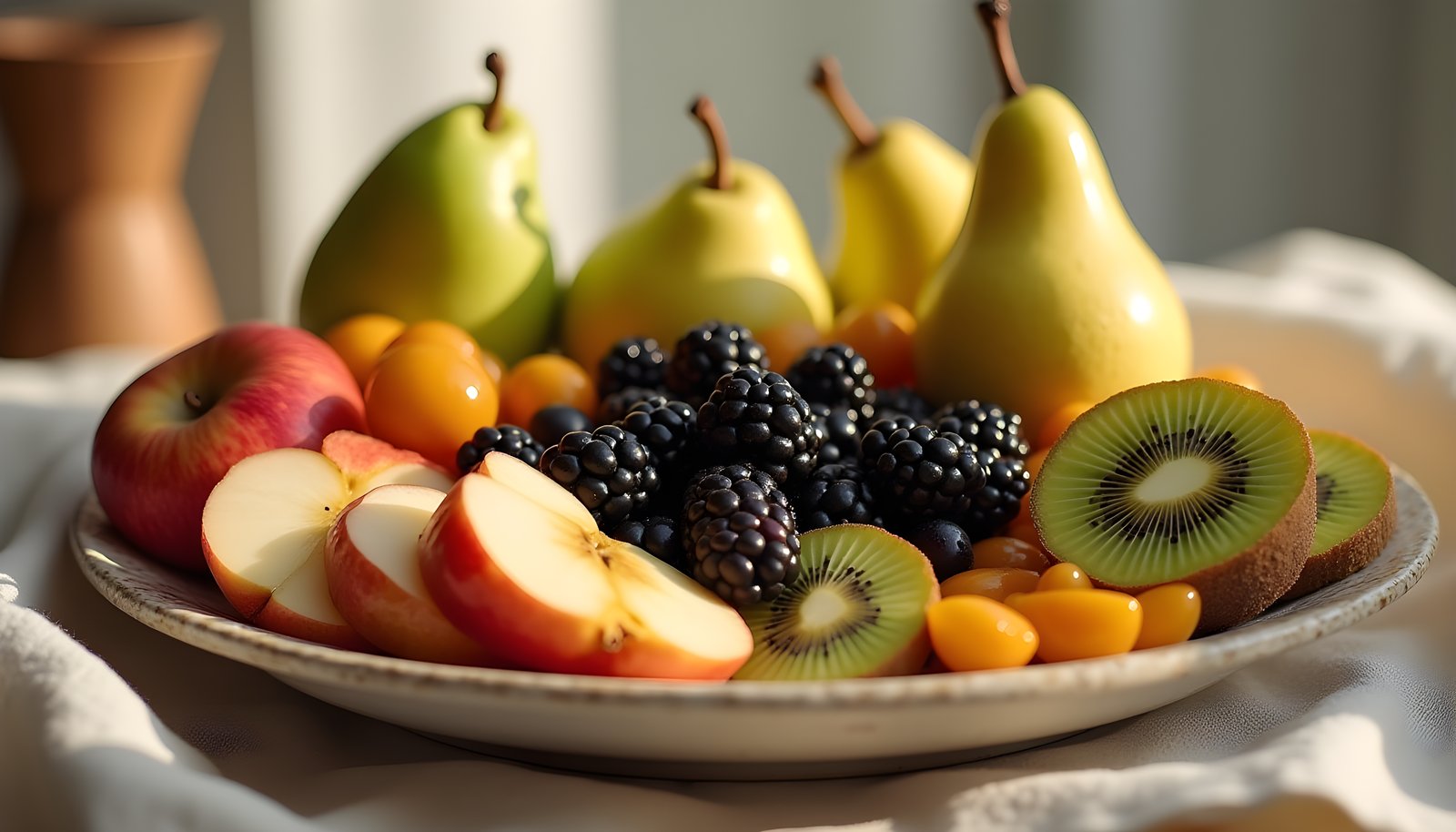
Fall is when the guide’s tree fruit list fills out. A medium pear with skin gives 5.5 grams, and a medium apple with skin gives 4.8 grams.
If you see Asian pears at the market, grab them. A medium Asian pear carries 6.5 grams for only 75 calories, one of the best fiber per calorie ratios of any fruit.
Raspberries also show up on the fall list, so late season berries keep the summer numbers going a little longer.
Cranberries and pomegranates
Fresh cranberries are rarely eaten raw, but their numbers are impressive: a cup of chopped cranberries has 4.0 grams of fiber and about 51 calories. Simmering them into a sauce keeps the whole berry, skins included.
Pomegranates appear in fall and again in winter. Half a cup of the seeds, called arils, gives 3.5 grams for 72 calories, because you eat the small fibrous seed inside each juicy coating.
Wondering how many of these fall fruits it takes to hit your daily number? Our fiber calculator gives you a personal target to plan around.
Winter fruits fiber: why the cold months aren’t a gap
Winter is where the myth falls apart. The guide lists pears, kiwifruit, grapefruit, oranges, pomegranates and apples, and every one of them gives at least 3.5 grams per serving.
| Winter fruit | Portion | Fiber | Calories |
|---|---|---|---|
| Pear | 1 medium | 5.5 g | 103 |
| Kiwifruit | 1 cup | 5.4 g | 110 |
| Grapefruit | 1 whole fruit | 5.0 g | 130 |
| Apple, with skin | 1 medium | 4.8 g | 104 |
| Orange | 1 medium | 3.7 g | 73 |
| Pomegranate seeds | 1/2 cup | 3.5 g | 72 |
Grapefruit surprises people. A whole fruit has 5.0 grams for 130 calories, more than a medium apple.
A medium orange gives 3.7 grams for just 73 calories, and the guide lists oranges for winter only, so this is their moment.
Persimmons, a winter extra
Persimmons aren’t on the USDA guide’s list, but if you spot them, they’re worth a try. One Japanese persimmon carries about 6.0 grams of fiber and 118 calories.
Fiber per calorie: which seasonal fruits work hardest
Per serving numbers favor bigger portions. Dividing fiber by calories shows which fruits deliver the most fiber for the energy they bring.
| Fruit | Season in the guide | Fiber per 100 calories |
|---|---|---|
| Raspberries | Summer, fall | 12.5 g |
| Blackberries | Spring, summer | 12.3 g |
| Asian pear | Fall (as pears) | 8.7 g |
| Rhubarb | Spring | 8.6 g |
| Cranberries | Fall | 7.8 g |
| Strawberries | Spring, summer | 6.1 g |
| Pear | Summer, fall, winter | 5.3 g |
| Orange | Winter | 5.1 g |
| Kiwifruit | Spring, fall, winter | 4.9 g |
| Pomegranate seeds | Fall, winter | 4.9 g |
| Apple, with skin | All four | 4.6 g |
| Blueberries | Summer | 4.3 g |
| Grapefruit | Winter | 3.8 g |
| Banana | All four | 2.9 g |
| Mango | Summer, fall | 2.6 g |
| Grapes | Summer, fall, winter | 1.3 g |
| Watermelon | Summer | 1.3 g |
Raspberries and blackberries give roughly four times the fiber per calorie of a banana. That matters if you want more fiber without many extra calories.
Bananas are listed in every season, which makes them convenient, but they sit near the bottom of this ranking. Swapping one banana a day for a pear adds about 2.3 grams of fiber.
A seasonal produce guide checklist for your shopping list
Use this list as a quick reference when you’re standing in the produce section. Each line gives you at least 4 grams of fiber in a normal serving.
- Spring: a cup of blackberries (7.6 g) or a cup of sliced kiwi (5.4 g)
- Summer: a cup of raspberries (8.0 g), or a peach plus a cup of blueberries (5.8 g)
- Fall: a medium pear (5.5 g), an Asian pear (6.5 g) or a cup of chopped cranberries cooked into sauce (4.0 g)
- Winter: a whole grapefruit (5.0 g), a cup of kiwi (5.4 g) or a pear (5.5 g)
- Any time: a medium apple with the skin on (4.8 g)
Mixing two picks from the same season stacks up fast. A summer bowl of raspberries and blackberries reaches 15.6 grams, and even a winter bowl of kiwi and pomegranate seeds lands near 8.9 grams.
Looking for ways to turn each season’s fruit into breakfasts and snacks? Our recipe eBooks have easy, high-fiber ideas you can rotate through the year.
Filling the off season with frozen fruit
Berries are the fruit most people miss in winter, and frozen ones fill that gap well. A cup of frozen unsweetened raspberries has 6.0 grams, and a cup of frozen unsweetened blackberries has 7.6 grams.
Choose bags with fruit as the only ingredient. Frozen fruit with added sugar keeps its fiber, but the extra sugar dilutes how much fiber you get per calorie.
Mayo Clinic puts adult targets at 21 to 25 grams a day for women and 30 to 38 grams for men. Two seasonal fruit servings of 5 grams each cover roughly a third to half of a woman’s target, before you count a single vegetable or grain.
One step to take this week
Look at the fruit you bought most often last month. If it’s bananas, grapes or melon, swap one of those servings for the top fiber pick of the current season from the checklist above.
In late fall or winter that’s a pear or a cup of kiwi, and in spring or summer it’s a cup of blackberries or raspberries. That single swap adds roughly 2 to 7 grams of fiber a day without changing how much fruit you eat.
Seasonal fruit and fiber: what people ask
Which seasonal fruit has the most fiber?
Raspberries lead, with 8.0 grams of fiber per cup and 64 calories. They’re listed for summer and fall in the USDA seasonal produce guide, and blackberries follow closely at 7.6 grams per cup.
What winter fruits are high in fiber?
Pears, kiwifruit and grapefruit are the top winter picks. A medium pear has 5.5 grams, a cup of kiwi has 5.4 grams and a whole grapefruit has 5.0 grams.
Which summer fruits have the most fiber?
Raspberries and blackberries top the summer list at 8.0 and 7.6 grams per cup. Pears, blueberries and apricots follow, while melons and grapes give less than 1.5 grams per cup.
Is watermelon a good source of fiber?
No. A cup of watermelon has about 0.6 grams of fiber, so it’s better for hydration than fiber. Pair it with berries if you want a high fiber summer snack.
Are frozen berries a good substitute out of season?
Yes. A cup of frozen unsweetened raspberries has 6.0 grams of fiber and frozen blackberries have 7.6 grams, so they keep your intake steady in winter.
Is rhubarb high in fiber?
Rhubarb is moderate, with 2.2 grams of fiber per diced cup and only about 26 calories. That gives it a strong fiber per calorie ratio, though most recipes add sugar to balance its tartness.
How much fruit fiber should I aim for each day?
There’s no fruit specific target, but Mayo Clinic recommends 21 to 25 grams of total fiber a day for women and 30 to 38 grams for men. Two high fiber fruit servings of about 5 grams each make a strong start.
Sources
- U.S. Department of Agriculture, SNAP-Ed Connection. “Seasonal Produce Guide.” USDA. snaped.fns.usda.gov
- U.S. Department of Agriculture and U.S. Department of Health and Human Services. “Food Sources of Dietary Fiber,” Dietary Guidelines for Americans, 2020 to 2025. dietaryguidelines.gov
- U.S. Department of Agriculture, Agricultural Research Service. “FoodData Central” (raw peaches 169928, rhubarb 167758, cranberries 171722, Japanese persimmons 169941, plums, mango, grapes, cantaloupe, watermelon; frozen unsweetened raspberries 168209 and blackberries 171710). 2019. fdc.nal.usda.gov
- Mayo Clinic Staff. “Dietary fiber: Essential for a healthy diet.” Mayo Clinic. 2024. mayoclinic.org