
In this article
- Why protein and fiber at breakfast
- Breakfast foods sorted by what they bring
- The protein side of the plate
- The fiber side of the plate
- Six high protein high fiber breakfast pairings
- A five step breakfast checklist
- Make ahead breakfasts for busy mornings
- Breakfast for muscle recovery
- Balanced breakfast swaps
- Morning nutrition when fiber is new to you
- The light breakfast edge case
- Common questions about high protein, high fiber breakfasts
- Sources
Oatmeal often gets billed as a protein breakfast, but half a cup of dry oats has only 5.3 grams of protein, according to USDA data. Two scrambled eggs have more than twice that, yet they carry no fiber at all.
That’s the puzzle behind a high protein high fiber breakfast. Most morning foods are good at one job, so the answer is to combine them rather than hunt for a single perfect food.
Below you’ll see which breakfast foods sit on which side, six pairings that hit both targets, and how to scale the plate for a training morning or a lighter one.
Why protein and fiber at breakfast
Protein matters most when it’s spread through the day. The International Society of Sports Nutrition suggests doses of about 20 to 40 grams every 3 to 4 hours, which makes breakfast the first of several protein stops.
Fiber has its own case. Mayo Clinic notes that high fiber foods tend to be more filling, so you’re likely to eat less and stay satisfied longer, a useful trait for the longest stretch of the morning.
Put together, a breakfast with around 20 grams of protein and 8 to 12 grams of fiber covers a good share of both daily targets. The FDA’s Daily Values are 50 grams of protein and 28 grams of fiber.
Breakfast foods sorted by what they bring
This table uses USDA FoodData Central values for common breakfast portions. The last column shows which job each food does best.
| Breakfast food | Serving | Protein | Fiber | Calories | Best at |
|---|---|---|---|---|---|
| Cottage cheese, 2% | 1 cup | 24 g | 0 g | 185 | Protein |
| Firm tofu | 1/2 cup | 21.8 g | 2.9 g | 181 | Protein |
| Edamame, cooked | 1 cup | 18.4 g | 8.1 g | 188 | Both |
| Greek yogurt, plain nonfat | 170 g | 17.3 g | 0 g | 100 | Protein |
| Eggs | 2 large | 12.6 g | 0 g | 155 | Protein |
| Hemp seeds, hulled | 3 tbsp | 9.5 g | 1.2 g | 166 | Protein |
| Milk, 2% | 1 cup | 8.1 g | 0 g | 122 | Protein |
| Black beans, cooked | 1/2 cup | 7.6 g | 7.5 g | 114 | Both |
| Rolled oats, dry | 1/2 cup | 5.3 g | 4.0 g | 152 | Fiber |
| Chia seeds | 1 tbsp | 2.0 g | 4.1 g | 58 | Fiber |
| Avocado, cubed | 1/2 cup | 1.5 g | 5.0 g | 120 | Fiber |
| Raspberries | 1 cup | 1.5 g | 8.0 g | 64 | Fiber |
Only two foods on the list do both jobs well: edamame and black beans. Everything else leans clearly one way, which is exactly why pairing works.
The protein side of the plate
Cottage cheese is the quiet champion here, with 24 grams of protein in a cup for 185 calories. Greek yogurt is close behind on a per calorie basis, giving 17.3 grams for about 100 calories.
Eggs are the most familiar choice and still useful at 12.6 grams for two. Tofu suits a savory plant based morning, with 21.8 grams in half a cup plus a little fiber of its own.
Hemp seeds are the odd one out. Three tablespoons add 9.5 grams of protein to oats or yogurt without any cooking, though they bring little fiber.
The fiber side of the plate
Raspberries lead the fruit bowl, with 8 grams of fiber per cup for just 64 calories. Frozen ones are easy to stir into hot oats or thaw overnight on yogurt.
Chia is the most concentrated option by volume. A single tablespoon adds about 4.1 grams of fiber, and an ounce brings 9.8 grams.
Oats sit in the middle at 4 grams per half cup dry, and their soluble fiber is the kind Mayo Clinic links with lower cholesterol. Avocado adds 5 grams per half cup to a savory plate.
Not sure how much fiber you’re aiming for each day? Our fiber calculator works out a target for your age and sex.
Six high protein high fiber breakfast pairings
Each of these combines one food from the protein side with one or two from the fiber side. Numbers are summed from the table above.
| Breakfast | Protein | Fiber | Calories |
|---|---|---|---|
| Tofu scramble: 1/2 cup tofu + 1/2 cup black beans | 29.4 g | 10.4 g | 295 |
| Cottage cheese bowl: 1 cup cottage cheese + 1 cup raspberries + 1 tbsp chia | 27.5 g | 12.1 g | 307 |
| Oats cooked in 1 cup 2% milk + 3 tbsp hemp + 1/2 cup raspberries | 23.6 g | 9.2 g | 472 |
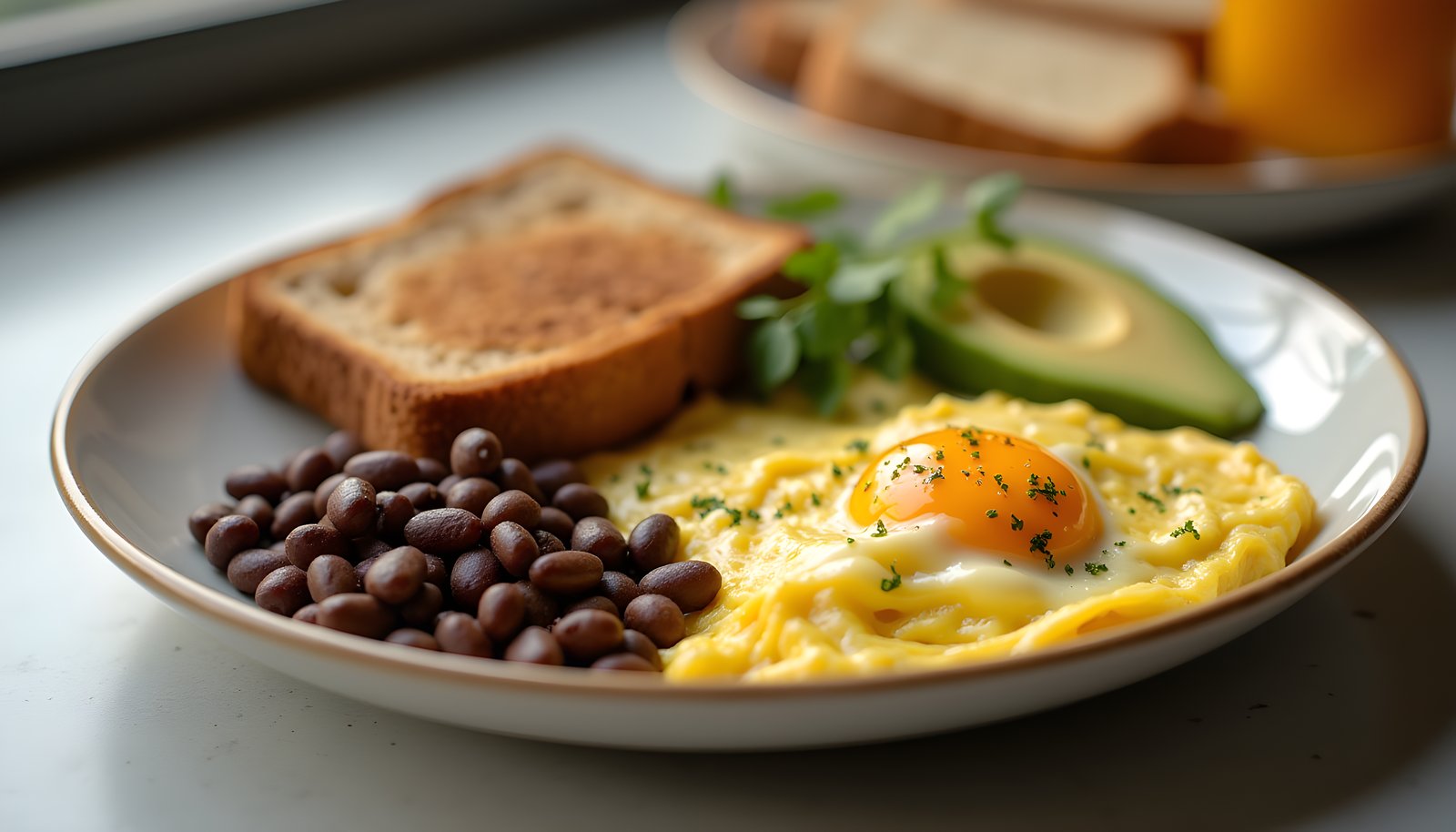
| Egg plate: 2 eggs + 1/2 cup black beans + 1/2 cup avocado | 21.7 g | 12.5 g | 389 |
| Yogurt parfait: 170 g Greek yogurt + 1 cup raspberries + 1 tbsp chia | 20.8 g | 12.1 g | 222 |
| Eggs and edamame: 2 eggs + 1 cup edamame | 31.0 g | 8.1 g | 343 |
All six clear 20 grams of protein, and five of them land above 9 grams of fiber. The tofu scramble and cottage cheese bowl give the most of both for around 300 calories each.
Want more morning meals built from these pairings? Our recipe eBooks are packed with easy, high fiber breakfasts.
A five step breakfast checklist
If you’d rather improvise, run through this list as you build your plate:
- Pick one protein anchor: eggs, Greek yogurt, cottage cheese or tofu.
- Add one fiber food: raspberries, chia, oats, avocado or beans.
- Check the protein: aim for about 20 grams, the low end of the ISSN range.
- Check the fiber: aim for 8 grams or more, close to a third of the Daily Value.
- Top it off if you’re short: hemp seeds for protein, chia for fiber.
The anchor and the fiber food can change every day, and you can rotate them to keep breakfast interesting. The checklist itself stays the same, so the numbers keep landing in range without any tracking.
Make ahead breakfasts for busy mornings
The fastest high protein high fiber breakfast is the one you made the night before. An overnight jar is the easiest version, and it keeps the same pairing logic.
Stir 170 grams of plain Greek yogurt, half a cup of dry rolled oats, a tablespoon of chia and half a cup of raspberries together, then refrigerate. In the morning you have about 25.3 grams of protein and 12.1 grams of fiber for roughly 342 calories.
The oats and chia soften as they sit, so there’s nothing to cook. Swap the raspberries for any berry you have, though few will match their 8 grams of fiber per cup.
A savory grab and go option
If sweet breakfasts aren’t your thing, boil a few eggs and keep a container of cooked edamame in the fridge. Two eggs and a cup of edamame make a no cook plate with 31 grams of protein and 8.1 grams of fiber.
A half cup of black beans works the same way. Warm them for a minute, add the eggs and a little salsa, and breakfast is done.
Breakfast for muscle recovery
If you train in the morning, breakfast often doubles as your recovery meal. The ISSN position stand treats meeting your total daily protein as the main priority, ideally in evenly spaced doses of 20 to 40 grams.
For active people, the ISSN puts daily needs at about 1.4 to 2.0 grams per kilogram of body weight. A 75 kilogram (165 pound) person would need roughly 105 to 150 grams a day, so a 30 gram breakfast covers a fifth to more than a quarter of that.
The eggs and edamame plate or the tofu scramble are the strongest picks here. Each delivers about 30 grams of protein along with 8 to 10 grams of fiber.
Balanced breakfast swaps
Small swaps can move a familiar breakfast into the high protein high fiber range:
- Plain oatmeal with water becomes oats cooked in milk with hemp seeds, adding about 17.6 grams of protein.
- Fried eggs on their own become eggs with black beans and avocado, adding 12.5 grams of fiber.
- Flavored yogurt becomes plain Greek yogurt with raspberries and chia, adding 12.1 grams of fiber.
- A bowl of berries becomes berries over a cup of cottage cheese, adding 24 grams of protein.
None of these swaps asks you to give up the food you started with. They just add the missing half.
Morning nutrition when fiber is new to you
Jumping from a low fiber breakfast to a 12 gram one overnight can be a lot for your gut. Mayo Clinic advises raising fiber gradually over a few weeks and drinking plenty of water along the way.
A gentle start is half the chia or half the beans for the first week. Raspberries and oats are easy entry points, and you can add the denser options once you’re comfortable.
If mornings tend to leave your stomach unsettled, our gut health guides walk you through easing into more fiber.
The light breakfast edge case
The biggest catch with these pairings is calories. Oats cooked in milk with hemp seeds come in near 470 calories, which is more than some people want before lunch.
If you prefer a lighter start, the yogurt parfait is the one to remember. It delivers about 21 grams of protein and 12 grams of fiber for roughly 222 calories, the best ratio of protein and fiber to calories on the list.
Common questions about high protein, high fiber breakfasts
What is a good high protein high fiber breakfast?
A tofu scramble with half a cup of black beans is one of the best, with about 29 grams of protein and 10 grams of fiber for under 300 calories.
Do eggs have fiber?
No. Two large eggs have 12.6 grams of protein and 0 grams of fiber, so add beans, avocado or vegetables to make the plate high fiber.
Is oatmeal high in protein?
Not on its own. Half a cup of dry rolled oats has about 5.3 grams of protein and 4 grams of fiber, so cook it in milk or add hemp seeds to raise the protein.
How much protein should I eat at breakfast?
About 20 to 40 grams is a useful target. That matches the per meal range the International Society of Sports Nutrition suggests for spreading protein across the day.
Which fruit adds the most fiber to breakfast?
Raspberries are a top pick, with 8 grams of fiber per cup and only 64 calories.
Is Greek yogurt high in fiber?
No. Plain Greek yogurt has 0 grams of fiber, but stirring in a cup of raspberries and a tablespoon of chia adds about 12 grams.
What is a good breakfast for muscle recovery?
Two eggs with a cup of edamame gives about 31 grams of protein and 8 grams of fiber, which fits the 20 to 40 gram protein dose the ISSN describes.
Sources
- U.S. Department of Agriculture, Agricultural Research Service. “FoodData Central” (oats 173904, raspberries 167755, hemp seed hulled 170148, chia seeds, eggs 173424, Greek yogurt 170894, cottage cheese 328841, firm tofu 172475, black beans, edamame, avocado, 2% milk). 2024. fdc.nal.usda.gov
- U.S. Food and Drug Administration. “Daily Value on the Nutrition and Supplement Facts Labels.” 2024. fda.gov
- Jäger R, Kerksick CM, Campbell BI, et al. “International Society of Sports Nutrition position stand: protein and exercise.” Journal of the International Society of Sports Nutrition. 2017. jissn.biomedcentral.com
- Mayo Clinic Staff. “Dietary fiber: Essential for a healthy diet.” Mayo Clinic. 2025. mayoclinic.org