
In this article
- The formula behind every meal
- High protein high fiber meals, compared
- The seven meals in more detail
- Easy swaps that keep the numbers
- A lighter breakfast option
- A full day built from the list
- Choosing the protein with the best package
- High protein high fiber meals for fitness nutrition
- Meal prep ideas for the week
- Keeping meal prep safe
- Going easy on your gut
- Start with one pot tonight
- High protein, high fiber meals: what people ask
- Sources
Thirty grams of protein and 10 grams of fiber is a strong target for a single meal. It sits in the 20 to 40 gram protein range sports nutrition experts recommend per meal, and it brings a solid dose of fiber in one sitting.
Most high protein high fiber meals hit both numbers the same way: one lean protein plus one legume. Below are seven balanced meals that clear the bar, with exact numbers from USDA FoodData Central and a simple meal prep plan to keep them on rotation.
The formula behind every meal
Animal proteins like chicken, fish and eggs are efficient protein sources but contain no fiber. Legumes like beans and lentils bring both, and whole grains add a little more of each.
So the most reliable build is simple:
- 3 to 4 ounces of a lean protein such as chicken, salmon, tuna, eggs, tofu or tempeh.
- 1 cup of a legume such as black beans, lentils, chickpeas, split peas or edamame.
- An optional half cup of whole grain such as quinoa or brown rice for extra energy.
A cup of most legumes adds 12 to 16 grams of fiber on its own, so it does the heavy lifting on the fiber side.
High protein high fiber meals, compared
| Meal | Protein | Fiber | Main fiber source |
|---|---|---|---|
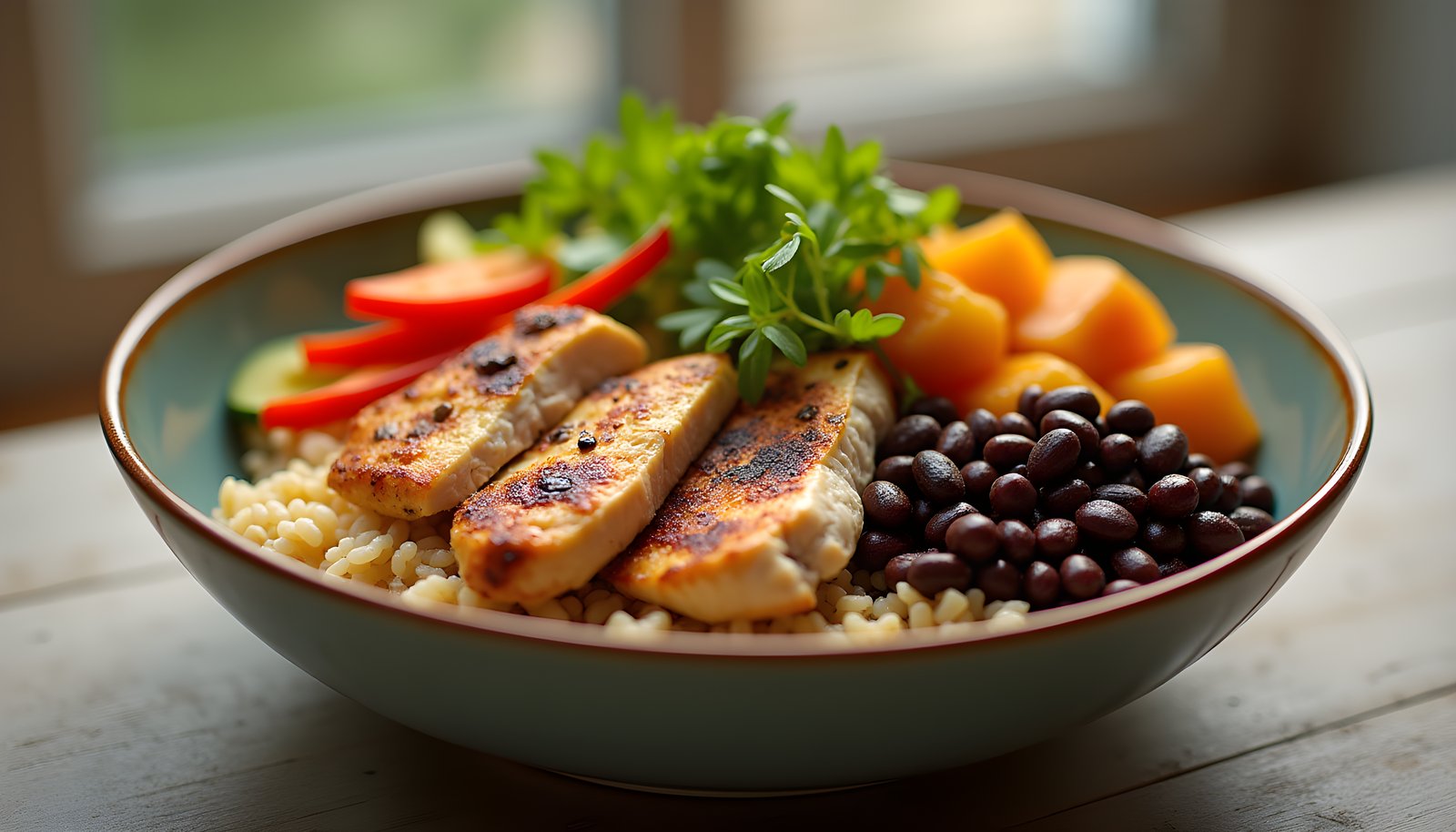
| Chicken burrito bowl: 4 oz chicken breast, 1 cup black beans, 1/2 cup brown rice | 52.8 g | 16.6 g | Black beans |
| Salmon and lentil bowl: 4 oz sockeye salmon, 1 cup lentils | 47.9 g | 15.6 g | Lentils |
| Tempeh grain bowl: 150 g tempeh, 1/2 cup lentils, 1/2 cup quinoa | 43.6 g | 10.4 g plus tempeh’s fiber | Lentils |
| Chicken and split pea soup: 3 oz chicken, 1 cup split peas | 42.7 g | 16.3 g | Split peas |
| Tofu and edamame stir fry: 200 g firm tofu, 1 cup edamame, 1/2 cup quinoa | 40.7 g | 12.5 g | Edamame |
| Egg and black bean breakfast: 3 large eggs, 1 cup black beans | 34.1 g | 15.0 g | Black beans |
| Tuna and chickpea salad: 3 oz light tuna, 1 cup chickpeas | 31.5 g | 12.5 g | Chickpeas |
Every meal in the table clears 30 grams of protein and 10 grams of fiber. The chicken burrito bowl comes out on top for both, with about 17 grams of fiber in one bowl.
Not sure what your own daily fiber goal should be? Our fiber calculator gives you a personal number in seconds.
The seven meals in more detail
Chicken burrito bowl
Four ounces of roasted chicken breast brings about 35 grams of protein, according to USDA. A cup of black beans adds 15 grams of fiber and another 15 grams of protein, and half a cup of brown rice rounds it out.
Top it with salsa and whatever vegetables you have. Those add fiber and volume beyond what’s counted in the table.
Salmon and lentil bowl
Harvard’s Nutrition Source lists 4 ounces of grilled sockeye salmon at about 30 grams of protein, with just over 1 gram of saturated fat. Over a cup of lentils, that’s nearly 48 grams of protein and 15.6 grams of fiber.
Tempeh grain bowl
Tempeh is one of the most protein dense plant foods, at 20.3 grams per 100 grams. Half a cup each of lentils and quinoa pushes the fiber past 10 grams, even before counting whatever fiber the tempeh itself adds, since USDA doesn’t report it.
Chicken and split pea soup
Split peas carry an even 16.3 grams of protein and 16.3 grams of fiber per cooked cup. Adding 3 ounces of shredded chicken turns a simple pea soup into a 42 gram protein meal.
Tofu and edamame stir fry
Firm tofu is low in fiber on its own, at under a gram per 100 grams. Edamame fixes that, adding 8.1 grams of fiber and 18.5 grams of protein per cup.
Egg and black bean breakfast
Three large eggs give you about 19 grams of protein. Paired with a cup of warm black beans, breakfast reaches 34 grams of protein and 15 grams of fiber before lunch.
Tuna and chickpea salad
Three ounces of canned light tuna provides about 17 grams of protein. Folding in a cup of chickpeas nearly doubles the protein and adds 12.5 grams of fiber.
Easy swaps that keep the numbers
You don’t have to stick to the exact legumes in each recipe. USDA values show how a simple swap changes a meal:
- Navy beans for black beans raises the fiber from 15 to 19 grams per cup, with the same 15 grams of protein.
- Lentils for chickpeas adds about 3.4 grams of protein and 3.1 grams of fiber per cup, while saving roughly 40 calories.
- Pinto beans for black beans keeps the meal almost identical, at 15 grams each of protein and fiber.
- Edamame for chickpeas adds 4 grams of protein but drops about 4 grams of fiber.
So if a meal feels repetitive, change the legume rather than the formula.
A lighter breakfast option
Not every meal needs 30 grams. A chia pudding made with 1 ounce of chia seeds, a cup of soy milk and 1 ounce of almonds gives you about 19 grams of protein and 13 grams of fiber.
USDA lists chia at 9.8 grams of fiber per ounce, which is why this small breakfast lands so high on fiber. It’s a good choice on days when a larger lunch or dinner covers the rest of your protein.
A full day built from the list
Picture a day that starts with the egg and black bean breakfast, moves to the tuna and chickpea salad at lunch, and ends with the salmon and lentil bowl.
Together they deliver about 113 grams of protein and 43 grams of fiber. That covers the protein needs of most active adults and brings far more fiber than the roughly 15 grams most Americans eat, before any fruit, vegetables or snacks.
Choosing the protein with the best package
Harvard’s Nutrition Source points out that what comes with your protein matters. A 4 ounce ham steak gives 22 grams of protein but about 1,500 mg of sodium, while 4 ounces of sockeye salmon gives 30 grams of protein and is naturally low in sodium.
That’s why the meals above lean on chicken breast, fish, eggs, tofu and tempeh rather than cured or processed meats. Legumes add to the package too, with fiber and virtually no saturated fat.
High protein high fiber meals for fitness nutrition
The International Society of Sports Nutrition recommends 1.4 to 2.0 grams of protein per kilogram of body weight a day for most people who exercise, split into doses of 20 to 40 grams every 3 to 4 hours.
For a 180 pound person, about 82 kilograms, that’s roughly 115 to 165 grams of protein a day. Three of the meals above plus a snack would land you in that range.
The fiber adds up quickly too. Three meals from the table would supply about 35 to 50 grams, a big jump for most people, so build up gradually if you’re used to eating less.
Meal prep ideas for the week
Cooking a few components once makes these meals easy to assemble. Here’s a simple Sunday plan:
- Cook a pot of lentils and a pot of black beans, or open a few cans and rinse them.
- Cook a batch of quinoa and a batch of brown rice.
- Roast chicken breasts and bake a block of tofu.
- Hard boil a half dozen eggs.
- Portion everything into shallow containers so it cools quickly.
Want more ways to turn a pot of lentils or beans into a week of meals? Our recipe eBooks are full of easy, high fiber recipes.
Keeping meal prep safe
The USDA Food Safety and Inspection Service says leftovers should be refrigerated within 2 hours of cooking. Dividing large batches into shallow containers helps them cool quickly.
Refrigerated leftovers keep for 3 to 4 days, so prep only what you’ll eat by midweek. Anything beyond that can go in the freezer, where leftovers keep their best quality for 3 to 4 months.
When you reheat, bring leftovers to 165°F as measured with a food thermometer. Freezing beans and grains in single portions lets you thaw one meal at a time later in the week.
Going easy on your gut
If you currently eat far less fiber, jumping straight to 35 grams or more a day can backfire on your digestion. Mayo Clinic recommends increasing fiber gradually over a few weeks and drinking plenty of water to avoid gas, bloating and cramping.
Start with one of these meals a day and add another once your gut has adjusted.
If more beans and lentils leave you uncomfortable, our gut health guides walk you through a gentle, step by step approach.
Start with one pot tonight
The single easiest step is to cook or open one batch of legumes today. With a cup of lentils or black beans ready in the fridge, any lean protein you already have becomes a high fiber meal in minutes.
High protein, high fiber meals: what people ask
What is a good high protein high fiber meal?
A chicken burrito bowl with 4 ounces of chicken, a cup of black beans and half a cup of brown rice gives about 53 grams of protein and 17 grams of fiber.
How do I get 30 grams of protein and 10 grams of fiber in one meal?
Pair 3 to 4 ounces of lean protein with a cup of beans, lentils, split peas or edamame. The legume alone usually supplies 8 to 16 grams of fiber.
Can a vegetarian meal be high in protein and fiber?
Yes. A tofu and edamame stir fry with quinoa gives about 41 grams of protein and 12.5 grams of fiber.
How long does meal prep last in the fridge?
The USDA says leftovers keep for 3 to 4 days in the refrigerator. Freeze anything you won’t eat by then, where it keeps best for 3 to 4 months.
Are high protein high fiber meals good for fitness?
Yes. Meals with 20 to 40 grams of protein fit sports nutrition recommendations, and each one adds at least 10 grams of fiber.
What is a high protein high fiber breakfast?
Three eggs with a cup of black beans gives about 34 grams of protein and 15 grams of fiber. A chia, soy milk and almond pudding is a lighter option with about 13 grams of fiber.
Can I eat a high fiber meal every meal?
You can, but build up slowly. Three meals like these supply 35 to 50 grams of fiber, so add one at a time and drink plenty of water.
Sources
- U.S. Department of Agriculture, Agricultural Research Service. “FoodData Central” (chicken breast, roasted; eggs, large; tuna, light, canned; tofu, firm; tempeh; black beans, lentils, split peas and chickpeas, cooked; edamame; quinoa and brown rice, cooked; chia seeds; almonds). 2026. fdc.nal.usda.gov
- Harvard T.H. Chan School of Public Health. “Protein.” The Nutrition Source. 2025. nutritionsource.hsph.harvard.edu
- Jäger R, Kerksick CM, Campbell BI, et al. “International Society of Sports Nutrition position stand: protein and exercise.” Journal of the International Society of Sports Nutrition. 2017. jissn.biomedcentral.com
- USDA Food Safety and Inspection Service. “Leftovers and Food Safety.” 2020. fsis.usda.gov
- Mayo Clinic Staff. “Dietary fiber: Essential for a healthy diet.” Mayo Clinic. 2025. mayoclinic.org