
In this article
- Why protein powder fiber is usually added
- The FDA list behind the fiber line
- Inulin and chicory root, the common catch
- A protein powder with fiber comparison by base
- A branded example: Premier Protein Plus Fiber
- Added fiber or whole food fiber?
- Reading the fiber line in grams and percent
- One shake, two routes
- A decision rule for your next tub
- What to check on every label
- Where fiber labeling is heading
- Protein powder fiber: questions people ask
- Sources
Two tubs can both promise 7 grams of fiber per scoop and still be very different products. One might get its fiber from chicory root inulin, the other from acacia gum or psyllium husk, and your gut can tell the difference even when the label can’t.
That’s why a useful protein powder with fiber comparison looks past the number. It asks where the fiber comes from, what protein it’s paired with, and whether you’d be better off adding fiber yourself.
This guide compares the common fiber types, the protein bases they’re mixed into and the do it yourself route, so you can read any label with confidence.
Why protein powder fiber is usually added
Protein powders are made by pulling protein away from the rest of a food. Whey is separated from milk, and pea or soy protein is extracted from the legume, which leaves most of the original fiber behind.
Milk never had fiber to begin with. Mayo Clinic defines fiber as the parts of plant foods your body can’t digest, so whey and casein start at zero.
So when a protein powder lists several grams of fiber, the maker has almost always put it there on purpose. The ingredient list tells you which fiber they chose.
The FDA list behind the fiber line
Not every fiber ingredient can be counted on a label. The FDA only allows a company to include an isolated or synthetic fiber in the dietary fiber number if the agency recognizes it as having a health benefit.
Seven made the original list in 2016, and the FDA has since said it will allow several more while it finishes rulemaking. Here’s how the fibers you’ll see on protein tubs line up:
| Fiber on the label | Also listed as | FDA recognition | Gut comfort note |
|---|---|---|---|
| Inulin | Chicory root fiber, inulin type fructans | Added in 2018 | Monash flags it for people with IBS |
| Galactooligosaccharides | GOS | Added in 2018 | A FODMAP, so it can bother sensitive guts |
| Acacia | Gum arabic | Added in 2021 | Not flagged in the Monash protein powder guide |
| Psyllium husk | Psyllium | Original 2016 list | Not flagged in the Monash protein powder guide |
| Guar gum | Guar | Original 2016 list | Not flagged in the Monash protein powder guide |
| Cellulose | Cellulose powder | Original 2016 list | Not flagged in the Monash protein powder guide |
| Resistant maltodextrin | Resistant dextrin | Added in 2018 | Not flagged in the Monash protein powder guide |
| Polydextrose | Polydextrose | Added in 2018 | Not flagged in the Monash protein powder guide |
The FDA also notes that a fiber still waiting on a petition can’t be counted as dietary fiber. It has to be listed under total carbohydrate instead, which can make two similar tubs show different fiber numbers.
Inulin and chicory root, the common catch
Inulin is one of the most popular fibers in protein powder, often listed as chicory root. It lets a brand market the product as prebiotic, a word used for fibers that feed gut bacteria.
The researchers behind the low FODMAP diet at Monash University advise people with IBS to check labels for inulin and chicory root. They go further, noting that “prebiotic” is a term closely tied to FODMAPs and may cause symptoms for some people.
If you don’t have IBS, that caution may not apply to you. If you do, a powder without inulin, chicory root or GOS avoids the ingredients Monash singles out.
A protein powder with fiber comparison by base
The protein itself matters for comfort too. Monash notes that whey protein concentrate is lower in protein and higher in carbohydrates like lactose, while whey isolate is more processed and carries less carbohydrate.
Plant proteins bring a different issue. Monash says soy and pea proteins are hard to purify and often contain some GOS and fructan, two FODMAP groups.
- Whey concentrate: no natural fiber and more lactose, so it suits people who digest dairy well.
- Whey isolate: no natural fiber and less carbohydrate than concentrate, which means less lactose too.
- Pea or soy: little fiber after extraction, plus possible FODMAP traces.
- Blends: a mix of the bases above, so each protein and added fiber is worth checking.
Shopping for a new tub? Our comparison charts show which popular powders use which fibers.
A branded example: Premier Protein Plus Fiber
Premier’s Protein Plus Fiber powder is a good illustration of how brands present added fiber. The company lists 25 grams of protein and 7 grams of prebiotic soluble fiber per serving, with 1 gram of sugar and no added sugar.
That 7 grams is a quarter of the FDA’s 28 gram Daily Value, which is generous for a powder. The word “prebiotic” is the cue to read the ingredient list if you’re prone to IBS, per the Monash advice above.
Neither of those facts makes the product good or bad. They just show why the fiber type deserves a look alongside the number.
Added fiber or whole food fiber?
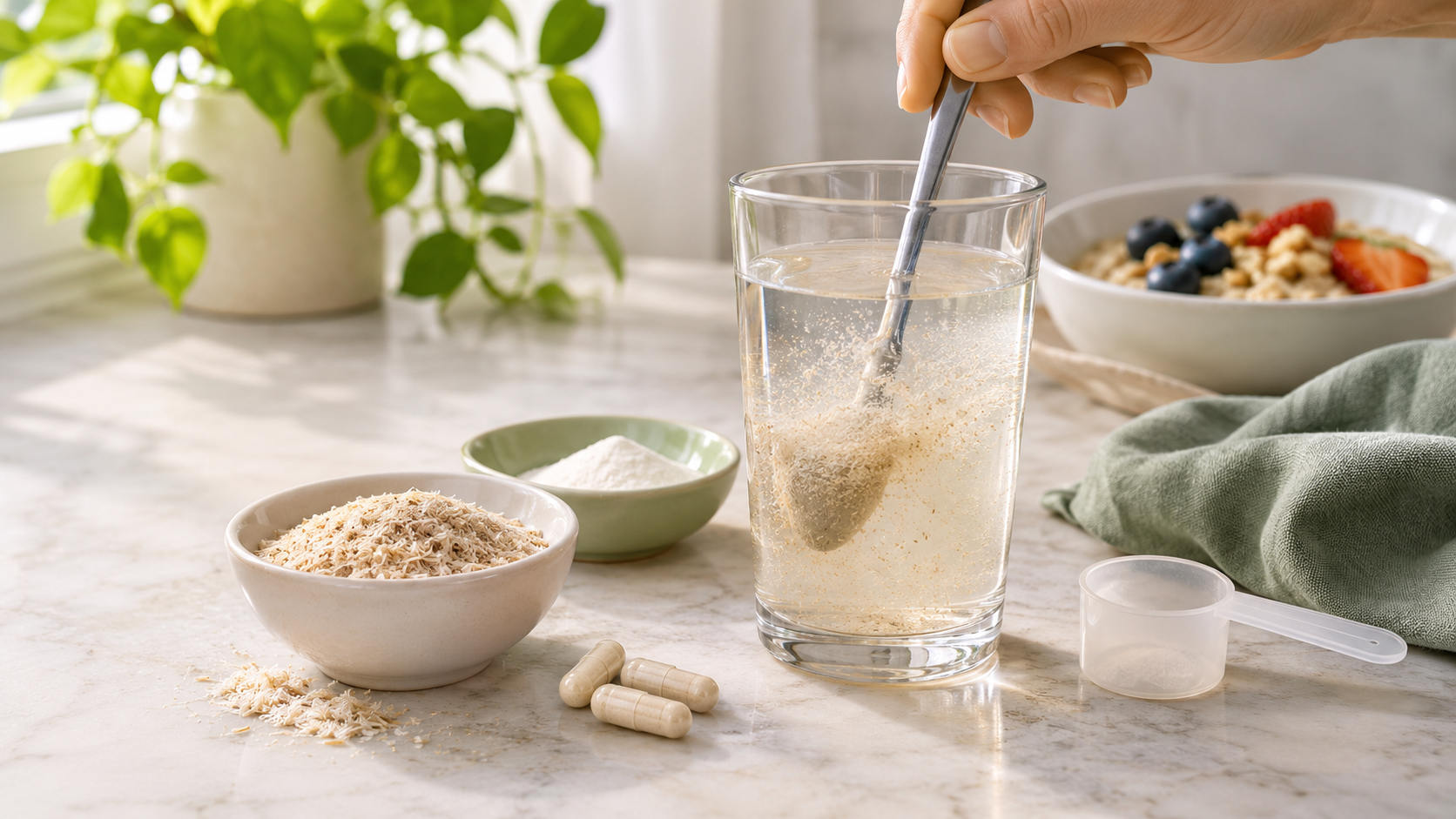
You can also buy a plain powder and add the fiber yourself. Mayo Clinic points out that fiber supplements don’t provide the variety of fibers, vitamins, minerals and other nutrients that foods do.
Whole foods are easy to blend in, and the numbers add up quickly. Using USDA values:
- Ground flaxseed: about 1.9 grams of fiber per tablespoon
- Chia seeds: about 4.1 grams per tablespoon
- Blackberries: about 3.8 grams per half cup
- Rolled oats: about 2 grams per quarter cup dry
- Banana: about 3.1 grams in a medium one
A tablespoon of chia, two tablespoons of ground flax and half a cup of blackberries give about 11.7 grams together. That beats the 7 grams on even a generous fortified powder.
Reading the fiber line in grams and percent
The percent Daily Value next to the fiber line is the fastest way to compare tubs. It’s based on the FDA’s 28 gram target, so 7 grams shows as 25% and 5 grams as about 18%.
Check the serving size in grams before you compare, though. A tub with a 45 gram scoop and 6 grams of fiber is less fiber dense than one with a 30 gram scoop and 5 grams, even though its number looks bigger.
Dividing fiber by the serving weight gives a fair comparison. In that example, the first tub has about 13 grams of fiber per 100 grams of powder and the second has about 17.
One shake, two routes
Here’s how the two approaches compare in a single morning shake:
| Route | What goes in | Fiber | Fiber sources |
|---|---|---|---|
| Fortified powder | 1 serving of a powder listing 7 g fiber, water | About 7 g | One added fiber |
| Plain powder plus foods | Plain whey isolate, 1 tbsp chia, 2 tbsp ground flax, 1/2 cup blackberries | About 11.7 g | Two seeds and a fruit |
| Middle ground | Fortified powder plus 1 medium banana | About 10.1 g | Added fiber and fruit |
The fortified route wins on speed, and the whole food route wins on fiber variety. The middle ground is a fair compromise if you like your current tub but want more than one fiber source.
Looking for blender recipes built on seeds, berries and oats? Our recipe eBooks have plenty of high fiber shake ideas.
A decision rule for your next tub
Use this as a quick filter when you compare labels:
- If you have IBS or a sensitive gut, skip inulin, chicory root and GOS, and start with a powder that avoids them, such as a plain whey isolate.
- If you want the most fiber with the least effort, pick a fortified powder with 5 grams or more and check the fiber type.
- If you want the widest range of fiber, buy a plain powder and blend in flax, chia, berries or oats.
- If the front of the tub says prebiotic, read the ingredient list closely before you buy, as Monash suggests.
If shakes with added fiber tend to leave you bloated, our gut health guides explain how to build up your intake comfortably.
What to check on every label
Beyond fiber, a few lines are worth scanning before you buy:
- Sugar alcohols: Monash notes that polyols like sorbitol, mannitol and xylitol can be used at doses well above what it considers a safe serve for sensitive guts.
- Protein per scoop: compare grams, not scoop sizes, since scoops vary.
- Serving size in grams: a bigger scoop can make fiber look higher without changing the ratio.
Mayo Clinic also suggests raising fiber gradually and drinking plenty of water. That matters with powders, since a 7 gram scoop is a sudden jump if your usual breakfast has little fiber.
Where fiber labeling is heading
Most of the fibers in today’s protein powders are on the FDA’s list through enforcement discretion, not a final rule. As of the agency’s 2024 update, inulin, acacia, resistant dextrin and polydextrose are allowed on labels while formal rulemaking catches up.
That could change how some products are labeled, and new fibers can still be added through petitions. For now, the most reliable comparison is the one you make yourself: the fiber number, the fiber type and how your own gut responds.
Protein powder fiber: questions people ask
Does protein powder naturally contain fiber?
Rarely. Whey and casein come from milk and have no fiber, and pea or soy protein loses most of its fiber during extraction, so the fiber on most labels is added.
Is inulin in protein powder bad for you?
Not for everyone, but Monash University advises people with IBS to check labels for inulin and chicory root, since these fructans can trigger symptoms.
Which added fiber is easiest on the stomach?
It varies by person. Monash flags inulin, chicory root, GOS and products marketed as prebiotic, so a powder without those is a sensible first try for a sensitive gut.
How much fiber should a protein powder have?
Around 5 grams or more is a meaningful amount, since that’s close to 20% of the 28 gram Daily Value. Premier Protein Plus Fiber, for example, lists 7 grams.
Is it better to add my own fiber to a protein shake?
It gives you more variety. A tablespoon of chia, two tablespoons of ground flax and half a cup of blackberries add about 11.7 grams of fiber from three foods.
Does whey isolate have fiber?
No. Whey isolate has no natural fiber, though it has less lactose than whey concentrate, which can make it easier to digest.
Do all fibers on a label count as dietary fiber?
No. The FDA only counts fibers it recognizes, and a fiber still under petition must be listed under total carbohydrate instead.
Sources
- U.S. Food and Drug Administration. “Questions and Answers on Dietary Fiber.” 2024. fda.gov
- Rhys-Jones D. “Protein powders and IBS.” Monash University FODMAP Blog. 2021. monashfodmap.com
- Mayo Clinic Staff. “Dietary fiber: Essential for a healthy diet.” Mayo Clinic. 2025. mayoclinic.org
- U.S. Department of Agriculture, Agricultural Research Service. “FoodData Central” (ground flaxseed, chia seeds, blackberries, rolled oats 173904, banana). 2024. fdc.nal.usda.gov
- Premier Protein. “Protein Plus Fiber Powders.” 2026. premierprotein.com
- U.S. Food and Drug Administration. “Daily Value on the Nutrition and Supplement Facts Labels.” 2024. fda.gov