
In this article
- Two kinds of vegetarian protein
- Vegetarian protein fiber, serving by serving
- Legumes: where protein and fiber overlap
- Soy foods for a meatless diet
- Nuts and seeds as protein toppers
- Why eggs and dairy still belong
- Myth vs fact: meatless means high fiber
- Pairing vegetarian proteins for fiber rich meals
- A vegetarian day, before and after
- Nutrients to watch on a vegetarian plan
- Start with one swap tonight
- Vegetarian protein and fiber: what people ask
- Sources
Picture a vegetarian day built on two eggs at breakfast, a carton of Greek yogurt at lunch and a bowl of cottage cheese in the afternoon. That’s about 54 grams of protein and, according to USDA data, 0 grams of fiber.
Going meatless doesn’t guarantee a fiber rich diet. Vegetarian protein fiber depends on which proteins you lean on, and the ones that bring both are beans, lentils, peas and soy foods.
Below you’ll find how each common vegetarian protein stacks up, why dairy and eggs still earn a spot, and a sample day that clears the fiber target with room to spare.
Two kinds of vegetarian protein
Mayo Clinic describes several styles of vegetarian eating. A lacto-ovo vegetarian diet skips meat, poultry and fish but keeps eggs and dairy, while lacto vegetarians keep dairy only and ovo vegetarians keep eggs only.
That split matters for fiber. Mayo Clinic defines fiber as the part of plant foods your body can’t digest, so eggs, milk, yogurt and cheese contain none at all.
Plant proteins are a different story. Legumes, soy foods, nuts and seeds come with fiber already built in, which is why they do the heavy lifting on a high fiber vegetarian plate.
Vegetarian protein fiber, serving by serving
Here’s how popular vegetarian proteins compare in a typical portion, using USDA FoodData Central values. The table is sorted by fiber.
| Vegetarian protein (USDA) | Serving | Protein | Fiber | Calories |
|---|---|---|---|---|
| Split peas, cooked | 1 cup | 16.3 g | 16.3 g | 231 |
| Lentils, cooked | 1 cup | 17.9 g | 15.6 g | 230 |
| Black beans, cooked | 1 cup | 15.2 g | 15.0 g | 227 |
| Chickpeas, cooked | 1 cup | 14.5 g | 12.5 g | 269 |
| Edamame, cooked | 1 cup | 18.4 g | 8.1 g | 188 |
| Firm tofu | 1/2 cup | 21.8 g | 2.9 g | 181 |
| Peanut butter | 2 tbsp | 7.2 g | 1.5 g | 191 |
| Cottage cheese, 2% | 1 cup | 24 g | 0 g | 185 |
| Greek yogurt, plain nonfat | 170 g | 17.3 g | 0 g | 100 |
| Eggs, hard boiled | 2 large | 12.6 g | 0 g | 155 |
The top four rows are almost a match of protein and fiber gram for gram. A cup of split peas alone covers 58% of the 28 gram Daily Value for fiber that the FDA uses on food labels.
Tofu and edamame sit in the middle. Dairy and eggs score high on protein but contribute nothing to the fiber column.
Legumes: where protein and fiber overlap
Beans, lentils and split peas are the rare foods that fill both needs at once. One cup of lentils gives you about 36% of the FDA’s 50 gram Daily Value for protein and 56% of the Daily Value for fiber.
They’re also easy to batch cook. A pot of lentils on Sunday can turn into soup, a grain bowl topping and a quick dal over the next few days.
Lentils bring iron too, with about 6.6 mg per cooked cup. That’s roughly a third of the 18 mg Daily Value, which helps on a meatless diet where iron needs extra attention.
Per calorie, the gap gets wider
Looking at fiber per 100 calories makes the difference even clearer:
- Split peas: about 7.1 grams
- Lentils: about 6.8 grams
- Black beans: about 6.6 grams
- Chickpeas: about 4.6 grams
- Edamame: about 4.3 grams
- Firm tofu: about 1.6 grams
- Peanut butter: about 0.8 grams
If you’re working with a set calorie budget, the first three give you the most fiber for every bite.
Soy foods for a meatless diet
Soy is the most protein dense of the plant options. Half a cup of firm tofu packs 21.8 grams of protein, close to what you’d get from a cup of cottage cheese.
Its fiber is modest at 2.9 grams, but tofu made with calcium sulfate brings a bonus. USDA lists that half cup at about 861 mg of calcium, roughly two thirds of the 1,300 mg Daily Value.
Edamame sits between tofu and beans. A cup of the shelled pods gives 18.4 grams of protein and 8.1 grams of fiber, which makes it one of the most balanced picks on the list.
Nuts and seeds as protein toppers
Nuts and seeds rarely carry a meal on their own, but they’re handy for topping one up. An ounce of almonds gives about 6 grams of protein and 3.5 grams of fiber.
An ounce of shelled pumpkin seeds, sold as pepitas, offers more protein at about 8.7 grams but less fiber at about 1.7 grams. Peanut butter lands lower on both counts, with 7.2 grams of protein and 1.5 grams of fiber in two tablespoons.
All three are calorie dense, so they work best as a sprinkle on yogurt, salads or grain bowls rather than as the main protein. A spoonful of almonds on a cup of Greek yogurt turns a zero fiber snack into one with a few grams.
Why eggs and dairy still belong
Zero fiber doesn’t mean zero value. Mayo Clinic notes that eggs and dairy are good protein sources for vegetarians, and that milk and dairy foods are the highest in calcium.
Vitamin B12 is the other reason to keep them. Mayo Clinic points out that B12 is found almost exclusively in animal products, so eggs, yogurt and cheese give lacto-ovo vegetarians a natural source.
Each large hard boiled egg also carries about 147 mg of choline, against an FDA Daily Value of 550 mg. That single egg covers about 27% of it.
The trick is to treat these foods as partners for fiber, not replacements for it.
Not sure what your own fiber target should be? Our fiber calculator gives you a personal number in a few seconds.
Myth vs fact: meatless means high fiber
Myth: Cutting out meat automatically raises your fiber intake.
Fact: Only the plant foods you add in place of meat raise it. A vegetarian who swaps chicken for cheese, eggs and refined pasta can end up with about the same fiber as before.
Harvard’s Nutrition Source makes a related point about the “protein package,” meaning everything that comes along with a protein food. Beans and lentils deliver fiber in that package, while eggs and cheese bring none.
Pairing vegetarian proteins for fiber rich meals
You don’t have to give up the foods you like. Pairing a zero fiber protein with a high fiber one keeps the protein you want and adds the fiber you need.
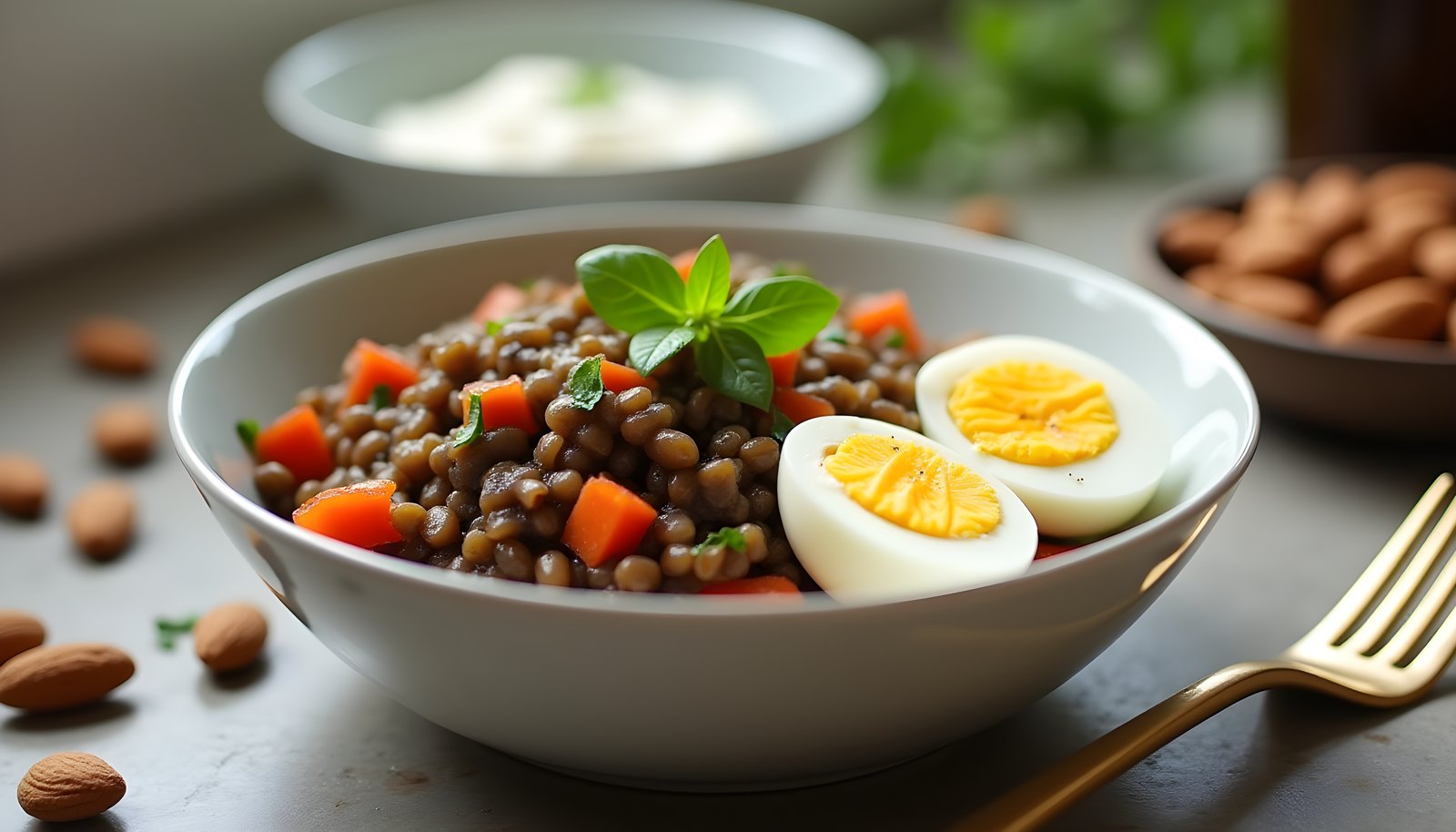
- Eggs: scramble two with half a cup of black beans for about 20 grams of protein and 7.5 grams of fiber.
- Cottage cheese: serve it next to a cup of lentil salad for over 40 grams of protein and 15.6 grams of fiber.
- Greek yogurt: blend it with cooked chickpeas, lemon and garlic into a thick dip for raw vegetables.
- Tofu: stir fry half a cup with a cup of edamame for 40 grams of protein and 11 grams of fiber.
Want more vegetarian dinners that combine both kinds of protein? Our recipe eBooks are full of simple meals to try this week.
A vegetarian day, before and after
Here’s that dairy and egg day from the start of this article, rebuilt with legumes and soy. Most of the same foods stay on the menu.
| Meal | Original day | Rebuilt day | Fiber in the rebuilt day |
|---|---|---|---|
| Breakfast | 2 eggs | 2 eggs + 1/2 cup black beans | 7.5 g |
| Lunch | Greek yogurt, 170 g | 1 cup lentil soup | 15.6 g |
| Snack | 1 cup cottage cheese | Greek yogurt, 170 g | 0 g |
| Dinner | Not counted | 1/2 cup tofu + 1 cup edamame | 11.0 g |
The rebuilt day totals about 34.1 grams of fiber, around 122% of the Daily Value, alongside roughly 96 grams of protein. The original version had none.
If that jump looks big compared with how you eat now, take it in stages. Mayo Clinic suggests adding fiber gradually over a few weeks and drinking plenty of water as you go.
Nutrients to watch on a vegetarian plan
Fiber isn’t the only thing that shifts when meat leaves the plate. Mayo Clinic flags a few nutrients that deserve attention:
- Iron: plant iron is absorbed less easily, so the recommended intake for vegetarians is almost double. Pairing lentils or beans with peppers, citrus or tomatoes helps.
- Zinc: also less absorbable from plants. Beans, lentils, soy, whole grains, cheese and yogurt all contribute.
- Omega 3s: diets without fish can run low in DHA and EPA. Walnuts, ground flaxseed, soybeans and canola oil supply a plant form.
Conveniently, the same legumes that fix your fiber also chip in on iron and zinc.
If your gut feels unsettled while you add more beans, our gut health guides explain how to ease into it comfortably.
Start with one swap tonight
Pick the meal where you lean hardest on cheese or eggs and add one cup of a legume to it tonight. A cup of lentils, split peas or black beans adds about 15 grams of fiber in one move, more than half your daily target.
Keep the eggs, keep the yogurt and keep the cottage cheese. Just make sure each of them has a bean, lentil or soy partner on the plate.
Vegetarian protein and fiber: what people ask
Which vegetarian protein has the most fiber?
Split peas lead, with 16.3 grams of fiber per cooked cup. Lentils and black beans follow closely at about 15 grams each.
Do eggs and cheese have fiber?
No. Eggs, cheese, milk, yogurt and cottage cheese all have 0 grams of fiber because fiber comes only from plants.
Is tofu a good source of fiber?
It’s a modest one. Half a cup of firm tofu has 2.9 grams of fiber and 21.8 grams of protein, so it’s better known for protein and calcium.
Can vegetarians get enough protein without meat?
Yes. Mayo Clinic says eggs and dairy are good sources, and eating a variety of plant foods through the day can also provide enough protein.
What is a high fiber vegetarian breakfast?
Try two eggs scrambled with half a cup of black beans. It gives about 20 grams of protein and 7.5 grams of fiber.
Is a meatless diet always high in fiber?
No. A meatless diet only gets high in fiber when beans, lentils, vegetables and whole grains replace the meat, rather than cheese and refined grains.
How much fiber should a vegetarian eat each day?
The FDA uses 28 grams as the Daily Value for fiber on food labels. One cup of lentils covers about 56% of that.
Sources
- U.S. Department of Agriculture, Agricultural Research Service. “FoodData Central” (almonds, pumpkin seed kernels, split peas, lentils, black beans, chickpeas, edamame, firm tofu 172475, peanut butter 324860, cottage cheese 2% 328841, Greek yogurt nonfat 170894, hard boiled egg 173424). 2024. fdc.nal.usda.gov
- U.S. Food and Drug Administration. “Daily Value on the Nutrition and Supplement Facts Labels.” 2024. fda.gov
- Mayo Clinic Staff. “Vegetarian diet: How to get the best nutrition.” Mayo Clinic. 2023. mayoclinic.org
- Mayo Clinic Staff. “Dietary fiber: Essential for a healthy diet.” Mayo Clinic. 2025. mayoclinic.org
- Harvard T.H. Chan School of Public Health. “Protein.” The Nutrition Source. 2023. hsph.harvard.edu