

In this article
- What it means to lose metabolic flexibility
- What it takes to restore metabolic flexibility
- How fiber fits into restoring flexibility
- Exercise versus fiber for restoring flexibility
- Fiber types that matter for metabolic flexibility
- How long before you notice a difference?
- Practical steps to restore metabolic flexibility
- Who should go slower or adjust
- Restoring metabolic flexibility: what readers ask
- Sources
In a 2010 trial, men with type 2 diabetes improved their metabolic flexibility by 63% in 12 weeks, bringing it back to the level of healthy men their age. The tool was exercise, not a pill or a supplement.
So can fiber help restore metabolic flexibility too? It can play a part, but the research points to a clear division of labor. This article explains which habits do the restoring, and what fiber adds.
By the numbers
- 63% improvement in metabolic flexibility after 12 weeks of training in men with type 2 diabetes
- 12 weeks of exercise brought flexibility back to the level of healthy men
- 4.25 to 4.81 rise in an insulin sensitivity score after 6 weeks of extra cereal fiber in overweight adults
What it means to lose metabolic flexibility
Metabolic flexibility is your body’s ability to switch fuels. Between meals and overnight, healthy muscle burns mostly fat. After a carb rich meal, insulin rises and muscle shifts toward burning sugar.
When that switch gets sticky, muscle keeps burning sugar when it should burn fat, and responds weakly to insulin after meals. Researchers measure this by tracking the gases you breathe out, which reveal the mix of fat and sugar being burned.
Why it slips
Loss of flexibility tends to travel with three other changes:
- Lower insulin sensitivity: muscle takes up less sugar when insulin calls for it
- Weaker mitochondria: the cell’s power plants produce energy less efficiently
- Rising blood sugar: over time, the pattern can progress toward metabolic syndrome and type 2 diabetes
These links matter for restoration. Anything that improves insulin sensitivity or mitochondrial function has a chance of improving flexibility too.
What it takes to restore metabolic flexibility
The clearest evidence for restoring flexibility comes from exercise. The trial in the hook, led by Ruth Meex and published in the journal Diabetes, tested it directly.
The 12 week training trial
The researchers enrolled 18 men with type 2 diabetes and 20 healthy men of similar age and weight, around 59 years old with a BMI near 30. Both groups did 12 weeks of supervised training: cycling twice a week and strength training once a week.
The results were striking for the men with diabetes:
- Metabolic flexibility: improved by 63%, reaching the same level as the healthy men
- Mitochondrial function: improved by 48%, also matching the healthy group
- Insulin sensitivity: improved by 63%, though it stayed below the healthy men’s level
What the trial shows
The healthy men changed far less. Their flexibility shifted by only about 7% and their insulin sensitivity by about 8%, and neither change was statistically clear. The biggest gains came where the most had been lost.
Flexibility and mitochondrial function came all the way back. Insulin sensitivity improved a great deal but didn’t fully catch up, which shows that some parts of the problem are harder to reverse than others.
The men with diabetes also stored a bit more fat inside their muscle cells after training, about 27% more, though that change was not statistically clear. The title of the paper links that extra storage with the better insulin response.
It was a small trial in men only, so it can’t tell you exactly what will happen for you. But it shows that lost flexibility is not a one way street.
Curious how your current meals stack up on fiber before you start changing things? Our fiber calculator adds it up in seconds.
How fiber fits into restoring flexibility
Fiber works on some of the same links, mostly through insulin sensitivity and blood sugar. It isn’t known to rebuild mitochondria the way training does.
- Slower sugar entry: soluble fiber slows how fast carbs reach the blood, easing the load on insulin
- Gut fermentation: fermentable fiber is turned into short chain fatty acids, which researchers are studying for effects on insulin and fat burning
- Fullness: fiber rich meals tend to be more filling, which supports weight control
That’s a narrower reach than exercise. Training works directly on muscle, the main place where the fuel switch happens, while fiber works mostly through what reaches the blood after a meal.
The question is whether these effects add up to a measurable change in people whose metabolism has already drifted.
The cereal fiber trial
A 2018 analysis of the ProFiMet trial, led by Martin Weickert and published in Nutrition and Diabetes, tested this in 72 adults who were overweight or obese, had a large waist and at least one other feature of metabolic syndrome, but no diabetes.
For 18 weeks, groups took supplements twice a day, while keeping their weight stable. One group added 15 grams of insoluble oat hull fiber twice a day. Others took extra protein, a mix of both, or a low fiber control.
What changed
In the fiber group, an insulin sensitivity score rose from 3.80 to 4.15 after 6 weeks. By 18 weeks, the change was no longer statistically clear.
The split by body size was more telling. Overweight adults in the fiber group improved from 4.25 to 4.81, while those with obesity saw no change. The high protein diet made insulin sensitivity worse in the group with obesity.
In this trial, cereal fiber was the type that moved insulin sensitivity, and its effect looked strongest before insulin resistance became advanced.
Exercise versus fiber for restoring flexibility
| Tool | What it improved | How far it went |
|---|---|---|
| Combined training, 12 weeks | Flexibility, mitochondria, insulin sensitivity | Flexibility and mitochondria restored to healthy levels |
| Cereal fiber, 6 to 18 weeks | Insulin sensitivity in overweight adults | Modest gain, clearest at 6 weeks, none seen in obesity |
The two tools aren’t rivals. Exercise does the heavy lifting on the fuel switch itself, while fiber supports the insulin side and makes meals easier on blood sugar.
The research on fiber and metabolism also hints at a timing message. Fiber’s effect showed up in people whose metabolism had drifted less, so acting earlier may give it more room to help.
Want a step by step plan that builds training and fiber habits together? Our guides break it into weekly stages.
Fiber types that matter for metabolic flexibility
Different fibers reach the insulin side of the problem in different ways.
Cereal fiber
Found in bran cereals, bulgur, whole wheat and oat bran. It was the type tested in the ProFiMet trial, and it adds bulk that makes meals more filling.
Soluble fiber
Found in oats, barley, beans and pears. It thickens in the gut and slows how fast carbs reach the blood, which smooths the after meal rise in blood sugar.
Fermentable fiber
Found in beans, lentils, onions and many fruits. Gut bacteria ferment it into short chain fatty acids, an active area of research for metabolic health.
Most whole plant foods contain more than one type, so a varied plate covers all three without counting.
If you only change one thing on the fiber side, swapping refined grains for bran cereal, bulgur or other whole grains is the closest food match to the cereal fiber tested, though the trial used an oat hull fiber supplement.
How long before you notice a difference?
It depends on what you’re measuring, and most of these changes only show up in lab tests.
- 1 to 2 weeks: fullness and regularity often change first as you add fiber
- 6 weeks: the point where the fiber group’s insulin sensitivity improved in ProFiMet
- 12 weeks: the length of the training program that restored flexibility in men with diabetes
- 18 weeks: by this point, the fiber effect in ProFiMet had faded on average
The fade at 18 weeks is a reminder that a single change may not hold on its own. Pairing fiber with regular movement gives you two levers instead of one.
Add fiber gradually, about 5 grams a week, and drink more water to limit gas and bloating as your gut adjusts.
Practical steps to restore metabolic flexibility
The trials point to a simple order of priorities.
- Make regular training the core, mixing cardio and strength as the training trial did
- Add cereal fiber from bran, bulgur and whole grains to support insulin sensitivity
- Build meals around beans and vegetables to slow the after meal sugar rise
- Start early, since fiber’s effect was clearest before insulin resistance became advanced
- Don’t lean on very high protein as a shortcut, since it worsened insulin sensitivity in the trial’s group with obesity
- Track blood sugar, waist size and fitness over months, not days
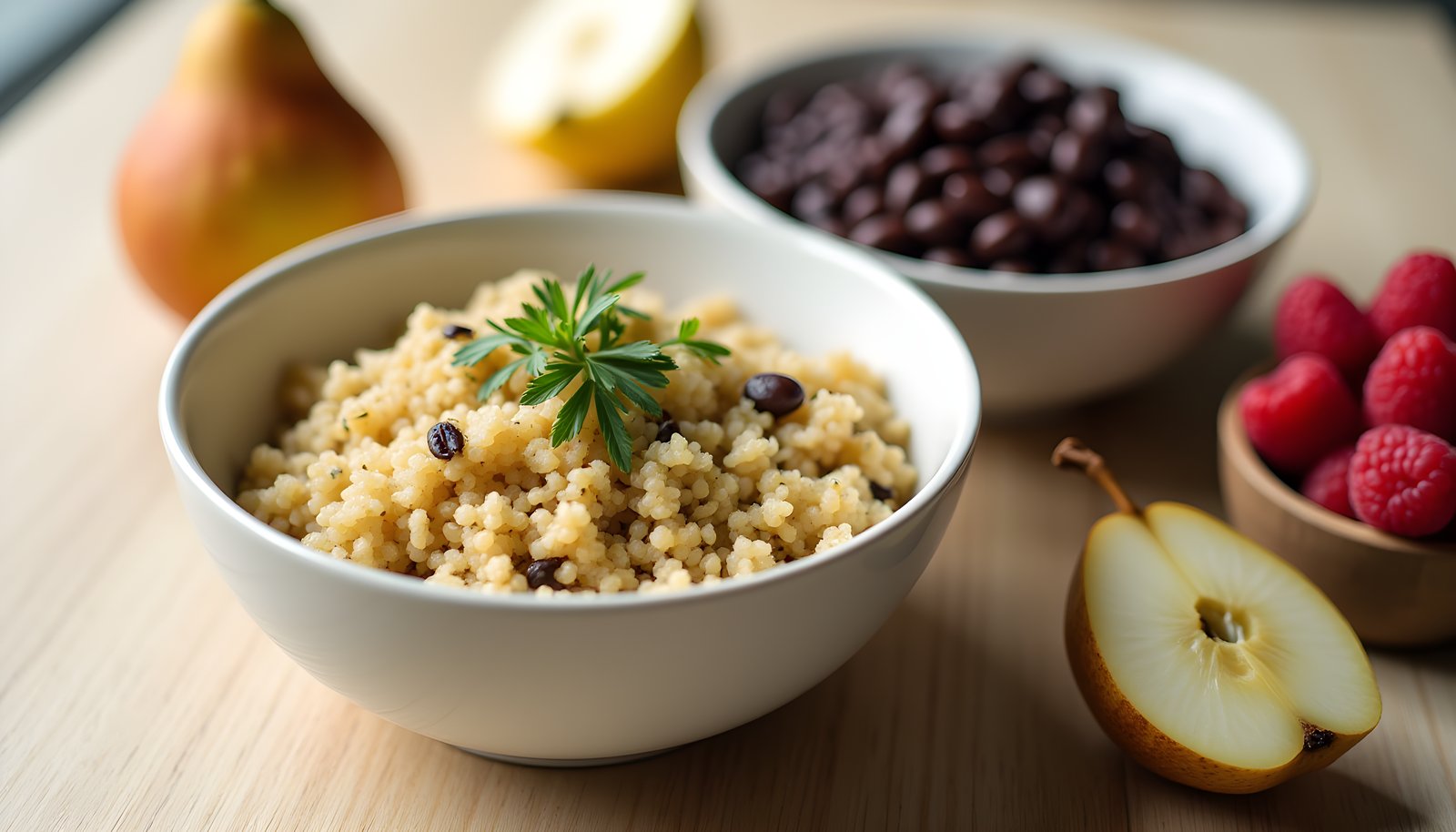
Fiber rich foods to build around
Fiber values come from the Dietary Guidelines for Americans.
| Food | Serving | Fiber (g) | Fiber type |
|---|---|---|---|
| Black beans, cooked | 1/2 cup | 7.5 | Soluble and insoluble |
| Raspberries | 1 cup | 8.0 | Soluble and insoluble |
| Shredded wheat cereal | 1 cup | 6.2 | Soluble and insoluble |
| Pear | 1 medium | 5.5 | Soluble and insoluble |
| Bulgur, cooked | 1/2 cup | 4.1 | Soluble and insoluble |
| Oat bran, cooked | 1/2 cup | 2.9 | Soluble and insoluble |
Looking for meal ideas that make these foods easy to eat every day? Our recipe eBooks are full of them.
Who should go slower or adjust
- People new to exercise: start with short sessions and build up, as the trial did with supervised training
- People taking diabetes medicines: training and diet changes can lower blood sugar, so keep monitoring closely
- People with IBS: some fermentable fibers can worsen symptoms, so favor gentler sources at first
Fiber alone is unlikely to restore metabolic flexibility, but it’s a useful partner to the habit that can. Pair it with regular training, start before problems become advanced, and give both a few months to work.
Restoring metabolic flexibility: what readers ask
Can metabolic flexibility be restored?
Yes, in some cases. In a 12 week trial, men with type 2 diabetes improved metabolic flexibility by 63%, reaching the level of healthy men.
Does fiber improve metabolic flexibility directly?
Not clearly. Fiber’s best evidence is for insulin sensitivity and blood sugar, which are closely linked to flexibility.
What is the fastest way to improve metabolic flexibility?
Regular exercise has the strongest evidence. The trial that restored flexibility combined cycling twice a week with strength training once a week.
Does fiber help insulin sensitivity in people with metabolic syndrome?
It can, modestly. In the ProFiMet trial, extra cereal fiber improved insulin sensitivity in overweight adults after 6 weeks, but not in those with obesity.
Do short chain fatty acids help metabolic flexibility?
Possibly. Gut bacteria make them from fermentable fiber, and researchers are studying their effects on insulin and fat burning.
Is high protein better than fiber for insulin sensitivity?
Not in ProFiMet. A high protein diet made insulin sensitivity worse in adults with obesity, while cereal fiber helped overweight adults.
How much fiber helps metabolic flexibility?
There’s no proven amount for flexibility itself. Our fiber calculator shows the daily target that fits you.
Sources
- Meex R, et al. “Restoration of Muscle Mitochondrial Function and Metabolic Flexibility in Type 2 Diabetes by Exercise Training Is Paralleled by Increased Myocellular Fat Storage and Improved Insulin Sensitivity.” Diabetes. 2010. https://pmc.ncbi.nlm.nih.gov/articles/PMC2828651
- Weickert MO, et al. “Effects of supplemented isoenergetic diets varying in cereal fiber and protein content on the bile acid metabolic signature and relation to insulin resistance.” Nutrition and Diabetes. 2018. https://link.springer.com/10.1038/s41387-018-0020-6
- U.S. Department of Agriculture and HHS. “Food Sources of Dietary Fiber.” Dietary Guidelines for Americans 2020 to 2025. https://www.dietaryguidelines.gov/resources/2020-2025-dietary-guidelines-online-materials/food-sources-select-nutrients/food-0