
In this article
- Follow one breakfast through your gut
- In your stomach: thickening the meal
- In your small intestine: fiber and blood sugar
- In your colon: fiber and gut bacteria
- The last stretch: fiber and digestion on the way out
- What does fiber do for your body? The whole route at a glance
- Where the fullness claim gets shaky
- Matching the job to what you want from fiber
- Your fiber function questions
- Sources
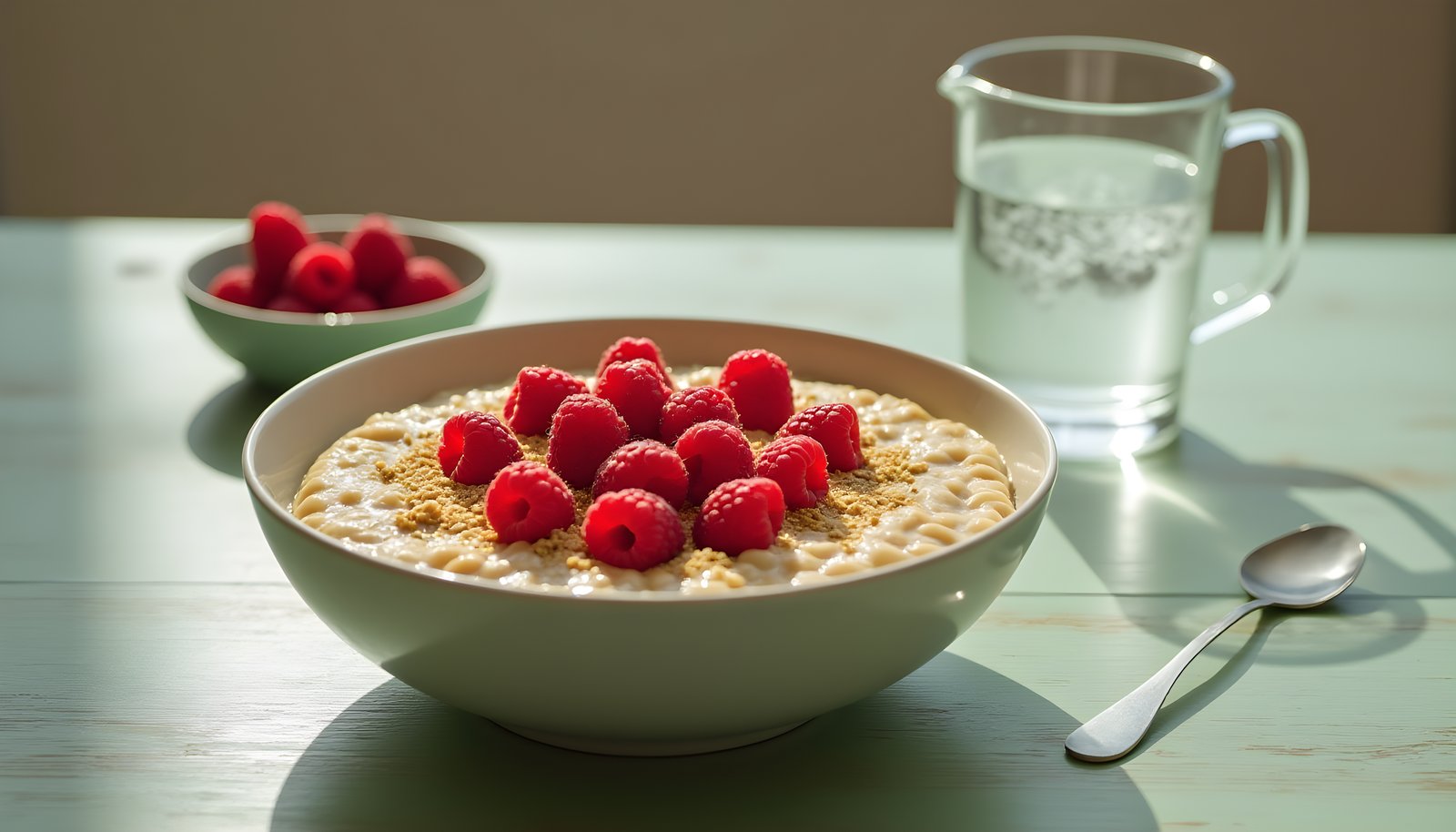
It’s 7 a.m., and you’re eating a bowl of oatmeal with raspberries and a spoonful of ground flaxseed. By lunchtime most of the starch in those oats is already in your bloodstream. The fiber, though, is just getting started on a trip that can take a day or more.
Tracing that trip is the clearest way to answer what does fiber do for your body. It doesn’t do one thing in one place. It does a different job at almost every stop, and each job explains a different benefit.
Follow one breakfast through your gut
That bowl holds roughly 10 grams of fiber. Using USDA FoodData Central values, half a cup of dry rolled oats brings about 4 grams, half a cup of raspberries about 4 grams and a tablespoon of ground flaxseed close to 2 grams.
Those three foods carry different kinds of fiber. Oats are known for beta-glucan, a soluble fiber that turns thick and slippery in water. Raspberries bring seeds and skins full of tougher, insoluble fiber, and flaxseed adds a gummy coating called mucilage.
What is dietary fiber, in this picture? It’s everything in the bowl your own enzymes can’t break apart. Because none of it gets absorbed early, it reaches places in your gut that the rest of breakfast never sees.
In your stomach: thickening the meal
Chewing cracks open some of the plant cell walls, but plenty stay whole. Once the oatmeal hits stomach fluid, the beta-glucan keeps absorbing water and the mixture gets thicker.
A thicker meal tends to leave the stomach more slowly. That’s the basis for fiber’s reputation as filling: a fuller stomach for longer, and a slower release of food into the small intestine.
Not every fiber does this. Wheat bran or the seeds in raspberries don’t form a gel, so they add volume without much thickening.
The stomach stage matters mostly because it sets the pace for everything after it. Food that leaves gradually reaches the small intestine in smaller batches, and that slower delivery is part of why the next stop goes differently with fiber on board.
Flaxseed’s mucilage adds a little to the thickening, but only when the seeds are ground. Whole flaxseeds often pass through with their coats intact, which is why recipes call for the milled kind.
In your small intestine: fiber and blood sugar
The small intestine is where starch becomes glucose and moves into your blood. A thick, gel-filled mixture slows that contact between enzymes, starch and the intestinal wall, so glucose trickles in rather than rushing.
That’s one of the effects the U.S. Food and Drug Administration accepts as proof that an added fiber is doing something useful: a lower rise in blood sugar and insulin after a meal. Steadier peaks after breakfast can mean fewer mid-morning slumps.
A second job happens here too. Your liver makes bile acids from cholesterol and sends them into the gut to help digest fat. Soluble fibers can hold onto some of that bile and carry it away, so the liver pulls more cholesterol from your blood to make a fresh supply.
The FDA lists lower LDL cholesterol (the type linked to clogged arteries) among fiber’s accepted benefits for exactly this reason.
In your colon: fiber and gut bacteria
Hours later, what’s left of breakfast reaches the colon, home to most of your gut bacteria. For them, fiber is the main meal of the day.
Bacteria ferment fiber and release short-chain fatty acids, chiefly acetate, propionate and butyrate. Butyrate is a major fuel for the cells lining your colon, and these acids also act as chemical messengers that reach other organs.
They do that by docking onto receptors in tissues that handle glucose and fat, according to the Myhrstad review covered below. Much of that signaling picture comes from animal work, so the human details are still being filled in.
How much does fiber actually change your bacteria? A 2018 analysis in the American Journal of Clinical Nutrition pooled 64 trials with 2,099 healthy adults. Fiber raised levels of Bifidobacterium and Lactobacillus, two groups generally seen as helpful, and it raised fecal butyrate.
The boost came mainly from prebiotic fibers such as fructans (found in onions and chicory) and galacto-oligosaccharides. Overall bacterial diversity didn’t change significantly, possibly because most trials lasted only weeks.
Does that bacterial shift improve your metabolism? A 2020 review in Nutrients by Myhrstad and colleagues looked at 16 human trials. Thirteen found changes in gut bacteria, and nine of those also saw changes in blood sugar or blood fat markers, but the authors judged the link between the two still unproven.
Fermentation also makes gas, which is normal. If a jump in fiber has left you uncomfortable before, our gut health guides lay out a slower build that lets your bacteria adapt.
The last stretch: fiber and digestion on the way out
Whatever the bacteria don’t eat keeps moving. The tough raspberry seeds and other insoluble fibers hold water and add bulk, which makes stool softer, larger and easier to pass.
Fermentable fibers help here in a different way. The bacteria they feed multiply, and bacterial mass itself makes up a good share of stool weight.
More frequent bowel movements are another effect the FDA counts as a real benefit. For most people this is the first change they notice, often within a few days of eating more fiber.
Water is the partner here. Bulk-forming fiber works by holding fluid in stool, so a big jump in bran or seeds without extra drinks can leave things firmer instead of easier. A glass of water with the high fiber meal is usually enough to keep the two in step.
What does fiber do for your body? The whole route at a glance
Here’s the same breakfast, stop by stop, with the fiber property that matters most at each point.
| Stop | What fiber does there | Property doing the work | What you might notice |
|---|---|---|---|
| Mouth | Makes you chew longer; intact cell walls shield nutrients | Structure | Slower eating |
| Stomach | Thickens the meal, slows emptying | Viscosity (gel) | Feeling full longer, for some fibers |
| Small intestine | Slows sugar absorption, carries off bile acids | Viscosity (gel) | Smaller blood sugar rise; lower LDL over weeks |
| Colon | Feeds bacteria, which make short-chain fatty acids | Fermentability | Some gas, especially at first |
| Exit | Holds water and adds bulk | Insoluble bulk plus bacterial mass | Softer, more regular stools |
The table also shows why the benefits of fiber depend on the source. A breakfast with only one kind of fiber covers only some of these rows.
Wondering how much fiber your own breakfast, lunch and dinner add up to? Our fiber calculator gives you a personal figure to compare against.
Where the fullness claim gets shaky
Fiber health benefits are often summed up as “keeps you full.” The research is more mixed than that slogan suggests.
A 2013 systematic review in the Journal of the American College of Nutrition by Clark and Slavin examined 44 studies covering 107 fullness tests and 55 food intake tests. Fiber improved people’s ratings of fullness in only 39% of the tests, and it cut how much they ate afterward in just 22%.
The fibers that helped most often were whole grain rye and rye bran, beta-glucan from oats and barley, lupin kernel fiber and mixed diets of fiber-rich foods. Most of the winners either kept their whole-food structure or thickened strongly in water.
Of the 25 fiber types tested for how much people ate later, only a few, including carrots, a high fiber bran cereal and resistant starch, cut intake in more than one test. Isolated powders stirred into drinks rarely made the list.
Most of these were single-meal lab tests, which may miss slower effects that build over weeks. Still, it’s a useful check: a fiber drink or gummy isn’t guaranteed to curb your appetite.
Matching the job to what you want from fiber
Why is fiber important? Because each of those stops serves a different goal. Pick the job you care about most and lean on the fibers that do it best:
- If you want steadier energy after meals: favor thick, gel-forming fibers such as oats, barley and beans, eaten with the carbs rather than hours apart.
- If you want lower cholesterol: make oats, barley, beans and lentils daily staples, since bile-binding builds up over weeks.
- If you want more regular bowel movements: add skins, seeds and whole grains, and drink more water as you go.
- If you want to feed your gut bacteria: rotate onions, garlic, leeks, legumes and slightly green bananas, and build up slowly to keep gas manageable.
- If you want fewer cravings: rely on whole foods with structure, like rye bread or bean dishes, rather than fiber added to snacks.
The strongest caveat sits with the colon stop. The same fiber can produce quite different results in two people because each starts with a different set of bacteria, and the trials so far haven’t proven which shifts matter for health. The other four stops depend far less on who you are, which is why steadier blood sugar and regularity are the effects you can count on most.
Your fiber function questions
What does fiber do in the digestive system?
Fiber thickens food in the stomach, slows sugar absorption in the small intestine, feeds bacteria in the colon and adds bulk to stool. Different fibers specialize in different steps, so mixed sources cover more of them.
How does fiber help gut bacteria?
Fiber is the main food your colon bacteria get. A 2018 analysis of 64 trials found fiber raised Bifidobacterium, Lactobacillus and fecal butyrate, mostly with prebiotic fibers like fructans and galacto-oligosaccharides.
Does fiber lower blood sugar?
It lowers the rise after a meal rather than your blood sugar overall. Gel-forming fibers slow how fast glucose reaches the blood, which is one of the benefits the FDA accepts for added fibers.
Does fiber really keep you full?
Sometimes. A 2013 review found fiber improved fullness ratings in only 39% of tests. Whole grain rye, oat and barley beta-glucan and mixed high fiber diets worked most consistently.
How long does fiber take to pass through your body?
Usually a day or more from plate to toilet, though it varies widely. Most of that time is spent in the colon, where bacteria ferment part of it.
Is soluble or insoluble fiber more important?
Neither on its own. Soluble, gel-forming fiber does most of the blood sugar and cholesterol work, while insoluble fiber does more for bulk and regularity. Most whole plant foods contain both.
Sources
- So D, Whelan K, Rossi M, et al. “Dietary Fiber Intervention on Gut Microbiota Composition in Healthy Adults: A Systematic Review and Meta-Analysis.” American Journal of Clinical Nutrition. 2018. pubmed.ncbi.nlm.nih.gov
- Myhrstad MCW, Tunsjø H, Charnock C, et al. “Dietary Fiber, Gut Microbiota, and Metabolic Regulation: Current Status in Human Randomized Trials.” Nutrients. 2020. mdpi.com
- Clark MJ, Slavin JL. “The Effect of Fiber on Satiety and Food Intake: A Systematic Review.” Journal of the American College of Nutrition. 2013. doi.org
- U.S. Food and Drug Administration. “Questions and Answers on Dietary Fiber.” FDA. 2024. fda.gov
- U.S. Department of Agriculture, Agricultural Research Service. “FoodData Central.” USDA. 2024. fdc.nal.usda.gov