
In this article
- What is fiber? A plain definition
- Fiber digestion: what happens after you swallow it
- Types of fiber and where they come from
- Why fiber started to matter: the fiber hypothesis
- The stool weight study that tested the idea
- Why is fiber important? What held up and what didn’t
- Fiber and gut health: more than bulk
- High fiber foods worth knowing
- When less fiber is the right call
- Fiber and why it matters: common questions
- Sources
In 1966, a surgeon named Denis Burkitt came home to England after about 20 years of work in Africa, where he had already described a childhood cancer that now carries his name. Within two years, he was collecting monthly reports from more than 140 mostly rural hospitals across Africa and the Indian subcontinent.
The question he kept asking those hospitals sounds simple: why were so many diseases common in England and rare there? His answer turned an overlooked part of plant food into a research field, and it’s the best way to understand what is fiber and why it matters.
What is fiber? A plain definition
Dietary fiber is the part of plant food your body can’t digest or absorb. Mayo Clinic describes it as passing relatively intact through your stomach, small intestine and colon and out of your body.
The U.S. Food and Drug Administration uses a more technical definition for food labels. It counts carbohydrates made of three or more sugar units, plus a woody compound called lignin, that your digestive enzymes can’t break down and that are naturally present and intact in plants.
Fiber that has been extracted or made in a factory only counts on a label once the FDA agrees it does something useful in the body, such as lowering blood sugar after a meal. That rule is why some powders that pass through you undigested still don’t count as fiber.
Because fiber comes from plant cell walls and plant gums, animal foods such as meat, eggs and plain milk contain none naturally. Any fiber listed on a yogurt or protein shake label has been added.
Fiber digestion: what happens after you swallow it
Most carbohydrates are broken down into sugars in your small intestine and absorbed into your blood. Fiber skips that step, so it reaches your large intestine largely as it went in.
Once there, it follows one of two broad paths. Some fiber holds water and adds bulk to stool, which helps it move. Other fiber becomes food for the bacteria that live in your colon, which ferment it into gases and useful compounds.
That fermentation is part of why fiber affects more than your bathroom habits. It is also why adding a lot of fiber at once can bring gas and bloating while your gut bacteria adjust.
Types of fiber and where they come from
Nutrition guides usually split fiber into two types based on how it behaves in water. Mayo Clinic describes them this way:
- Soluble fiber: dissolves in water to form a gel-like material. It’s found in oats, peas, beans, apples, citrus fruits, carrots, barley and psyllium, and it can help lower blood cholesterol and glucose levels.
- Insoluble fiber: doesn’t dissolve, so it helps material move through your gut and adds bulk to stool. It’s found in whole-wheat flour, wheat bran, nuts, beans and vegetables such as cauliflower, green beans and potatoes.
Most plant foods contain both kinds in different proportions. That’s one reason eating a mix of plant foods matters more than chasing one type.
Why fiber started to matter: the fiber hypothesis
Before the 1970s, fiber was mostly treated as inert roughage, a filler with no real role in health. Burkitt and a small group of British doctors changed that view.
A 2018 history in Nutrition Research Reviews by John Cummings and Amanda Engineer traces how the idea came together. Hugh Trowell, a physician who had worked at Mulago Hospital in Kampala from 1935 to 1958, helped define dietary fiber in 1972.
Surgeon Captain Thomas Cleave had used natural bran for constipation in sailors during the Second World War, though he blamed sugar rather than missing fiber for most disease. Surgeon Neil Painter’s work convinced him that a bulky diet helps prevent diverticular disease.
Burkitt pulled these threads together. He argued that diseases appearing together in Western countries might share a common cause, and he named a diet stripped of fiber as a prime suspect.
His list was long: constipation, appendicitis, diverticular disease, large bowel cancer, hemorrhoids, varicose veins, obesity, diabetes, heart disease and even tooth decay. He became known as “the Fibre Man.”
The stool weight study that tested the idea
Burkitt’s hypothesis rested on a measurable difference: people on traditional, high fiber diets produced far larger stools, and passed them faster. A 1992 study in Gastroenterology by Cummings and colleagues set out to put numbers on that link.
The team first collected bowel habit data from 220 healthy adults in the United Kingdom. The median daily stool weight was 106 g, and food took a median of 60 hours to pass through the gut, with women slower than men.
They then compared average stool weights from populations around the world. Those averages ranged from 72 g a day in a group of Scottish women to 470 g a day in Uganda, the setting of Burkitt’s own observations.
Across those populations, heavier stools went with lower rates of colon cancer, a strong inverse correlation of r = -0.76. The same paper found that each extra gram of fiber eaten per day added about 5 g to daily stool weight.
The limits are real. The population samples weren’t all randomly chosen, and a link between countries can’t prove that fiber itself, rather than other parts of those diets and lifestyles, explains the difference in cancer rates.
To see where your own intake sits before you start comparing foods, our fiber calculator works out a personal figure from a few quick questions.
Why is fiber important? What held up and what didn’t
Fifty years on, some of Burkitt’s predictions look remarkably good and others have faded. The table compares his original claims with the evidence as Cummings and Engineer summarized it in their 2018 review.
| Condition | Burkitt’s claim | Where the evidence stands now |
|---|---|---|
| Constipation | Low fiber diets cause it | Fiber is still recommended, though the quality of trial evidence is debated |
| Diverticular disease | A bulky diet prevents it | Fiber is still recommended, with the same caveat about trial quality |
| Heart disease | More common on low fiber diets | High fiber diets now regarded as key to prevention |
| Diabetes and obesity | Linked to refined, low fiber diets | Also regarded as key to prevention |
| Hemorrhoids, varicose veins, hiatus hernia | Caused by straining on low fiber diets | The authors say the idea has been far less enlightening here |
The pattern is telling. Burkitt was strongest where fiber acts directly on the gut and the blood, and weakest where his theory relied on straining alone.
The reviewers also credit him on a point he shared with Cleave: history has proved him right about refined sugar, especially for diseases of the large bowel.
Fiber and gut health: more than bulk
The biggest change since Burkitt’s day is how active fiber turned out to be. Cummings and Engineer note that fiber is now known to have physiological and metabolic effects well beyond the gut, the opposite of the inert filler it was once thought to be.
The FDA’s list of accepted benefits shows how wide that reach is. It includes lower blood sugar and insulin after meals, lower LDL cholesterol, lower blood pressure, more frequent bowel movements, better mineral absorption and lower calorie intake.
Different fibers deliver different items on that list. A gel-forming fiber such as oat beta-glucan works on cholesterol and blood sugar, while wheat bran mostly adds bulk, which is why a varied plant diet covers more ground than any single source.
If your gut tends to protest when you eat more plants, our gut health guides explain how to build up slowly so your bacteria have time to adapt.
High fiber foods worth knowing
Fiber is spread unevenly across plant foods, and a handful of them do most of the work. According to Mayo Clinic’s food tables, which round to the nearest half gram, legumes lead by a wide margin:
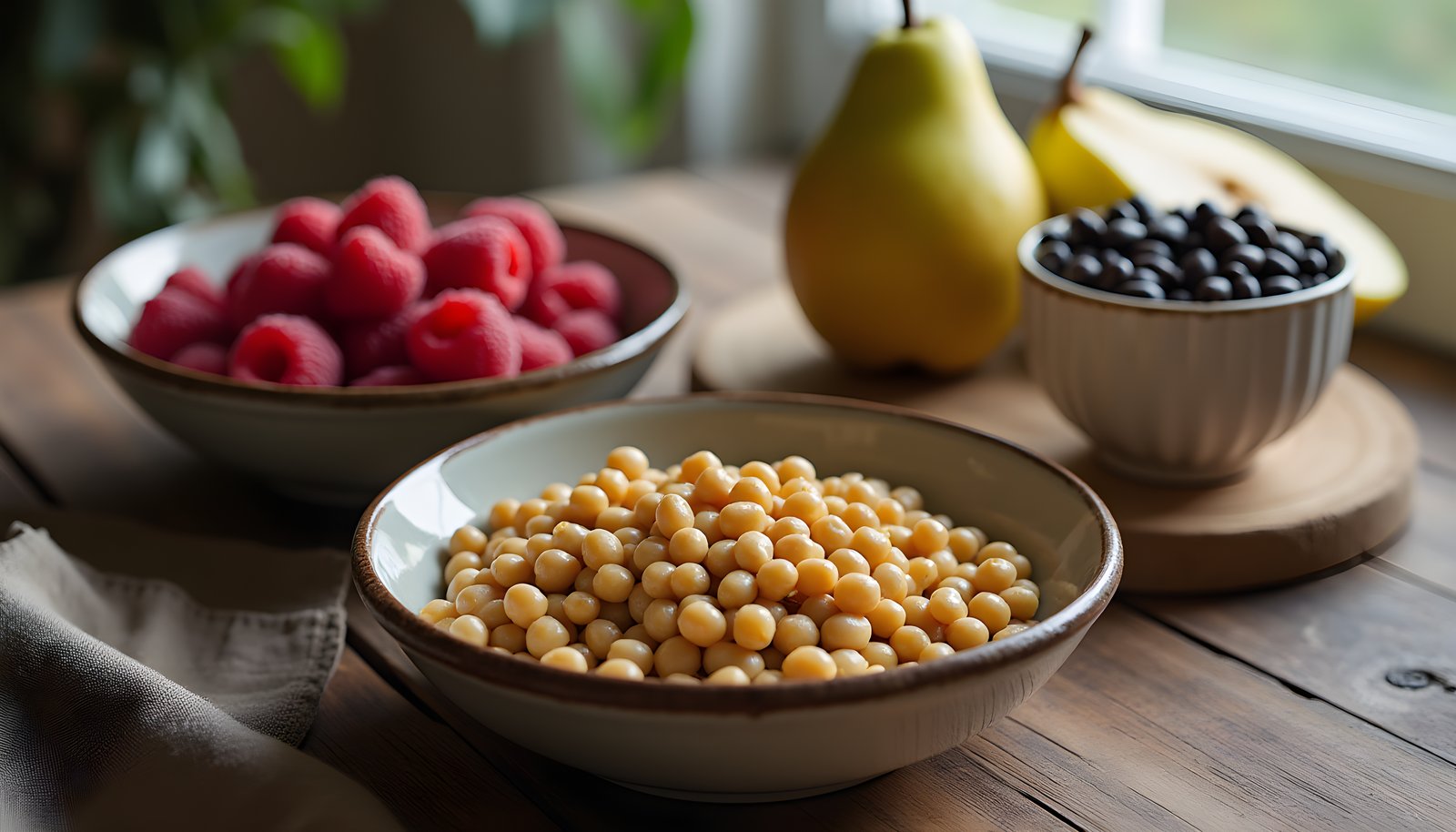
- Legumes: 1 cup of boiled split peas has about 16 g of fiber, lentils 15.5 g and black beans 15 g.
- Seeds: 1 ounce of chia seeds has about 10 g.
- Vegetables: 1 cup of boiled green peas has 9 g, and a cup of boiled broccoli about 5 g.
- Fruit: 1 cup of raspberries has 8 g, and a medium pear with its skin 5.5 g.
- Grains: 1 cup of cooked whole-wheat spaghetti or pearled barley has about 6 g, compared with 3.5 g in a cup of brown rice.
Mayo Clinic suggests adding fiber gradually over a few weeks and drinking plenty of water, since a sudden jump can cause gas, bloating and cramping.
Looking for ways to work more beans, barley and berries into dinners you already like? Our recipe eBooks are full of simple dishes built around them.
When less fiber is the right call
For all its benefits, fiber isn’t right for everyone at every moment. Mayo Clinic notes that doctors sometimes prescribe a low fiber diet when the bowel is narrowed by a tumor or by inflammatory disease such as Crohn’s disease or ulcerative colitis.
The same advice can follow bowel surgery, or treatments such as radiation that irritate the digestive tract. These diets are usually temporary, and fiber is added back once the gut has had time to recover.
That edge case says something about why fiber matters. Its effects on bulk and movement in the gut are strong enough that, in a damaged bowel, doctors sometimes need to dial them down.
Fiber and why it matters: common questions
What is fiber made of?
Fiber is made of plant carbohydrates, mostly chains of three or more sugar units that your digestive enzymes can’t break apart, plus a woody compound called lignin. It comes from plant cell walls and gums, so animal foods contain none naturally.
Why is fiber important for your body?
Fiber adds bulk to stool, feeds your gut bacteria and slows how fast sugar enters your blood. The FDA accepts benefits including lower LDL cholesterol, lower blood sugar after meals and more frequent bowel movements.
Who discovered that fiber was important for health?
Surgeon Denis Burkitt popularized the idea in the late 1960s and 1970s, building on the work of Hugh Trowell, Thomas Cleave and Neil Painter. He linked low fiber Western diets to diseases that were rare in rural Africa.
How is fiber different from other carbohydrates?
Sugars and starches are broken down and absorbed in your small intestine. Fiber isn’t, so it reaches your colon largely intact, where it adds bulk or is fermented by bacteria.
Does fiber help gut health?
Yes. Fiber is the main food for many of the bacteria in your colon, and it adds bulk that keeps stool moving. Adding it gradually helps limit gas and bloating while your gut adjusts.
Which foods are highest in fiber?
Legumes lead the list, with about 15 to 16 g in a cup of boiled split peas, lentils or black beans. Chia seeds, green peas, raspberries and whole grains such as barley and whole-wheat pasta are also strong sources.
Sources
- Cummings JH, Engineer A. “Denis Burkitt and the Origins of the Dietary Fibre Hypothesis.” Nutrition Research Reviews. 2018. doi.org
- Cummings JH, Bingham SA, Heaton KW, Eastwood MA. “Fecal Weight, Colon Cancer Risk, and Dietary Intake of Nonstarch Polysaccharides (Dietary Fiber).” Gastroenterology. 1992. pubmed.ncbi.nlm.nih.gov
- U.S. Food and Drug Administration. “Questions and Answers on Dietary Fiber.” FDA. 2024. fda.gov
- Mayo Clinic Staff. “Dietary Fiber: Essential for a Healthy Diet.” Mayo Clinic. 2024. mayoclinic.org
- Mayo Clinic Staff. “Chart of High-Fiber Foods.” Mayo Clinic. 2025. mayoclinic.org
- Mayo Clinic Staff. “Low-Fiber Diet Do’s and Don’ts.” Mayo Clinic. 2025. mayoclinic.org